18 Jun 2026 - {{hitsCtrl.values.hits}}
Linking high profile politicians’ names to the conspiracy theory heightens the sense of mystery
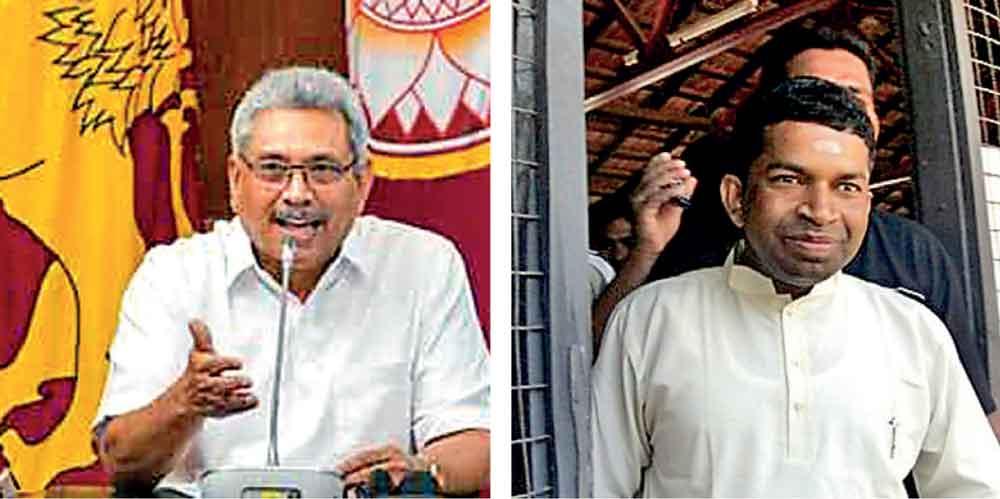
 History is full of bizarre twists where events take surreal turns. Those who appeared to be the saviours of the Easter Sunday terrorist attack victims – victims of one of the most heinous crimes in Sri Lankan history committed seven years ago, now stand accused of the same crime.
The Sri Lanka Podujana Peramuna (SLPP) that accused the then ruling parties, the United National Party (UNP) and the Sri Lanka Freedom Party (SLFP) of weakening the intelligence apparatuses of the country leading to the terrorist attacks that took place on April 21, 2019, are awkwardly struggling now to prove its innocence for the same carnage.
Gotabaya Rajapaksa, who was considered then to be a tough and strong administrator and an expert in security-related matters, promised the country six days after the Easter Sunday mayhem to take charge of the country. He gave an assurance that such disasters would never happen in the future. Alas, he has now been accused of being a party to the crime and has requested an order from the court to prevent his possible arrest.
The strongest defence of the apologists for the SLPP and Rajapaksa — that a fanatical Muslim terrorist group would not kill themselves to enthrone a hardline Sinhalese Buddhist—has been substantially shattered by Britain’s Channel 4. According to Azad Mawlana, the Secretary to the former Chief Minister of Eastern Province Sivanesathurai Chandrakanthan alias Pillayan, who was interviewed by the TV channel in September 2023, the Easter Sunday attacks resulted from a combination of two different objectives.
He quoted Pillayan as saying that the leaders of the National Thowheed Jama’ath (NTJ) that carried out the suicide bombings on one of the holiest days of Christians wanted to attain paradise by eliminating the enemies of their faith; while the supporters of Gotabaya Rajapaksa were seeking ways to create an unsettled situation in the country, which would demand a person like Rajapaksa at the seat of power to handle it.
Pillayan had liaised with him and Shaini Mawlavi—the brother of NTJ leader Zahran Hashim—to achieve the two objectives, Mawlana said. In fact, the former already had connections with Shaini as both had been incarcerated at the Batticaloa prison in connection with two different cases in 2017.
Pillayan had stated, “we can use them (NTJ) for our purpose.” Mawlana also quoted the then head of the State Intelligence Service (SIS) Suresh Sallay as saying that an unsettled situation was needed to ensure Rajapaksa’s victory at the Presidential election that was to be held in late 2019.
Though logical, this narrative did not carry any hard evidence to prove it. The Channel 4 also later said that it did not go deeper into the details of the narrative. In fact, this conspiracy theory did not originate with Mawlana. It was first floated by some MPs of the Samagi Jana Balawegaya (SJB), especially Manusha Nanayakkara and Harin Fernando, and those of the National People’s Power (NPP) in 2021.
Nevertheless, the investigations into the 2019 terrorist attacks seems to be conducted now based on these lines. Pillayan was arrested on April 9, last year over the disappearance of former Vice Chancellor of the Eastern Province, Professor S Raveendranath. But Public Security Minister Ananda Wijepala has told Parliament more than once that the evidence indicates involvement of the former Eastern Province Chief Minister in the Easter Sunday attacks.
Then in February 25, this year, Suresh Sallay was arrested under the draconian Prevention of Terrorism Act (PTA) over the 2019 terrorist attacks, and a foreign travel ban was imposed on June 3 on Gotabaya Rajapaksa and two military officers by Colombo Fort Magistrate Pasan Amarasena in connection with the ongoing investigations into the Easter Sunday attacks. Rajapaksa in turn has filed a writ petition in the Court of Appeal seeking an order preventing his arrest or detention in connection with the same investigations.
In the absence of clarity about the evidence that law enforcement authorities possess against Pillayan, Sallay and Rajapaksa, people are more justified to interpret the merit or demerit of the case in line with the stances of political parties they are aligned with. However, some parties seem to be struggling to decide where to stand.
The SLPP, as it should be, denies everything the government, the Criminal Investigation Department (CID) and the state counsel say. They view the whole episode as political vendetta by the NPP government.
It was the leaders of the SLPP who had first promised the country and the Catholic community prior to the 2019 Presidential election to reveal the real masterminds of the tragedy while riding on a huge Islamophobic wave created by the party itself. However, they did nothing afresh once Gotabaya assumed office as the President, but declared that Naufar Mawlavi, who was already in prison, was the mastermind.
And it was during Gotabaya’s tenure that Mohamed Ibrahim, the father of two of the suicide bombers of Easter Sunday attacks, was granted bail. These incidents might have mortified the rank and file of the SLPP while frustrating the Catholic community. It was against that backdrop that the allegation against the SLPP of plotting to carry out the terrorist attacks gradually took shape.
Manusha Nanayakkara and Harin Fernando explained the alleged plot graphically with names of various individuals who they said played a critical role in it, and accused of Suresh Sallay of masterminding it. They did so not in their personal capacity but as members of the SJB. Leader of the United Republican Party (URP), Champika Ranawaka also stated with utmost confidence that it was the Rajapaksas who were behind the crime.
Leader of the SJB and the Opposition Sajith Premadasa requested the previous Ranil-Rajapaksa government to hand over the investigations into the Easter Sunday attacks to Shani Abeysekara, who handled the matter before Gotabaya Rajapaksa came to power. Yet, ironically, when Udaya Gammanpila published a book refuting SJB’s conspiracy theory, Premadasa was a prominent attendee of its launching ceremony. Harin and Manusha have crossed over to the UNP and no longer seem to want to be involved in the controversy. SJB MP Dayasiri Jayasekara has sided with the SLPP in this matter. Other party members have muted their voices on the subject.
Only SJB MP Mujibur Rahman seems to be still holding the party’s earlier stance. SJB’s problem seems to be that they either really did not want the law to take its course against SLPP leaders, despite them previously accusing the latter; or they do not want to see the credit going to the NPP if the current investigations against the SLPP leaders are successfully concluded.
All in all, although the Easter Sunday terror attacks were a human tragedy that should be viewed objectively, everybody prefers to view them through a political party prism.
19 Jun 2026 14 minute ago
19 Jun 2026 25 minute ago
19 Jun 2026 30 minute ago
19 Jun 2026 33 minute ago
19 Jun 2026 36 minute ago