02 Dec 2025 - {{hitsCtrl.values.hits}}
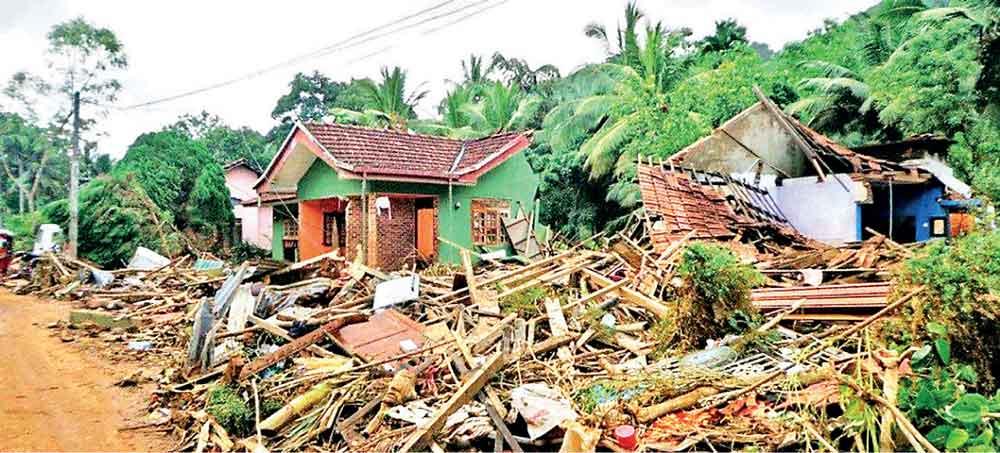
Damaged homes expose decades of reactive crisis management, as successive governments have scrambled for solutions only when disaster strikes rather than constructing robust systems of preparedness
 Concerning disaster management, successive Sri Lankan governments have behaved like monkeys attempting to build houses during a rainstorm, a damning but apt comparison for decades of reactive, haphazard crisis response.
Rather than constructing robust systems of preparedness in times of calm, successive administrations have consistently scrambled for solutions only when disaster strikes, leaving citizens to bear the consequences of governmental shortsightedness. Early Thursday morning, as Cyclone Ditwah made landfall and brought renewed devastation to the eastern and central regions of the island nation, this pattern of incompetence repeated itself once again.
The opposition deserves credit for its approach, unlike in the past when opposition leaders only pointed fingers at whoever was in power.
With wind speeds reaching 65 kilometers per hour, Cyclone Ditwah unleashed torrential rainfall exceeding 300 millimeters between Thursday and Friday, triggering deadly flooding and landslides that have claimed numerous lives. While technically classified as a tropical storm rather than a full cyclone, it demonstrates the destructive power that tropical weather systems can unleash on vulnerable communities.
These storms develop over warm ocean waters near the equator through a continuous cycle of rising warm air creating zones of low pressure. When wind speeds reach 62 kilometers per hour, systems are classified as tropical storms. At 120 kilometers per hour or greater, they become tropical cyclones. The heavy rainfall accompanying Cyclone Ditwah has triggered flooding and landslides.
A Nation Defined by Natural Disasters
Sri Lanka’s geographical position makes it uniquely vulnerable to floods, landslides, cyclones, droughts, windstorms, and coastal erosion. Human-made disasters including deforestation, indiscriminate coral and sand mining, and industrial accidents compound these natural hazards.
Flooding represents the most common disaster. Among the country’s 103 river basins, ten major rivers—particularly the Kelani, Gin, Kalu, Nilwala, and Mahaweli, are prone to overflow. Population growth has pushed communities into vulnerable floodplains, dramatically increasing risk. The Southwest and Northeast monsoons bring seasonal flooding to different regions, with districts including Kegalle, Ratnapura, Kalutara, Colombo, Gampaha, and Galle facing inundation during Southwest rains, while Ampara, Trincomalee, Badulla, Polonnaruwa, Batticaloa, Matale, and Monaragala suffer during Northeast season.
Landslides pose severe threats in mountainous regions. The January 1986 landslides claimed 51 lives and displaced nearly 90 families, but the May and June 1989 events proved even more catastrophic, killing over 200 people with estimated losses reaching 142 million rupees.
Cyclone activity from the Bay of Bengal particularly affects Eastern, Northern, and North Central regions. The 1978 cyclone devastated the nation, affecting over one million people, killing and destroying 90 percent of Batticaloa district’s coconut plantations. Relief efforts alone cost over 600 million rupees.
Droughts strike regionally every three to four years and nationally approximately every decade. The 2001 drought disrupted power supplies and affected more than 370,000 families across eight districts. Meanwhile, coastal erosion threatens over half of Sri Lanka’s 1,585-kilometer coastline, with rates reaching 3.4 to 4.5 meters per year in some areas.
The Tsunami Wake-Up Call
The December 26, 2004 tsunami exposed fundamental gaps in disaster preparedness. The catastrophic event caught the nation completely unprepared, prompting Parliament to establish a Select Committee on February 10, 2005. The 21-member cross-party committee, chaired by Hon. Mahinda Samarasinghe, investigated emergency preparedness failures and developed comprehensive recommendations.
The committee’s five-year disaster risk management programme proposed six critical elements. First, establishing an institutional framework spanning national to local levels—deemed the foundation from which all other elements would stem. Second, developing systematic data collection and multi-hazard risk assessment systems, building on initiatives begun by the National Disaster Management Centre with UNDP support. Third, integrating disaster risk management into development policies across the environment, water resources, power, energy, education, and health sectors.
Fourth, establishing effective early warning systems and disaster preparedness plans. The committee emphasised that Sri Lanka’s vulnerability to hydro-meteorological hazards occurring far more frequently than tsunamis required a multi-hazard approach. Crucially, improved forecasts must be matched with effective communication systems, public awareness, and community-level infrastructure enabling life-saving actions.
Fifth, implementing natural disaster mitigation strategies at each government level and integrating risk management into development planning, with particular emphasis on protecting public infrastructure. The May 2003 floods’ experience in five southern districts was identified as a replication model. Finally, launching a national public education and awareness programme through the proposed National Disaster Management Authority collaborating with NGOs and community organizations.
International Support and Partnerships
The committee emphasised mobilising national, regional, and international resources. Following the May 2003 floods, the Asian Development Bank initiated the Coast Conservation Project while UNICEF led rehabilitation efforts. The Swedish International Development Cooperation Agency committed approximately 1.3 million dollars for recovery activities, while UN agencies pledged 1.6 million dollars for drought mitigation in 2004.
Organisations including UNDP, USAID, the Intermediate Technology Development Group, and various NGOs contributed expertise and resources. UNDP committed to supporting institutional capacity building, mainstreaming disaster risk management into development planning, establishing risk information systems, and strengthening local-level management. These initiatives would complement existing government institutions including the National Building Research Organization’s Landslide Studies Division, the Centre for Housing, Planning and Building, and the National Aquatic Resources Research and Development Agency.
Despite comprehensive proposals nearly two decades ago, Cyclone Ditwah’s impact raises urgent questions about implementation. The committee’s concluding remarks warned that immediate action was essential, noting disasters could strike again—sometimes in already affected areas. Following the tsunami, Ampara was quickly hit by flooding, illustrating recurring threats.
The committee stressed that at minimum, emergency response plans should be prepared immediately with effective warning systems. More fundamentally, they questioned whether basic paradigms could be changed to ensure created systems would actually function when calamities occur. This question remains unanswered as successive governments continue their pattern of reactive crisis management—monkeys building houses in the rain.
Economic Implications
Cyclone Ditwah’s timing presents particular challenges for Sri Lanka’s fragile economic recovery. Last year, President Anura Kumara Dissanayake was elected on promises to end painful austerity measures imposed under an International Monetary Fund bailout package. While maintaining the IMF agreement, the administration seeks alternative paths to economic improvement.
The economy has shown tentative recovery signs this year, particularly in tourism. However, this progress remains precarious and heavily dependent on debt management. Disasters like Cyclone Ditwah threaten to derail fragile momentum, diverting resources from development to emergency response and reconstruction.
Conclusion
As Sri Lanka grapples with Cyclone Ditwah’s aftermath, the disaster underscores that vulnerability to natural hazards remains an existential challenge requiring sustained national commitment. Building genuine resilience demands improved early warning systems and emergency response capabilities while addressing underlying factors amplifying disaster impacts—deforestation, improper land use, inadequate infrastructure, and climate change adaptation.
For a nation navigating complex economic challenges while building a stable future, recurring disasters demand that the comprehensive framework proposed two decades ago finally be fully implemented. The question remains whether this latest disaster will catalyse the systemic change that previous calamities, despite their devastating toll, failed to achieve. Or will Sri Lanka’s governments continue their pattern—monkeys frantically building houses while the rain pours down, leaving citizens exposed to storms that could have been weathered with proper preparation.
The writer can be reached at [email protected]
14 Jun 2026 6 hours ago
14 Jun 2026 8 hours ago
14 Jun 2026 9 hours ago
14 Jun 2026 14 Jun 2026
14 Jun 2026 14 Jun 2026