06 May 2025 - {{hitsCtrl.values.hits}}
 The price tag for a brand new 1200 cc car caught my eye–Rs. 9.9 million. Cool, outrageous and whopping? You can choose your adjective.
As if offering an apology for the price, the seller says you can drive it away for a monthly payment of Rs. 76,000/=.
That sounds a lot better, but add to that income tax, servicing and fuel, and the owner will be spending Rs. 100,000 a month or more for his or her new car. There are very few people in that income bracket, and they already have good cars.
Owning a brand new car was beyond the reach of most Sri Lankans even before the two Cs–Covid and the Crash. Now it’s an impossible dream.
 Forget new cars. There was a thriving reconditioned vehicle market which satisfied most Lankan car buyers since the 1980s. Now, even that is gone. Looking at Colombo city streets, one can see cars which are ten to twenty years old, or more, running in various states of disrepair–creaking axle boots, no air conditioning, with rust, bumps and dents, overheating engines, no signals or even headlights at night.
A car bought just before Covid is now five years old, and it’s time for an overhaul or a new car. But most owners are struggling just to keep their ageing vehicles running, and there is only the very risky second-hand car market to fall back on.
Alternatives such as offering luxury bus services within city limits and cycle commuting have failed for many number of reasons. The main reason may be that car owners trust their own four wheels more than any alternative. Think tanks should think again about offering a normal bus service now, rather than a luxury service for car users in Colombo, but there is no such sign.
The future looks scary for car owners, as that dramatic upturn in the economy, needed to relax taxation and restrictions on car imports, looks unlikely in the foreseeable future. If no such positive changes occur within the next five years, we could end up like Cuba or like Jaffna during the war years.
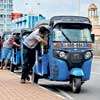
The demarcation line between the middle class and working class, or white collar and blue collar, was defined by the noisy three-wheeler. But car owners may have no alternative but to replace their cars with three-wheelers in the future.
Why worry so much about cars? It’s because cars cannot be dismissed as a capitalist marketing tool or a middle and upper-class privilege. It’s a universal need, and even the former USSR finally realised an unpalatable truth when Soviet leaders decided in the 1960s that the masses needed cars and the Soviet car industry with its five year plans was unable to meet the demand–hence, the decision to build Fiat cars in Russia as Lada or Zhiguli.
India took the plunge in the 1980s when Indian car makers were given the green light to switch from picturesque but antiquated European car models to modern Japanese technology, making Indian cars competitive in foreign markets.
Sri Lanka had a nascent car assembly industry in the 1980s, but it died when the entrepreneur behind it disappeared in a plane crash.
It isn’t necessary for developing countries, even the more prosperous ones, to build cars. Mexico and Brazil are the exceptions. Malaysia is one exception in Asia. Other countries are content to import cars for their populations at affordable prices.
This isn’t just a matter of prestige. More cars in their cities pose big headaches for governments via traffic jams, congestion, parking space and pollution. But cars don’t represent simply snob value. They represent efficiency and public morale.
Even in those countries with efficient public transport, car ownership is high because people feel better, are happier, and constitute a more efficient workforce when they own cars. That goes beyond capitalist theory or communist dogma. Cars fill a profound psychological need in people’s minds for more security, visibility and economic clout. Traffic jams, funnily enough, are a visible sign of a country’s economic power. Even if the economy is troubled, traffic jams continue for miles.
This is true even of the worst-hit economies such as Sri Lanka. The only trouble is that most Lankans can no longer afford cars–new, reconditioned, or used.
In developed countries, car ownership ceased to be a measure of wealth long ago (unless you think of Ferraris). The facts and figures of car ownership from the developed world are a prime indicator of the glaring inequalities that exist in our world.
The country with the highest car ownership per capita is tiny San Marino, with 1,263 cars per 1,000 people (only 61 sq. km with a population of 33,574). Other countries with high car ownership per capita include Monaco (899), the United States (795), New Zealand (774), Liechtenstein (750), Iceland (745), Australia (740), Luxembourg (739), Malta (693), and Italy (679).
Sri Lankan car ownership per capita per 1000 people is given at 157. while Russia’s is 364 and China’s figure is 322 and Oman’s 323. But these statistics were compiled in 2023, and now the figure for Sri Lanka could be less, as some old cars are cast aside for lack of spares.
The rate of car ownership can’t be taken as a prime indicator of development. Nauru Island, for example, whose sole industry is phosphate mining, has 423 cars per thousand people. Car ownership is an indicator of a given country’s wealth, but also of social inequalities. Many countries have car ownership rates of 300 or more per 1000 people. But this is again not necessarily the most reliable indicator of wealth. Iran, an oil-producing country, has only 183 cars per thousand.
Surprisingly, Iran makes cars. Iran’s automotive industry is the third most active industry of the country, after its oil and gas industry, accounting for 10% of Iran’s GDP and 4% of the workforce (700,000 people). Interestingly, Iran’s per capita income is $5,300 compared to Sri Lanka’s $4,516 in 2024. This marks the first time Sri Lanka’s per capita income has surpassed USD 4,000. In other words, there isn’t much of a difference in our per capita income and Iran’s, though the latter unquestionably is more industrialised, making automobiles, petrochemicals, steel, textiles and armaments (including missiles).
Statistics are one thing, the reality experienced in homes and streets another. Despite per capita figures, most Lankans have trouble making ends meet, and cars remain a distant dream. Hanging on to what one already has is now a big challenge.
05 Jun 2026 29 minute ago
05 Jun 2026 47 minute ago
05 Jun 2026 57 minute ago
05 Jun 2026 1 hours ago