17 Dec 2025 - {{hitsCtrl.values.hits}}
An industrious government should now turn the disaster into an opportunity to reorganise the economy
 The World Bank was earlier commissioned to conduct a Global Rapid-Post Disaster Damage Estimation (GRADE). Its report, which was initially due in two weeks, should be available this week. One might agree that the move itself was a smarter one, and that whatever numbers emerge would have greater credibility than ad hoc government figures, given the habit of government agencies to resort to back-of-the-envelope numbers
Also, rather than mere rebuilding after the disaster, the government should plan for planned and organised development of townships and damaged infrastructures with walking paths, public spaces, and designated spaces for hawking. Such measures are often opposed by groups with vested interests
 As Sri Lanka heads into the post-disaster reconstruction phase following Cyclone Ditwah, the government seems clueless about how to proceed. Its pre-disaster response had been lacklustre; its response in the immediate aftermath commendable, but where it matters most for the long-term recovery, it lags.
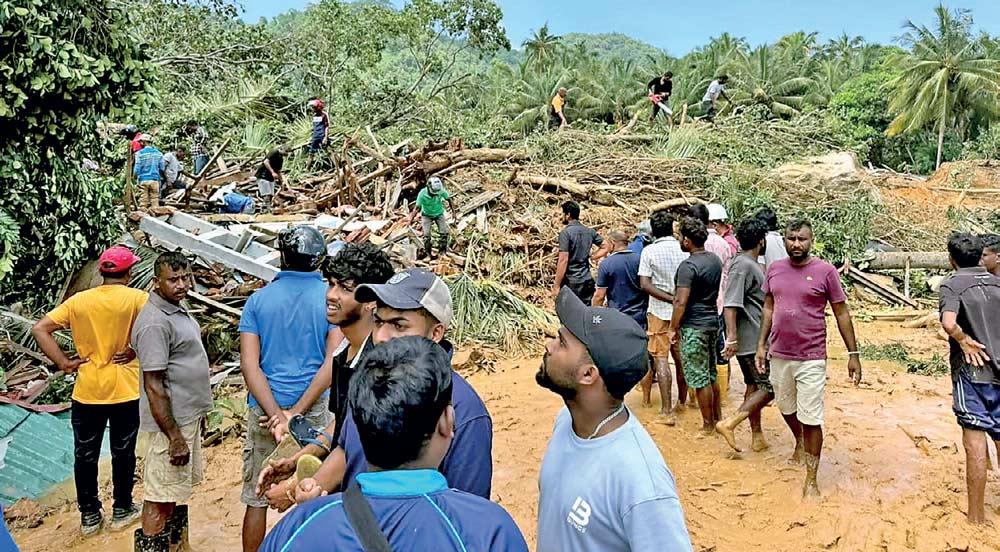
The devastation has been extensive, though an exact estimate of the damage and cost of reconstruction is not yet established. Other than the immense human loss— 640 dead, over 200 missing— the landslides and flooding destroyed roads, rail tracks, bridges, telecommunication and electricity networks, and farmlands.
Government estimates put the figure at around US$6-7 billion. The government has announced a Rs 72.2 billion relief package should partially compensate for the loss of private property. However, beyond that, how the country rebuilds itself after the disaster remains uncertain.
Sri Lanka’s best chance for rebuilding itself is through coordinated national and international effort. Many – including my last week’s column - called upon the government to organise an international donor conference similarly modelled on local and international cooperation during the 2003 Tokyo conference and the post-tsunami aid conference in Kandy.
The government itself is reportedly considering a donor conference once the ongoing need assessments conducted by the World Bank and government agencies are concluded.
The World Bank was earlier commissioned to conduct a Global Rapid-Post Disaster Damage Estimation (GRADE). Its report, which was initially due in two weeks, should be available this week. One might agree that the move itself was a smarter one, and that whatever numbers emerge would have greater credibility than ad hoc government figures, given the habit of government agencies to resort to back-of-the-envelope numbers. As the aftermath of the Express Pearl disaster and the shipping line’s snub of the court ruling revealed, the world does not buy them.
Foreign Affairs Minister Vijitha Herath was quoted as saying the government plans to hold a donor conference. The Daily Mirror reported: “ When asked whether the government intended to call for an international donor conference, Minister Herath replied, ‘Yes, we have that plan’.”
That does sound like an afterthought, much less a well-thought-out government strategy for post-disaster rebuilding.
Delay would be costly
While one might agree that the government should wait till the World Bank’s GRADE and other state assessments are completed. However, when the data is available, the government should be in a position to organise a donor conference within the least possible delay. That would mean the government should approach the prospective donor partners beforehand, and canvas support from its allies, ideally invite one or several key international players as co-chairs of the conference, and work on logistics. The delay would be costly, as in a turbulent world, most countries would soon move on. The delay would also smack of state inefficiency, which would not inspire confidence inwould-be donors.
Therefore, the government should proceed with a sense of urgency towards a Post-Ditwah donor conference.
Also, rather than mere rebuilding after the disaster, the government should plan for planned and organised development of townships and damaged infrastructures with walking paths, public spaces, and designated spaces for hawking. Such measures are often opposed by groups with vested interests. The disaster provides an opportunity to override those petty machinations and to move towards an organised urban planning initiative, not just on paper, but in practice.
Also, in the aftermath of the damage, the government could explore the private-public partnerships in the Railway. The General Manager of Railway previously stated that rebuilding the damaged rail tracks and network would cost Rs 190 billion (US$600 million). Certain different numbers are floated now— US$400 million. State-owned enterprises such as the Railway operated sub-optimally even in the best of times. The annual loss of Sri Lanka Railway is around Rs. 15 billion – this is large enough to give from Rs 100,000 to 150,000 to students (almost half of the annual cohort that takes Advanced Level) to pursue some form of tertiary education. While the public transport, at its subsidised rates, requires certain government assistance, Sri Lanka Railway is more than burning cash; it is a byword for inefficiency and poor quality of service despite the picturesque sightseeing, thanks to the colonial British marvel.
This should be the time to restructure the Railway through a private-public partnership with an established international partner – not the local wheeler-dealers. It is a shame that Sri Lankan public transport, both buses and railways, had been frozen in the 1980s when the world had moved to electric buses and high-speed railways. The root of the malfunction is the state monopoly, or when it isn’t, the mom and pop operators in the sector.
An industrious government should now turn the disaster into an opportunity to reorganise the economy.
19 Jun 2026 3 hours ago
19 Jun 2026 5 hours ago
18 Jun 2026 9 hours ago
18 Jun 2026 9 hours ago
18 Jun 2026 18 Jun 2026