16 Oct 2025 - {{hitsCtrl.values.hits}}
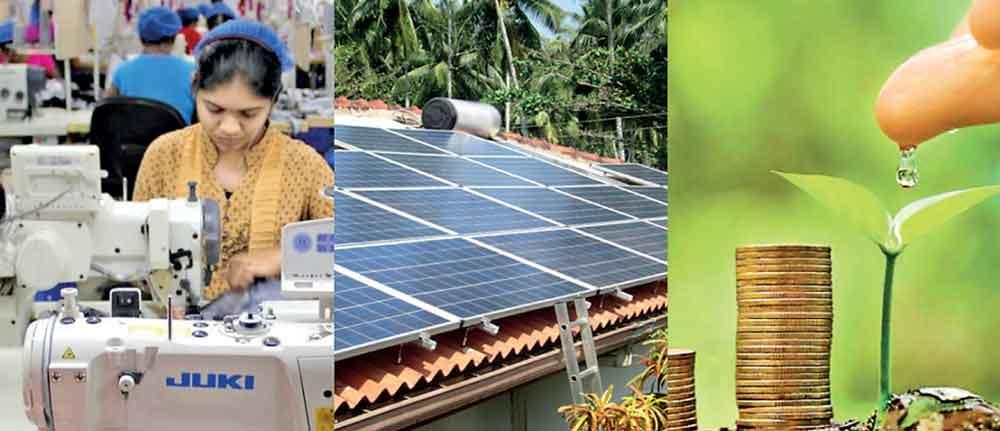
Sri Lanka’s path to competitiveness lies in aligning industry, innovation, and sustainability, encompassing ethical manufacturing, renewable energy, and responsible investment. FILE PHOTO
 Sustainability is increasingly becoming non-negotiable in international trade and supply chains. Companies and countries are integrating sustainable practices into their policies and mandates. For smaller developing countries like Sri Lanka, the shift poses both a challenge and an opportunity. The primary challenge is higher compliance costs, which can restrict market access, especially for small and medium-sized enterprises (SMEs).
Yet this very challenge can be transformed into an opportunity. By meeting—and, where possible, exceeding—sustainability requirements, Sri Lanka can position itself as a trusted and competitive partner. In a region dominated by larger neighbours with scale and cost advantages Sri Lanka cannot match, strong sustainability credentials could become a distinctive edge, helping the country stand out in global markets.
Greening trade and supply chains
Four key forces drive this trend:
Consumer demand - A growing societal awareness of climate change and environmental issues has led to increased demand for sustainably produced goods. A 2024 PwC global survey of 20,000 consumers across 31 countries found that 80% of respondents are willing to pay a premium for sustainably produced goods.
Climate litigation - Grantham Research Institute on Climate Change and the Environment, in its “Global trends in climate change litigation: 2025 snapshot”, noted a striking surge in climate litigation. The number of cases filed annually has more than doubled from 2014 to 2019, from just under 100 to over 200. In 2021, the cases filed surpassed 300. Climate activists increasingly target companies: around one-fifth of the climate cases filed in 2024 targeted companies, their directors, or officers.
Mandatory sustainability reporting – The European Union, the world’s second-largest importer, leads the way with an array of recent directives. These include the Corporate Sustainability Reporting Directive (CSRD), the Corporate Sustainability Due Diligence Directive (CSDDD), and the European Union Deforestation Regulation (EUDR). Other countries are also following suit, and companies worldwide are increasingly under pressure from governments to disclose the environmental impact of their activities.
Reputational risks for firms - Many corporations have made public commitments to green their supply chains. A 2023 survey on the status of sustainable supply chains found that investors and large corporate buyers are increasingly demanding greater compliance from their partners and suppliers. Companies now face greater reputational risk as consumers hold them accountable for non-compliance. A global survey by NielsenIQ in 2023 found that 77% of consumers would stop purchasing from brands associated with greenwashing. The reputational damage resulting from non-compliance often translates into severe economic losses.
From challenge to opportunity
Sri Lanka, a small island economy, struggles to compete on scale and cost with larger neighbours such as India, Bangladesh, Vietnam, and Thailand. In terms of land availability, labour supply, and the attraction of sizeable domestic markets, Sri Lanka remains at a disadvantage compared with many of its South and Southeast Asian peers.
To enhance its competitiveness as an investment and sourcing destination, Sri Lanka must strengthen factors beyond volume and price. Connectivity stemming from its location in the Indian Ocean is a key competitive advantage. Positioning itself as a sustainable and ethical hub for manufacturing, services, and trade presents another opportunity to differentiate itself from the rest.
Other smaller countries have already adopted similar approaches. For instance, “Essential Costa Rica” is a national branding initiative that promotes tourism, investment, and exports by highlighting the country’s sustainable practices. In 2019, Costa Rica received the UN’s “Champions of the Earth” award for its efforts in environmental protection and climate action. These measures have strengthened the country’s attractiveness to investors.
Building upon an existing track record
Sri Lanka already has a track record to build on. Preferential schemes such as the EU GSP+ are currently viewed primarily as market access tools. There is an untapped opportunity to leverage enhanced compliance with the 27 international conventions on human rights, labour, the environment, and good governance as a means of strengthening the country’s brand.
Larger Sri Lankan corporates have already moved down this path, realising the competitive advantage of positioning themselves as greener, ethical and sustainable suppliers. Take the apparel sector, for example. In 2006, amid increased competition from low-cost rivals, the apparel industry launched the “Garments without Guilt” initiative. The initiative introduced strict labour and environmental standards for garment factories. By 2015, around 80% of garment factories were certified as compliant, attracting high-end fashion brands. At the firm level, large apparel companies have taken the lead in establishing net-zero carbon manufacturing plants, investing in solar parks and women’s empowerment, and earning international recognition for their sustainability efforts.
The country can build on these sectoral and firm-level initiatives and, on preferential schemes, such as the EU GSP+, to make its mark as a destination for sustainable and ethical businesses. This, however, requires the country to invest in creating an enabling environment for sustainability to take root.
If Sri Lanka is to convert sustainability into a source of competitiveness, it cannot afford to be complacent. Larger regional competitors, already advantaged by scale and lower production costs, are introducing measures to integrate sustainability into their industries. Thailand and Vietnam, for instance, have either enacted or are in the process of enacting laws that mandate corporate compliance with sustainability requirements.
Another example of sustainability in practice is the transformation of traditional industrial parks into eco-industrial parks (EIPs). According to the World Bank, the number of EIPs worldwide grew from fewer than 50 in 2000 to around 250 by 2018. The trend has only accelerated since then. These parks allow businesses to collaborate by sharing resources and by-products, boosting efficiency and competitiveness while reducing environmental impacts and climate risks across supply chains. Yet, to date, Sri Lanka has no functioning EIPs.
The country now stands at a crossroads. Sustainability standards are reshaping global trade. For Sri Lanka, aligning with these standards may appear daunting, but it also offers a unique opportunity to differentiate the country from many larger regional competitors.
Subhashini Abeysinghe is Research Director of Verité Research’s International Economics Programme. Research Assistance was provided by Bulani Weerawardane, Research Analyst at Verité Research.
04 Jun 2026 6 hours ago
04 Jun 2026 7 hours ago
04 Jun 2026 7 hours ago
04 Jun 2026 8 hours ago
04 Jun 2026 8 hours ago