27 Jul 2017 - {{hitsCtrl.values.hits}}
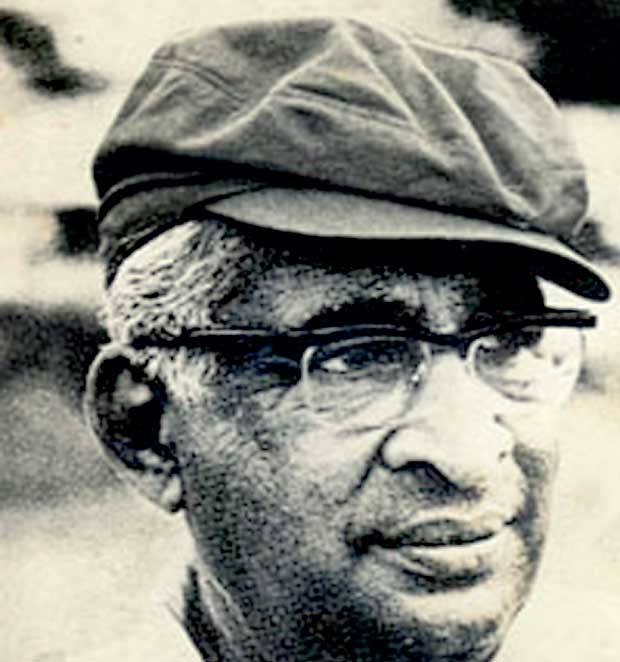
 Dudley Senanayake vehemently opposed a proposal by JR to a grand coalition with SLFP in government. Ceylon National Congress was dominated by politicians of Victorian vintage who followed the principles of liberal democracy of the era of Gladstone and Disraeli. Father D.S. Senanayake was a leading member of the CNC when young Dudley joined the organization with JR. He was highly impressed by the Indian freedom struggle [Swaraj movement] and the role played by Pandit Nehru in it, for whom he developed a great affection. Dudley built up a significant relationship with elder statesmen like Sir Ponnambalam Arunachalam, E. W. Perera, Sir James Peiris and D. B. Jayatilake apart from his uncle F.R.Senanayake.
In 1940, Dudley became the joint secretary of the congress along with JR. Being receptive to new ideas, he joined with a band of young radicals who wanted to transform the CNC into a mass political organization similar to Indian National Congress. Two of them drafted a new Constitution for CNC. At this time a group of young Marxists who returned from English universities were organizing the urban working class. Dudley, though he cherished the friendship with them, the liberal democrat was not prepared to accept an ideology based on revolutionary principles. The 24 year-old entered politics at the general elections held in 1936 contesting the Dedigama seat in the State Council. Making his first victory address in 1936, he said, “I saw that those who sought election were all new-comers to politics. As I had decided to devote my whole life to politics, I saw here an opportunity to start early. I saw no reason why my youth should be a hindrance to an early beginning.” He was appointed Minister of Agriculture and Land at the age of 36. He regained his seat at the elections held in 1947 under the Soulbury Constitution and continued in the same Ministry.
A mass workers’ rally organized by the Marxists who controlled 80 to 90% of trade unions in July 1953 to protest against moves by govt to cut the rice subsidy, a legacy of World War II, which the people cherished as their birth right. The leftist called for a Hartal (stop work, close shops etc.,) on August 12. Crowds went on a rampage creating trouble compelling police to baton charge and tear gas. The ‘Hartal’ turned out to be a fierce mass uprising. Violent demonstrations in four provinces compelled a reluctant PM Dudley Senanayake to sign ‘shoot at sight with impunity’, an agonizing decision for the sensitive man. A couple of months later Dudley resigned from Premiership and party leadership.
In 1956 elections, the party suffered a humiliating loss. Sir John Kotalawela who spearheaded the contest as PM was not inclined to attend Parliament, and as a political party, the UNP became rudderless and began to drift in a troubled sea of uncertainty. Dudley was under pressure from all quarters to return and take over the reins of the party, which request he obliged with great reluctance.
What is important here is not how many times he became Prime Minister, but the number of times he was elected by the people. In that sense Dudley was incomparable; he never implored for leadership, in fact once he abdicated the ‘throne’ and party leadership but was reluctantly dragged in and installed in positions by the membership and masses. He did not attempt to consolidate his position in the party through manipulations, but was chosen unanimously, and once over the more senior members to be the PM. It happened in 1952 after the untimely death of Senior Senanayake. Dudley, the youngest PM in the Commonwealth was at 41 when his father passed away on March 22, 1952. But he was not contented; Dudley the staunch liberal democrat dissolved Parliament and left the destiny of the nation and his party with the people, who overwhelmingly voted him back to power.
He became the PM for the fourth time in a UNP-led coalition in 1965, following an electoral success. An extract from his victory speech on that occasion…
“I am glad that circumstances have enabled me to form a National Government, which might have been denied me if I had obtained more seats. I am glad that I have been given the opportunity, I believe for the first time in this country, of making a sincere and genuine effort to solve the divisions among us racially. Let us cast all isms aside. I say that I and my Government whatever the ism will seek the greatest good of the greatest number.”
Born on June 19, 1911, Dudley Senanayake became the second Prime Minister of Ceylon and went on to achieve the status on three subsequent occasions during 1950s and 1960s. Famed for his wit in Parliament, he was an orator with authoritative voice. He excelled as a brilliant debater among the brightest of politicians, that included, SWRD, Philip Gunawardene, JR, Keuneman, Dr. N.M. Perera, Dr. Colvin R. de Silva and Dr. S.A. Wickremesinghe - all orators of the supreme calibre and gentlemen politicians of good old days.
Head prefect at S. Thomas’ College, Mount Lavinia, Dudley was a sportsman like the father and only brother Robert, all former Cricket captains of STC. He played hockey, was a keen boxer and excelled as an athlete too.
An unpublished, ‘eye-witness account’ of the last few days of the gentleman politician’s life, as related to me by the nurse, assigned by the Durdans Hospital to attend on the ailing ex-PM in April 1973.
“He never called me nurse or sister, but, ‘P.….’ “(her first name), said the young lady, who was engaged to my erstwhile friend and colleague at the Multinational, located close to Durdans. She was the regular nurse who attended on each of the few occasions, (after the UNP was relegated to the opposition with only eight seats in 1970 elections) when Dudley was rushed there in the 1971-73 period. He had differences with R. Premadasa, who decided to go his own way by forming an organization named ‘Citizens Front’ against his leader and mentor, exchanging open letters in print media critical of each other. This happened in the backdrop of Dudley and JR, the leader and deputy ironing out their distrusts. To be fair by Premadasa, he backed Dudley ‘to the hilt’ in this clash of giants. From the hospital bed, ‘like a prayer’ every morning, he read the newspapers and dictated his replies. The nurse prevented the paper reaching him as it contained a offensive statement by Premadasa. Sensing what had transpired, he became a little restless and emotional. Dudley pleaded with the nurse, attempting to convince her referring to his relationship with Premadasa; how he groomed him to be a junior leader of the party. He assured, “Premadasa is my pet; I will not take him seriously”
What is important here is not how many times he became Prime Minister, but the number of times he was elected by the people. In that sense Dudley was incomparable; he never implored for leadership
In late May, 1915, during the height of communal violence, Colonial regime arrested ‘anti-arrack’ movement leaders under the pretext of controlling communal riots; one morning the four-year old Dudley was having a skirmish with his ayah over something when the soldiers arrived at Woodlands and arrested the 30 year-old DS. A Punjabi soldier pushed away the ayah who protested and intervened. The son, too small to realise the seriousness of the drama, but was pleased that his bête noire, ayah was ‘punished’- as recalled later in life by this affable man. Edward Gunawardene, retired senior DIG, an officer and gentleman of Police in his book memoires says, that he was serving as ASP in Kegalle during 1965 elections,“…It was indeed a tense and closely contested election.
The comment that Robert made was after having observed how the count was going. At that moment I was the nearest person to the two brothers. The immediate response of Dudley to Robert’s apprehensions was certainly not a studied statement for political gain. It was a soft, low voiced conversation between two brothers and I happened to be a listener. The words that came out of Dudley spontaneously were, ‘Robert, if that is the wish of the people, we have to accept it.’ These were great words from a great man. They are greater still because they were not made to the public but out of his heart to his only brother; and I was the only other man who heard this! They were indeed words that brought out the true democrat in Dudley.”
The great Policemen who never succumbed to pressure from any quarter, says, he was lying in bed pondering over all that had transpired during the day. “What a large hearted man indeed’, was the dominant thought that was being drummed into me. What more? He did not mind having in his unit the security personnel that served Sirimavo Bandaranaike. He wanted the security officers attached to her to be with her as long as she wanted!...Even Police Sergeant Miskin, his official driver for all formal state occasions had been with the former PM. Indeed here was a true leader who believed in professionalism, who recognized the real worth of an individual; and in whose creed there was not even a shade of petty mindedness.”
At the 1970 UNP election disaster, deputy leader JR was toying with the idea of the UNP joining hands with the SLFP to form a unity Government. Dudley firmly believed it was a betrayal of the party to do so. A resolution condemning JR’s proposal won overwhelmingly. Dudley emphasized the fact that more than the party, the country would lose a good opposition, an essential feature of Liberal Democracy. JR along with two others of the working committee walked out in protest passing the angered supporters who started jeering JR. Dudley heard this and rushed to the door and silenced the crowd and accompanied his long time friend to his car.
The UNP and a coalition swept to power in 1965, Dudley was to take oaths for the fourth time; but agreed to step down and make C. P. de Silva, the SLFP dissenter as PM, as a mark of gratitude towards his role in bringing down the SLFP/Leftist coalition. Once again in 1970, Dudley refused the Opposition leader’s post and hand it over to JR proving the mettle of his character. During his life, we didn’t see there wasn’t a single instance where he attempted to grab positions or hold on to them by hook or by crook. Senanayakes are a good example for our present day politicians who try to grab and remain in power through violence and crime ignoring any loss of lives.
Massive crowds that lined up between old the Parliament and Independence Square, a sea of heads from Colombo 1 to 7 was filled with people who gathered to pay homage to this great leader.
‘Power has only one duty - to secure the social welfare of the People.’ - Benjamin Disraeli
DUDLEY SENANAYAKE MEMORIAL ORATION
THE DUDLEY SENANAYAKE MEMORIAL ORATION organised by the Dudley Senanayake Memorial Foundation and the Friedrich Naumann Stiftung will be held today (July 27) at 7.00 pm at the Reception Hall at Temple Trees. The distinguished orator will be Prime Minister Ranil Wickremesinghe. It will indeed be an historic event as both of them share the rare privilege of having been Prime Ministers of Sri Lanka four times. The venue is also one which has been occupied by both of them while in office. The vote of thanks will be given by Ruwan Wijewardene, State Minister for Defence. Entrance to this very special event will only be by invitation.
18 Jun 2026 19 minute ago
18 Jun 2026 50 minute ago
18 Jun 2026 2 hours ago
18 Jun 2026 3 hours ago
18 Jun 2026 3 hours ago