17 Feb 2025 - {{hitsCtrl.values.hits}}
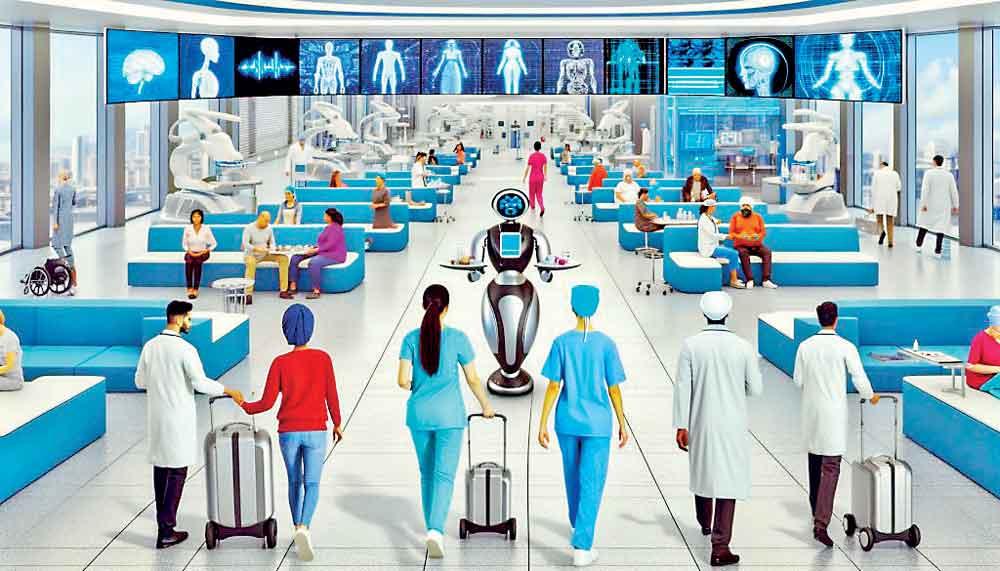
An AI generated image indicating the future of the medical and healthcare sector
 We’ve already seen how Artificial Intelligence (AI) is widely used to fake anything from music to art. Researcher Sasha Luccione affirms that tech companies are violating copyright laws by plagiarising images and text by artists and authors. But it’s a legal quagmire and it’s hard for artists and authors to find proof that their work has been used for training AI models without their consent.
Therefore, a group of artists got together and formed an organisation called Spawning AI, and created a tool called ‘Have I Been Trained?’ to search massive AI data sets.
Science fiction is now becoming reality. Our future wellbeing depends on how the fast developing AI capability is handled by humans. The dangers are already evident
Using this tool, Sasha Luccione has found in a massive AI database called LAION-5B nine images under her name. Two were genuine images of her, but the others showed scantily clad women by the name of Sasha. Some women were shown with three hands. While Luccione dismissed this as nonsensical, artist Carla Ortiz with two fellow artists has sued AI companies for copyright infringement for unauthorised use of their work.
Faking images isn’t anything new and goes back a century or more to the era of negative/positive photography and filmmaking. But that took technical skill. Now, anyone with a computer can do it with ease.
Take this one step further, and AI can be used by unscrupulous parties to wreck relationships and families.
Israeli thinker and historian Yual Noah Harari is outspoken of the dangers of AI. He acknowledges its benefits to humanity. For example, road accidents cause one million deaths worldwide every year due to human error, but self-drive vehicles using AI could solve this problem. Medical science and healthcare is another big beneficiary of AI. ‘AI doctors’ can function 24/7 without a break, again eliminating human error, using massive databases of case histories and medical breakthroughs (though just how much this is applicable to less developed countries with less internet access per capita, faulty power grids etc. remains to be seen. The cost of such AI services in countries where most people depend on free or subsidised medicare is another factor).
Wars in Gaza and Ukraine have already demonstrated how AI can be used militarily. It’s the human hand which presses the button or pulls the trigger, but AI selects the target.
Historian Harari outlines the dizzying development of AI in just eight years – in 2016, when first generation AI looked more like a science fiction fantasy, to where it is today, where thinkers and scientists and many others worry of an AI-controlled future not that far away.
What sets AI apart from mere technical devices is its ability to not just programme, but also to analyse and decide. Harari gives as an example a coffee machine, which is programmed to provide the customer with the kind of coffee the latter asks for. It’s the customer who decides, not the coffee machine. This isn’t AI.
But an AI coffee machine would be different. It will analyse from a massive database the customer’s preferences, time of day etc. and decide what kind coffee the latter would like best at a given time.
Harari says that, despite all the hype, AI is still at a very primitive, amoeba level of evolution. In human evolution, it took millions of years to get from that level, moving past the dinosaurs, to Homo Sapiens. But, at the current rate of technological evolution, AI could be a frightening Tyrannosaurus in a couple of decades, or less.
AI is based on algorithms, and that’s nothing new. Facebook, now twenty years old, owes its success to algorithms which identify user preferences and prioritises them. That’s why users are bombarded with videos, music and ads they like.
Algorithms can calculate, they can’t think. Early on, they caught on to the fact that negative human emotions such as hate and prejudice were ‘crowd pullers.’ When people post text or videos with content that is detrimental and targeted towards a religious or ethnic minority, the result is a flood of like-minded posts and videos from many other sources. Birds of a kind flock together.
By the time tech company executives realised what was happening and decided to introduce safeguards, the damage has been done. Research shows examples from many countries where hate videos led to attacks on minority groups, immigrants, political opponents and those who defend their minority rights. It has even led to ethnic cleansing in some countries and divided entire countries and populations – In the US, Republicans vs. Democrats, in India, the BJP followers against others – everywhere, the right and the far right against liberals and the left.
But these hate videos are made by people. As Harari points out, there is a greater danger when AI is able to like, dislike, love or hate on its own, independent of the human brain using it. In other words, when it develops consciousness, which has so far been a human monopoly.
So far, this has not happened. But what about the future?
AI is a godsend to hardline or totalitarian states. Dictators like Hitler and Stalin could force the masses to listen to their words and obey them. But they couldn’t produce intimacy. Now, AI can be trained to produce intimacy. In science fiction movies, we see robots who function as humans but they can’t feel. Gradually, though, they acquire this capability (Ridley Scott’s ‘Blade Runner’ is an example).
Science fiction is now becoming reality. Our future wellbeing depends on how the fast developing AI capability is handled by humans. The dangers are already evident. Hardline regimes are already making good use of AI to monitor restive populations. As Hariri points out, even democracies do this, and he gives his own country Israel as an example.
In Iran, it was hard to enforce the hijab law because the police could not be everywhere. But, thanks to AI surveillance cameras with facial recognition data which can identify not just pedestrians but even vehicle occupants, Iran can now enforce the hijab law everywhere 24/7. If a car occupant is detected without hijab, a message is sent to her phone within seconds: ‘Stop the car. It will be confiscated.”
In a country like Iran, losing one’s car could be as bad as the death penalty, or worse.
Harari says this problem is not limited to countries like Iran or China. It could happen in the United States. He takes the virulent anti-abortion campaign, which has even bombed known abortion clinics, as an example.
AI could detect that a woman has suddenly ceased to be pregnant. It could ask: ‘You were pregnant yesterday. But you aren’t pregnant today, and you haven’t given birth to a baby. What happened?’
Seen in those terms, the future looks frightening indeed.
03 Jun 2026 03 Jun 2026
03 Jun 2026 03 Jun 2026
03 Jun 2026 03 Jun 2026
03 Jun 2026 03 Jun 2026
03 Jun 2026 03 Jun 2026