23 Apr 2025 - {{hitsCtrl.values.hits}}
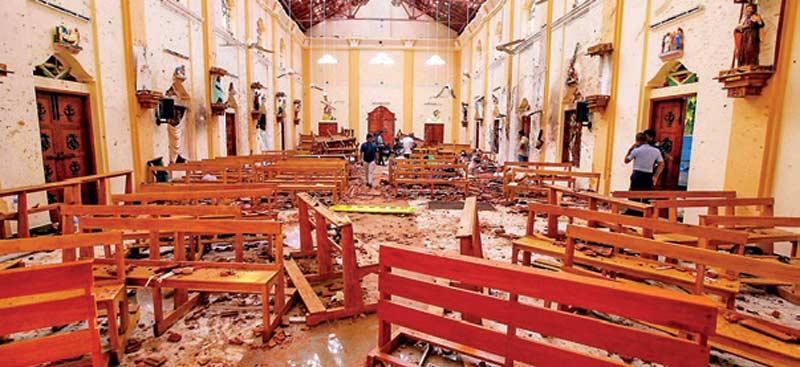
 Cardinal Malcom Ranjith previously threatened to have a protest march from Colombo to Katuwapitita church which covers 37 km, on the 6th anniversary if the government fails to catch the masterminds, however, he settled for a much shorter march in Colombo from St Lucia’s Cathedral to the nearby St Anthony’s Church
In an Affidavit submitted to the District Court of Central California, the FBI had identified Zahran Hashim as the ‘Mastermind’ of the Easter Sunday Attacks
For several years since the tragic Easter Sunday attacks, which marked their 6th anniversary this week, a section of the Catholic church and assorted groups wanted us to believe that nine suicide Islamist terrorists—who pledged their allegiance to the Islamic State—blew themselves up, killing 270 churchgoers in three churches and patrons in three posh hotels, in order to bring to power Gotabaya Rajapaksa, an ardent Sinhala Buddhist nationalist.
 The thrust of all the conspiracy theories, unsubstantial allegations and a search for an elusive ‘mastermind’ are based on this whimsical premise.
This runs counter to findings not only from the Sri Lankan investigation agencies but also from the FBI and a group of foreign investigation teams, including Australian, Dutch, Scotland Yard, and Danish, and Indian.
The elusive ‘mastermind’ Cardinal Malcolm Ranjith claims was behind the attacks, has long been revealed by a host of foreign intelligence agencies which investigated the attack alongside their Sri Lankan counterparts.
Earlier on December 20, 2020, in an extraordinary affidavit submitted to the District Court of Central California, the FBI had identified Zahran Hashim as the ‘mastermind’ of the attack.
This is what the affidavit stated: “The attackers and their co-conspirators were members and supporters of ISIS and created a group, “ISIS in Sri Lanka,” hereinafter referred to by its name or, more generally, as the ‘group”, that ISIS formally recognised as an ISIS affiliate operating in Sri Lanka. ISIS claimed responsibility for the attacks via its news agency, declaring that “Islamic State fighters” had “targeted citizens of coalition states and Christians in Sri Lanka.” ISIS also posted pictures and a video of the attackers swearing allegiance (“bayat”) to ISIS’s then-leader, Abu Bakr al-Baghdadi.
“… Before detonating an IED that killed himself and a score of victims, Jahran Mohamed Cassim, also known as (“aka”) Mohamed Cassim Mohamed Zahran, aka Zahran Hashim (“Zahran”), was the mastermind behind the Easter Attacks and the self -proclaimed leader of the ISIS in Sri Lanka.”
“Zahran claimed to have communicated directly with the ISIS leadership in Syria and obtained the approval to operate as an ISIS affiliate.”
In pursuit of the affidavit, the Justice Department later charged three Sri Lankan citizens with terrorism offences, including conspiring to provide material support to a designated foreign terrorist organisation (ISIS).
The three defendants named in the criminal complaint, all of whom pledged allegiance to ISIS, are: Mohamed Naufar, the “second emir” for the group of ISIS supporters that called itself “ISIS in Sri Lanka,” who allegedly led the group’s propaganda efforts, recruited others to join ISIS, and led a series of multi-day military-type trainings.
Mohamed Anwar Mohamed Riskan, who allegedly helped manufacture the IEDs used in the Easter Attacks and Ahamed Milhan Hayathu Mohamed, who allegedly executed a police officer in order to obtain the officer’s firearm, shot a suspected informant, and scouted a location for a separate terrorist attack.
The three suspects are in jail in Sri Lanka.
However, back in Sri Lanka, the local authorities have left the investigations into this grim tragedy to become a political football, and to be exploited by the groups who always had a chip on their shoulder of the very (Sinhala Buddhist ) foundation of the Sri Lankan state.
Recently, Cardinal Malcolm Ranjith threatened a protest march from Colombo to Katuwapitiya church, covering 37 km, on the 6th anniversary if the government fails to catch the masterminds. Later, he settled for a much shorter march in Colombo from St Lucia’s Cathedral to the nearby St Anthony’s Church, where the suicide bombers attacked first in a series of suicide attacks six years back.
The new government of NPP, which came to power promising many things, including catching those elusive masterminds of the nihilistic terrorist attacks, seem to be more interested in placating the Cardinal and the Church.
Earlier, the President, on the campaign trail for the upcoming local government elections, pledged to provide new revelations of the attack by the sixth anniversary of the tragedy. Since then, he has changed the tune, saying investigations are delicate and the ‘public would not know the new findings instantly’.
However, the minister of Public Security, Ananda Wijayapala has linked the recent arrest of Pillayan, the former Chief Minister of the Eastern Province and a leader of the splinter group of the LTTE turned political outfit, Tamil Makkal Viduthalai Pulikal (TMVP), to the Easter Sunday attacks.
“Recently, former State Minister Pillayan was arrested by the Criminal Investigations Department. There is substantial information linking him to the Easter Sunday Terror Attacks, suggesting his involvement. The investigations are ongoing. We will never allow any crime to be covered up, nor will we permit any criminal to roam free. It is imperative to establish law and order in the country. Justice must prevail, and we will take all necessary actions to achieve this,” he said in Parliament.
Pillayan’s arrest is linked to a separate incident involving the disappearance of the former Vice Chancellor of the Eastern University, Sivasubramaniam Raveendranath, on December 15, 2006, in Colombo 7. Prof Ravindranath’s disappearance is one of a long list of tit-for-tat violence that unfolded after the split of Vinayagamoorthy Muralitharan alias Karuna-led Eastern faction from the LTTE. That gory past should not be investigated selectively. Counterterrorism and counterinsurgency fought anywhere in the world entails a good deal of dirty business if the government is to prevail over terrorists who fight a war of attrition of will, limiting the government’s scope and, at the same time, escalating terrorist attacks. However, Pillayan’s arrest has no factual link with the Easter Sunday attack unless you take it as the universal truth by a statement by an asylum seeker, Asad Maulana, a former associate of Pillayan who had implicated the latter and head of Military Intelligence, Suresh Sallay, an illustrious military intelligence officer.
A simple fact check of Maulana’s claims would reveal grave inconsistencies and deliberate lying. He claimed he fled the country due to threats to his life ostensibly by Gotabaya Rajapaksa, but he left the country only after Gotabaya Rajapaksa regime collapsed, and the gravy train all associates rode crashed to the ground, and he was implicated in financial crime in a Colombo court. He claims he arranged a meeting between Suresh Sallay and Islamists. He also claims Sallay asked him to escort a suicide bomber from the Taj Samudra Hotel. He was referring to Abdul Latif Jameel Mohammed, the botched bomber of the Taj Samudra hotel, whose bomb is suspected to have malfunctioned. He later blew up at a Dehiwala motel.
However, During the time period, Maulana alleged Sally was meeting Islamists in an Eastern hideout and asked him to escort Jameel, Sallay was in fact, in India pursuing his NDC course. Unless he has super power to teleport himself to the hideout in Eastern Sri Lanka, it is hard to establish how either incident occurred.
Ananda Wijayapala seems to be content with buying his story.
All that portends a very dangerous attempt to rewrite the history of the Easter Sunday attacks.
If there had been foul play and an attempt to shield the ‘masterminds’ as the Church and the Cardinal allege, the rest of the nations, whose nationals were also victims of the Easter Sunday attack, would not have remained silent. Instead, they have concluded that the attack was carried out by homegrown Islamists affiliated with the Islamic State.
Australian Federal Police has written to their Sri Lankan counterparts that “there are no ongoing investigations by the AFP into the 2019 Easter Sunday terrorist attack”.
Yet, Cardinal and his associates seem to think they know better than a plethora of foreign and local investigation arms that probed the attack.
The government seems to placate him rather than serve justice to the victims. This is a very dangerous attempt at rewriting the history of a grim tragedy that all Sri Lankans should oppose.
Follow @RangaJayasuriya on X
04 Jun 2026 04 Jun 2026
04 Jun 2026 04 Jun 2026
04 Jun 2026 04 Jun 2026
04 Jun 2026 04 Jun 2026
04 Jun 2026 04 Jun 2026