03 Mar 2026 - {{hitsCtrl.values.hits}}
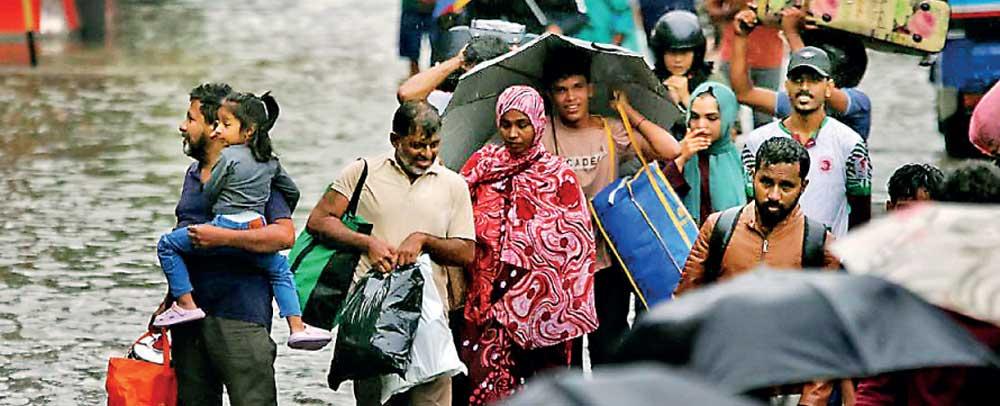
As homes were flooded during cyclone Ditwah, people left homes and their meager assets seeking alternative shelter
Source: Displaced International
 People who have lost their homes are all over my social media feeds. But they are from Gaza, not from Sri Lanka. The pictures are horrific and the stories are heart rending.
But we’re not doing much for them beyond putting flags on our profiles. As social animals, we are programmed to sympathize. Those who do not are called sociopaths.
Close to home
In addition to the many innocents who have lost their homes in West Asia, we also have many close-to-home who had homes in November but for the last three months have had to depend on the kindness of others. Here, we can do something, in addition to extending our sympathy. But for anything, our homeless must also appear on the news feeds.
According to the Government, 158,585 individuals including children from 46,185 families lost their homes to the landslides and flooding resulting from cyclone Ditwah. Of this number, 155,182 persons from 45,034 families were staying with relatives and friends; 3,403 persons from 1,151 families were in government centers/camps. Still others moved out of camps assured that they would receive LKR 25,000 a month for six months to pay for rented accommodation. Not all of them have received the money.
According to the government newspaper, only 36.3 percent of those eligible for rental assistance (3,648) have received the money two months after LKR 500 billion was approved for Ditwah recovery. The ‘Ceylon Daily News’ proudly announced that the LKR 25,000 house-cleaning allowance had been disbursed to 427,569 families, 98 percent of an undefined denominator. It may be assumed that those who have no homes to go back to did not receive the house-cleaning allowance.
What happens to the 3,648 families when the rental assistance runs out after six months? The day of reckoning may be further away for the 47,000 plus families who will hopefully receive the rental assistance in the coming weeks.
Three months is a long time
The Ditwah displaced have been homeless and dependent for three months. The housing subcommittee of the Task Force chaired by the Prime Minister has met only once (in February) and has not generated any data or recommendations. By this time, temporary housing should have been procured for the 1,000 plus families in camps and perhaps for the other difficult cases such as those whose homes along with the land are no longer there, carried away by a sliding mountainside.
Perhaps not wanting to repeat the experience of long-retired Former Secretary to Treasury Charitha Ratwatte who is on bail for his alleged role in the procurement of grain storage facilities that were not used, no one appears to have acted to procure temporary accommodation for the Ditwah displaced. This kind of initiative that was common among our administrators appears to have been extinguished.
The gargantuan 25-person task force appointed by the President, a full month after Ditwah, wreaked its devastation is not up to the job. A task force where every member has other pressing duties cannot move at speed. It is appalling that the housing subcommittee has met only once. The task force can break log jams and be useful. But there must be a single driven individual whose only performance indicator is how many families are back in their own homes, permanent or transitional. One is reminded of the perhaps apocryphal question asked by President Kumaratunga early in her first term: “where is my Paski?”
Getting more for the rupee
The supplementary estimate approved in December allocated LKR 100 billion for housing reconstruction. More will be needed. Some of the houses will need access roads. All will need water, sewerage and electricity connections. The 5,354 houses reported as having been destroyed by a December DMC situation report and around half the 81,625 houses reported as having been partially damaged add up to the number of families reported above.
Land that can be built on has to be found (acquired in some cases). Some of the homeless report the land their home was on is gone. Others report their land cannot be built on because of continued landslide risk.
Once the land problem is solved, houses must be built. Starting from clinker to cement to roofing sheets, most construction material is imported. The effective tariff rate on tiles amounts to 100.63 percent plus SSCL. On aluminum, it’s 81 percent plus. Costs double when construction material clears the port.
With these exorbitant prices, our young people are unable to realize the dream of owning a home; tourist hotels are hamstrung in competition with neighbouring countries. And now, the Ditwah displaced will get less house for the money.
The 2026 Budget promised to phase out para tariffs such the Port and Airport Levy (PAL) and CESS. The National Tariff Policy was just approved by Cabinet but is not yet public. Whatever is in these documents, the urgent need is to zero out the punitive para tariffs applied to construction material. No gradual phasing out; zero.
Those who have been gorging at the para-tariff trough will protest. Treasury officials will raise concerns about negative impact on revenue targets. Absent strong public support for the immediate lowering of construction-material prices, they will win, again.
What can be done
Think about 50,000 families with no homes to go back to. Pressure the Government to appoint empowered officials to drive the housing initiative; and to make that their only job. Defeat the protectionist lobbies behind the para tariffs and bring down the cost of home building for all, not just the Ditwah displaced. Sympathise with all who have lost their homes across the world. But do not forget those close to home. It could be us the next time.
14 Jun 2026 5 hours ago
14 Jun 2026 7 hours ago
14 Jun 2026 7 hours ago
14 Jun 2026 14 Jun 2026
14 Jun 2026 14 Jun 2026