01 Apr 2025 - {{hitsCtrl.values.hits}}
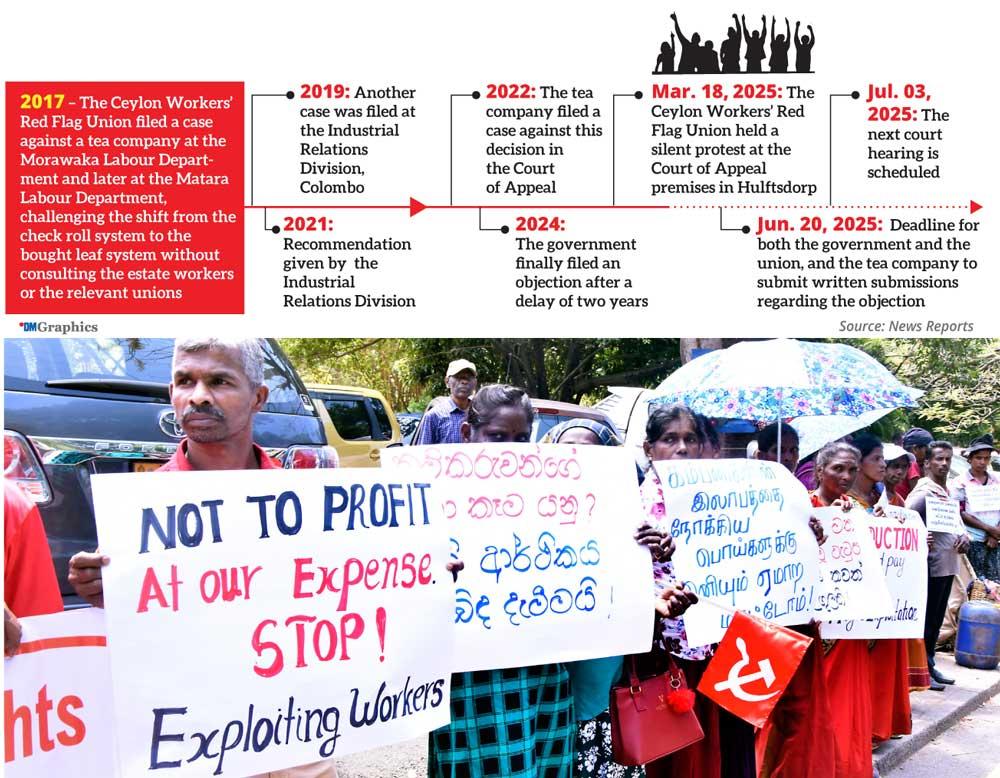
Close-up of a protester holding a banner
Pix by Nimalsiri Edirisinghe
By Aakil Riyaz
The Ceylon Workers Red Flag Union (CWRFU) stood out in protest on recently, 2025, at the Court of Appeal Premises, Hulftsdorp. This silent protest was held against informalisation, a system that has threatened to upend the lives of the workers in the tea and rubber plantation sector within the country. Before delving into what informalisation implies as a phenomenon, it is necessary to have an understanding of the gravity of the problem.
Background to the problem
In 2017, the Ceylon Workers’ Red Flag Union filed a case against a tea company on the grounds of informalisation at the Morawaka Labour Department and the Matara Labour Department later on. The case was filed on the grounds that the tea company had decided to pivot from the check roll system to the bought leaf system, without consulting the estate workers or the relevant unions.
Following this, another case was filed in 2019 at the Industrial Relations Division, Colombo District, which went on from 2019 to 2021, wherein a recommendation was given by the Division. The recommendation stated that the company would have to revert to the check roll system, and in the event they did not wish to do so, they could continue with the bought leaf system, but with the caveat of having to provide the workers with all the benefits under Sri Lankan labour laws. In 2022, the tea company filed a case against this decision in the Court of Appeal.
Initially, the government failed to file an objection, even though the case involves both the government and the Ceylon Workers’ Red Flag Union. The union submitted its objection, but the government did not file theirs. Despite appealing the decision on February 17, 2022, the government did not respond with an objection until 2024. The case continued to drag on, and in 2025, the court resumed hearing it. The court instructed both parties—the government and the Union (together), and the tea company—to submit written submissions concerning the objection by June 20, 2025. The court will review these submissions, and the next hearing is scheduled for July 3, 2025.
“The facilities and benefits of these estate workers have been dealt a severe blow; to their EPF/ETF facilities, maternal benefits have all been snatched away from them. We vehemently condemn the informalisation process and would like to make it clear that it is our job security that matters to us”, states Menaha Kandasamy, Advisor, Ceylon Workers’ Red Flag Union.
How damaging has informalisation been to the estate workers?
These workers have been denied facilities such as the payment of Employment Provident Fund and Employment Trust Fund (EPF/ETF), along with the denial of maternity leaves and other employee benefits. It is quite discernible that the tea companies are resorting to such strategies to cut corners extensively with their employees. If this isn’t bad enough already, the maintenance cost for the plantations has been offloaded onto the backs of the estate workers. They are denied contractual employment, and the plantation land is given to them to cultivate, with land ownership vested in the tea companies. The only right the workers possess is for the cultivated bushels of tea.
This means that they have to bear all implicit costs such as fertilising, pruning and the overall upkeep of the crops alongside this, the workers are required to sell the tea back to the plantation owners at the price the owners are willing to pay for it. This represents an almost rudimentary feudal system with the companies acting as the feudal lords and the workers the serfs.
The companies that promote informalisation paint an image of the system being flexible and running congruously with workers’ day-to-day lives. Some of the features informalisation promotes are the freedom to decide their working hours (much akin to freelance workers), and engage family members or friends to co-work alongside them.
Niyanthini Kadirgamar, PHD student in Education, with field work in the Nuwara Eliya District, had this to say on the matter, “Workers’ leaves and benefits are completely hindered, and all the costs are transferred to the workers. This reduces their collective power, and their bargaining power is also diminished as a result. When they are moved from one plantation to another, their mobility is also curtailed until their obligations are met”.
The entire system of informalisation is a blight on the lives of the plantation workers, as it is an illegal system that is being perpetuated. The lack of EPF/ETF provisions has also resulted in many workers exiting the plantation sector and seeking work elsewhere, such as going abroad to seek work as domestic workers in the Middle East or moving to Colombo. This might seem like a much better alternative to their plight in the estates, but these environments are not the most conducive to their way of life, leading to a continuous cycle of oppression and exploitation from their employers once again.
Anandi Sivasubramaniyam, General Secretary, Ceylon Workers’ Red Flag Union, expressed her comments on the protest, “We have organised this protest today in response to the informalisation system that is rapidly spreading within the tea and rubber plantation sectors. This essentially means that the workers who had been employed as permanent workers have had this replaced with an informal system”.
Sivasubramaniyam further commented, “This has affected their maternal leaves, service gratuity and other benefits enjoyed by the estate workers, along with infringing on their constitutional rights. This system has slowly encroached on the lives of these workers over the years. We are against it as a union. We hope that some justice will be meted out to the estate workers after today’s hearing. If informalisation is fully accepted, this would lead to dire economic consequences within the country in the long run. We will continue to raise our voices against this injustice,”.
How has informalisation affected the workers’ families?
Women workers play a pivotal role in the plantation sector, they have to deal with the double burden of working and taking care of their families at the same time. Informalisation has also led to the unavailability of maternity leaves and their need for fair wages. The children within these families have been left in a vulnerable position, with their parents being unable to look after them, leaving the grandparents to shoulder this insurmountable burden. Further, women face barriers in unionisation and participating in collective bargaining, which is another side effect of informalisation. Moreover, the increased fear of job security hangs above their heads like a proverbial sword of Damocles.
We have been protesting against this since 2017, and we hope today’s court decision will be in favour of these workers, states Deva Kumar, Deputy General Secretary, Ceylon Workers’ Red Flag Union.
What are the workers asking for?
Simple, an end to informalisation. This signifies the restoration of a system that upholds their labour laws, which include: adequate wages, access to union representation
and most importantly, guaranteed job security, which is a quintessential requirement.
With the impending court hearing on July 3, there is much at stake and untangling this Gordian knot will not be an easy task for the estate sector workers, but their perseverance through it all is a testament to their indomitable spirit.
Informalisation is a system that replaces formal jobs with informal jobs. This is a malpractice that has seeped into the lives of the estate sector workers, severely undermining their most basic human rights. Informalisation entails systems such as the revenue sharing model, buy-back system and the production-based payment. Such methods have greatly impacted the lives of these workers, leading to them coming under fire from labour laws. Moreover, this leaves them out to exploitation, of which they have succumbed to time and again.
11 Jun 2026 2 minute ago
11 Jun 2026 5 minute ago
11 Jun 2026 7 minute ago
11 Jun 2026 10 minute ago
11 Jun 2026 15 minute ago