12 Jun 2025 - {{hitsCtrl.values.hits}}
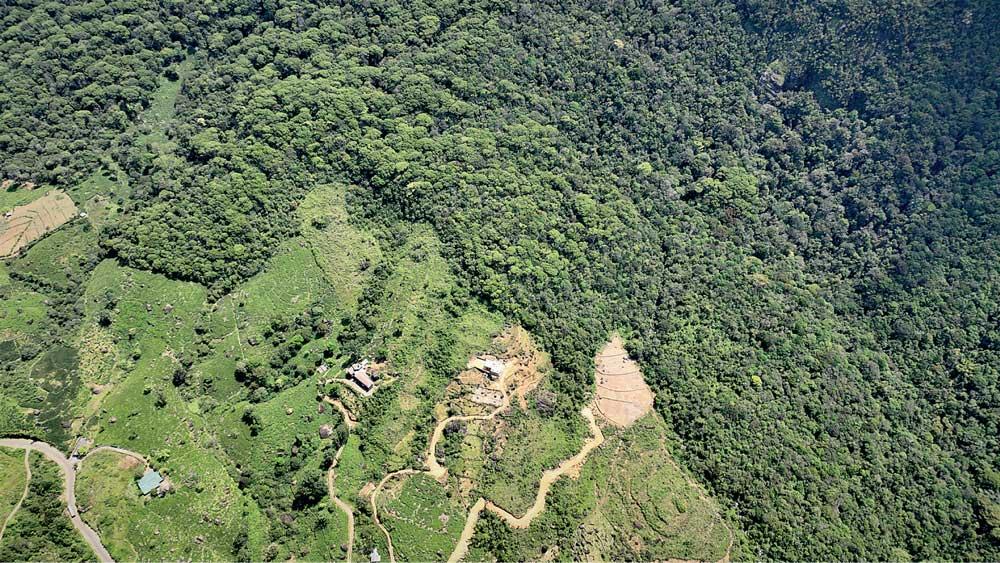
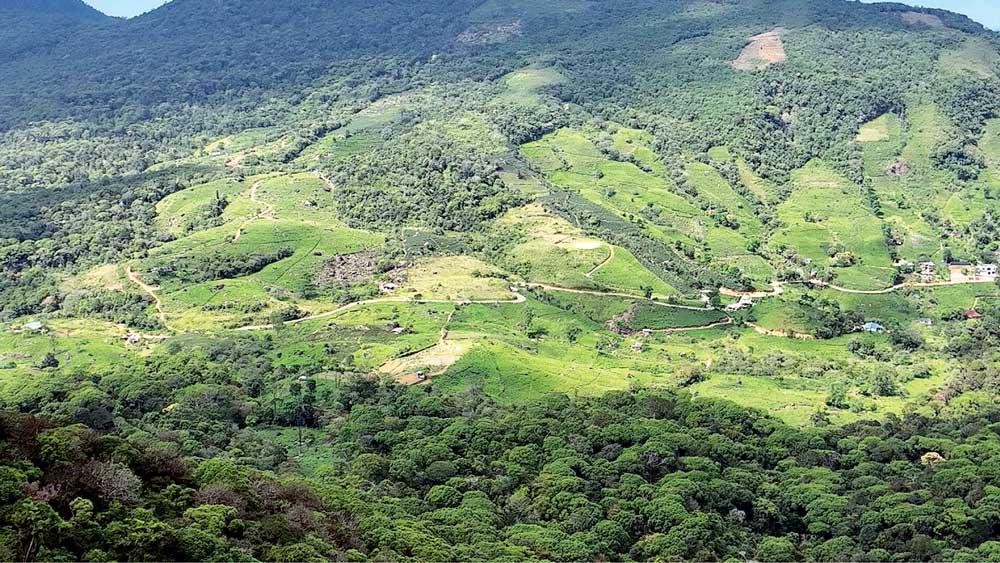
 Due to the lack of maintenance of company-owned tea lands and the declining productivity of older plantations, rainforests are being rapidly cleared to establish new tea plantations and increase yields, fueling the expansion of tea cultivation. To raise public awareness of the resulting issues, we have created two posters.
Furthermore, efforts are underway to convert tea plantations into multi-crop systems based on agro forestry and ecological farming principles. These efforts aim not only to improve the economic and social well-being of tea cultivators but also to promote food sovereignty and create an environment where all living beings, including humans, can thrive.
This effort began after studying the forest cover statistics last published in 2010 by the Department of Forest Conservation. According to these figures, 196,573 hectares of rainforest remain—about 3% of the country’s total land area or 13% of the wet zone. This accounts for just 0.011% of the world’s total rainforest cover.
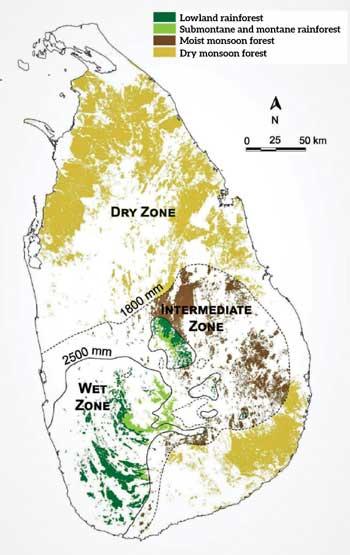 Three types of rainforests
Of the country’s three types of rainforests, only 123,302 hectares (1.9%) of lowland rainforests, 28,513 hectares (0.4%) of sub-montane rainforests, and 44,758 hectares (0.7%) of montane rainforests remain. These figures reflect the state of the forests 15 years ago, and since then, the area has further declined due to the clearing of significant portions of rainforest to expand tea plantations.
As a result of clearing rainforests in this manner, the mechanisms that draw rainfall to the ground and the watersheds that retain rainwater in the wet zone, which receives the highest rainfall, have been lost. This has had a severe impact on the survival of very rare species with limited distributions that live in these rainforests.
However about 90% of the country’s endemic species live in the very few rainforests that remain in Sri Lanka today. Moreover, 99% of the species classified as critically endangered are found in these forests.
The destruction of rainforests began in 1867, when James Taylor initiated tea cultivation on an 8-hectare plot in Loollkandura, Kandy. Since then, tea cultivation has expanded across 221,969 hectares in both the hill country and the lowland wet zone. What began with just 8 hectares in 1867 has now led to the near-complete clearing of virgin montane, sub-montane, and lowland wet forests to allow for such expansion. This continued expansion, driven by the clearing of montane and lowland wet forests, is primarily due to the market demand for tea. As a result, even protected forest areas are now being cleared illegally to make way for tea plantations.
Green deserts
Tea plantations established by clearing rainforests are similar to green deserts and their biodiversity is extremely low. Due to the excessive use of agrochemicals and the lack of vegetation cover, tea plantations have become degraded landscapes with low biodiversity. As a result, these green tea plantations are often referred to as ‘green deserts.’
The expansion of tea plantations into forest ecosystems has also fragmented the remaining forest into isolated patches. Many species do not travel through tea plantations, resulting in the isolation of wildlife populations within these forest fragments.
The main contributors to deforestation are large tea plantations owned by plantation companies and large-scale entrepreneurs. Many rural small-scale tea cultivators maintain their tea plantations as multi-crop systems. A variety of plant species are cultivated in and around these small-scale plantations. In addition to commercial crops like cinnamon, coffee, pepper, cardamom, cloves, areca nut, coconut, and agarwood, rural farmers also grow jackfruit, breadfruit, brindleberry, soursop, bananas, durian, as well as various vegetables.
This approach aims to maximise productivity on small plots of land, diversify income sources, and achieve food sovereignty. However, plantation companies and large-scale businessmen do not have to maintain such cultivations. The Tea Research Institute also promotes monoculture as the recommended model for tea cultivation.
Tea plantations can be transformed into living ecosystems by adopting ecological farming and agro forestry principles to enhance land productivity. This transformation can generate multiple income streams, meet food needs, reduce soil erosion, increase profits by lowering costs through reduced reliance on external inputs, improve water security, and create interconnected forest patches that form larger forest systems, reduce the impact of climate change and minimise natural disasters.
Moreover, transforming tea plantations from ‘green deserts’ into natural ecosystems will help ensure the survival of many species. With all these benefits, forest clearing for tea cultivation can be halted by providing farmers with multiple income sources from a single plantation. It is essential to pressure the government to adopt a policy decision in support of this transformation. In doing so, small-scale producers can be empowered to replace the system of slave-like labour that persists in tea plantations.
11 Jun 2026 10 minute ago
11 Jun 2026 27 minute ago
11 Jun 2026 52 minute ago
11 Jun 2026 57 minute ago
11 Jun 2026 1 hours ago