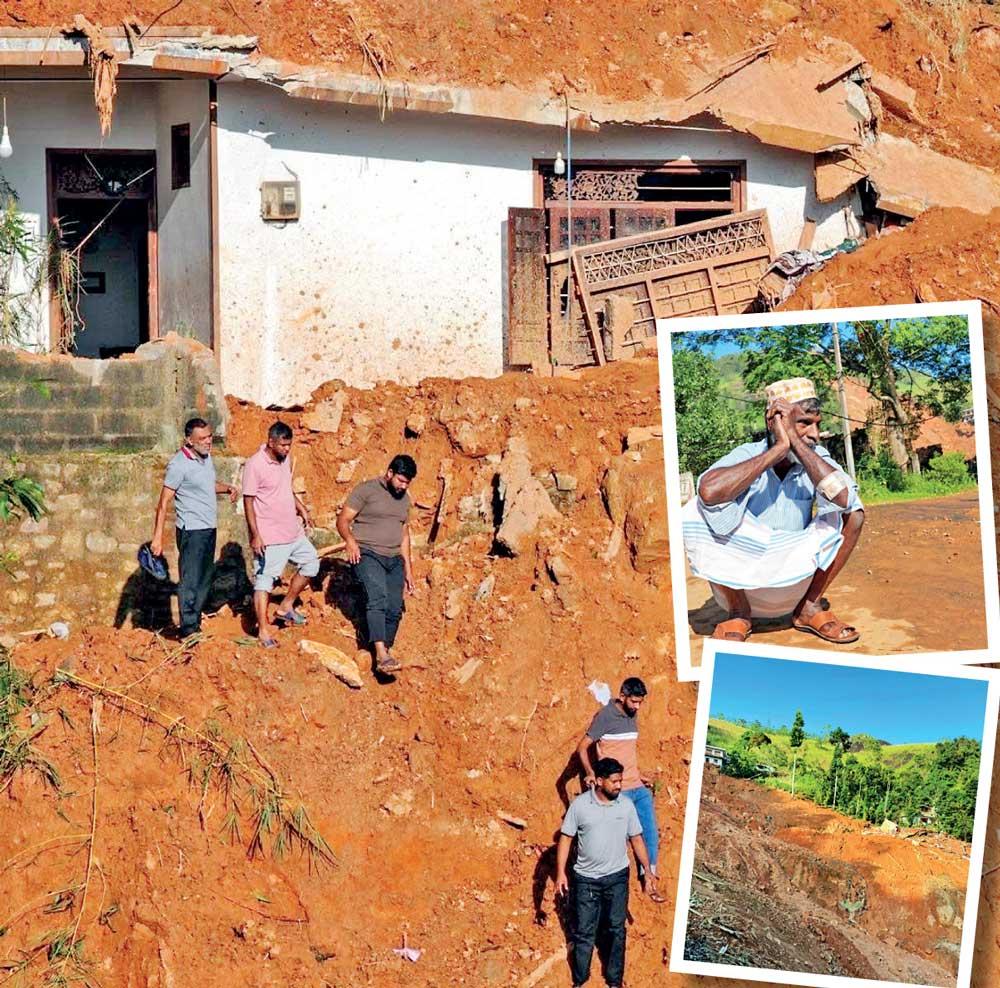
- “My house, my vehicle, everything is gone. Everything is finished. There is nothing left now. I’m not worried about that. It’s enough that I didn’t lose anyone in the family”
-Silmi, landslide survivor
- “All I can say now is that we are safe. So many people have died. After the landslide, we can’t go to other places because of the risk of further landslides”
-Zameera Ramzan, Law College student and survivor
- “As the telephone communication network in the Rambuk-ela area is completely down, we are unable to transmit any information from there. We are providing daily relief supplies and medical facilities. Two or three doctors come daily to examine those staying in the mosque camps”
- Irfan Qadar, Secretary of the Akurana Masjidhs Federation
- “There was no opportunity to take those rescued from the midnight landslide with serious injuries to the hospital. The communication network didn’t allow us to call any doctor or seek medical aid over the phone. We had to wait until dawn to treat the injured”
-Samhar, Rescue Worker from Rambuk-ela

I thought someone was cutting branches for goats, so I opened the window. When I looked outside, I couldn’t see the houses, wells, trees, or electric poles that were opposite,’ says Fayis (53), who lives on Rambuk-ela Jumma Mosque Street and survived the landslide that occurred there last Friday, with a heavy heart.
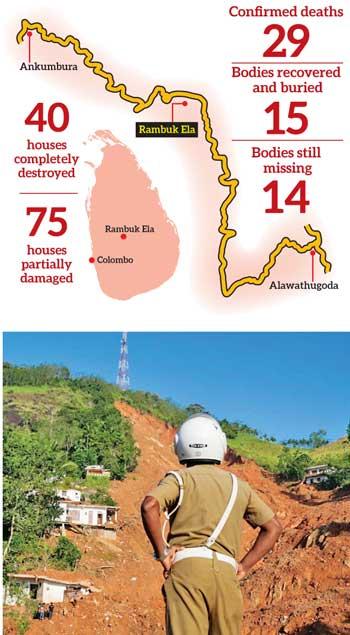
The landslide that took place in the Rambuk-ela area around 11:50 PM last Friday (28-11-2025) has been confirmed by the Akurana Masjidh Federation to have claimed 29 lives. While the bodies (Janaza) of 14 victims were recovered and interred with the help of the security forces and villagers, the remaining victims are in permanent sleep beneath the earth.
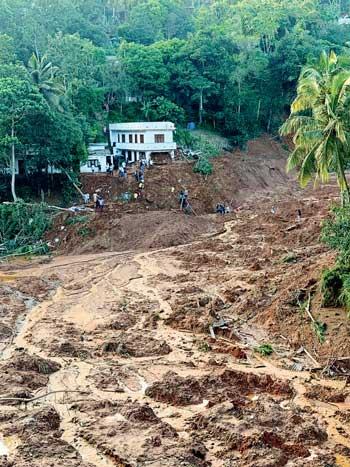 |
| As many as 56 people maybe buried in the mud |
The exact number of the deceased remains difficult to ascertain. Unofficial sources suggest that as many as 56 people may have been buried in this soil. Unconfirmed reports also indicate that many people who had come in search of safety from various areas threatened by landslides were staying in Rambuk-ela and perished in the disaster.
Rambuk-ela isn’t just the name of a village. It has now become a symbol that loudly proclaims how vulnerable villagers are to natural disasters and how far we still need to go in disaster management. The entire mass of earth collapsed in a very short time. Survivors’ accounts make it clear that the people, who were asleep at night, didn’t get a single moment to comprehend what was happening or escape sans injuries.
Survivors’ accounts and damage
The Rambuk-ela village, located on the Alawathugoda – Ankumbura road within the Akurana Pradeshiya Sabha and Alawathugoda Police Division, is home to about 500 Muslim families.
Silmi, who managed to save everyone in his house from the clutches of the landslide, says: “My house, my vehicle, everything is gone. Everything is finished. There is nothing left now. I’m not worried about that. It’s enough that I didn’t lose anyone in the family,” as he shares his grief through tears.
This landslide, which completely changed the geographical landscape of Rambuk-ela village, has inflicted irreparable sorrow upon 28-year-old Nazir from the area. He managed to escape through the roof of his house just before it was completely buried in the mud. He is unable to describe the incident because he has lost everyone -- his two younger sisters, his mother, and his father. Only his eldest sister, who was not at home at the time, remains in that family.
‘Pray for my family’
“Please pray for my family,” says Ramees with tears. He lost nine people, including his wife and two children, in the landslide. Furthermore, he appeals to the government to focus on the swift restoration of the road network and electricity facilities for the area, even in this difficult situation.
According to the census conducted by the Rambuk-ela Jumma Mosque administration, nine vehicles were completely buried in the landslide: five three-wheelers, two vans, one lorry, and one motorcycle are buried beyond recovery. Moreover, 40 houses in Rambuk-ela village were completely destroyed, and 75 houses were partially damaged.
The landslide turned Rambuk-ela into a ghost village
Zameera Ramzan, a Law College student from the area who spoke about the incident, says, “All I can say now is that we are safe. So many people have died. After the landslide, we can’t go to other places because of the risk of further landslides.”
Immediate needs and challenges
Due to the threat of landslides, many people from Rambuk-ela are currently sheltered in two Jumma Mosques. This includes men, women, children, and the elderly. Their immediate needs are medical facilities, food, and water. The Secretary of the Akurana Masjidhs Federation, Irfan Qadar, stated that the Federation is fulfilling their basic needs.
Speaking to Daily Mirror regarding this, Irfan Qadar says: “As the telephone communication network in the Rambuk-ela area is completely down, we are unable to transmit any information from there. We are providing daily relief supplies and medical facilities. Two or three doctors come daily to examine those staying in the mosque camps”.
 Failure of communications
The complete failure of the communication network in Rambuk-ela has caused panic among the people. They cannot inform neighbouring villagers or even ask for help. There are no means to inform relatives about what’s happening there or to warn visitors about the danger.
Samhar from Rambuk-ela, who is involved in the task of digging up the bodies, states, “There was no opportunity to take those rescued from the midnight landslide with serious injuries to the hospital. The communication network didn’t allow us to call any doctor or seek medical aid over the phone. We had to wait until dawn to treat the injured.”
The security forces were actively engaged in the task of digging up the bodies in Rambuk-ela. However, the forces have stopped the digging due to the warning that excavating the soil at the disaster site is a dangerous act. But Samhar mentions the people of Rambuk-ela are continuing the digging work based on the requests of the relatives, who demand that at least the bodies of their loved ones should be recovered and interred.
Commenting on the current situation, Ajmal Moulavi of the All Ceylon Jamiyyathul Ulama (ACJU) stated: ‘We are providing the necessary food and facilities to the Rambuk-ela people. However, it is difficult to go there as landslides have occurred and roads have broken in various places along the path to the village. The police allow us to go there because we are providing relief. But the situation is such that we cannot transport relief materials in vehicles like lorries. Only two-wheelers, three-wheelers, and small vans can go there.’
The two paths leading to Rambuk-ela village are extensively damaged. The Panselthenna road was already damaged and unrepaired before the landslide, and it has been completely ruined after the heavy rain and the landslide. Furthermore, the massive landslide has completely destroyed the winding road from Mudinakadai to Meezan Mosque on the Alawathugoda–Angumpura road, and the villagers assume that repairing it might even be an impossible task.
Irfan further stated that the government must take swift action to resettle the affected people or relocate them from the affected areas. He also mentioned that those currently staying in the mosques urgently require a generator, temporary sanitation facilities, and a cooler for medicines. He added that the affected people also desperately need mental health counselling.
Important Questions and Call to Action
The cries of those who lost their family members still echo in the two mosques. The search for the bodies continues. As the bodies recovered during digging are in a state of decomposition, they are being interred immediately at the recovery site, as the religious duties like enshrouding and bathing cannot be performed.
The tragedy in Rambuk-ela village raises critical questions for us:
1. Was this area identified as a high-risk zone during the rainy season? The question arises why plans to evacuate people to safe locations beforehand were not implemented.
2. Why did the government not establish alternative communication methods for such emergencies? The complete breakdown of telephone communication at the time of the disaster delayed medical aid and rescue operations.
3. What is the plan for permanent resettlement and psychological counselling? Beyond food and water, the people staying in the mosques are suffering from severe psychological trauma. The psychological wound from not being able to inter the buried bodies according to rituals cannot be healed with simple relief.
4. What is the plan to rebuild the damaged infrastructure? The difficult situation where relief supplies must be transported only in three-wheelers due to the extensive damage to the two main roads indicates our backwardness in basic infrastructure. Therefore, rebuilding this damaged infrastructure, along with resettling the affected people, is not only a great challenge but also the paramount duty of the government.
5. The Rambuk-ela village is a symbol of rising sorrow. The tears of those who lost their relatives and the condition of the survivors must be immediately addressed. Passing off this tragedy as just a lesson is like paving the way for future disasters. Therefore, the people of Rambuk-ela need not just relief, but a safe guarantee for the future and proper reconstruction.