27 Jan 2025 - {{hitsCtrl.values.hits}}

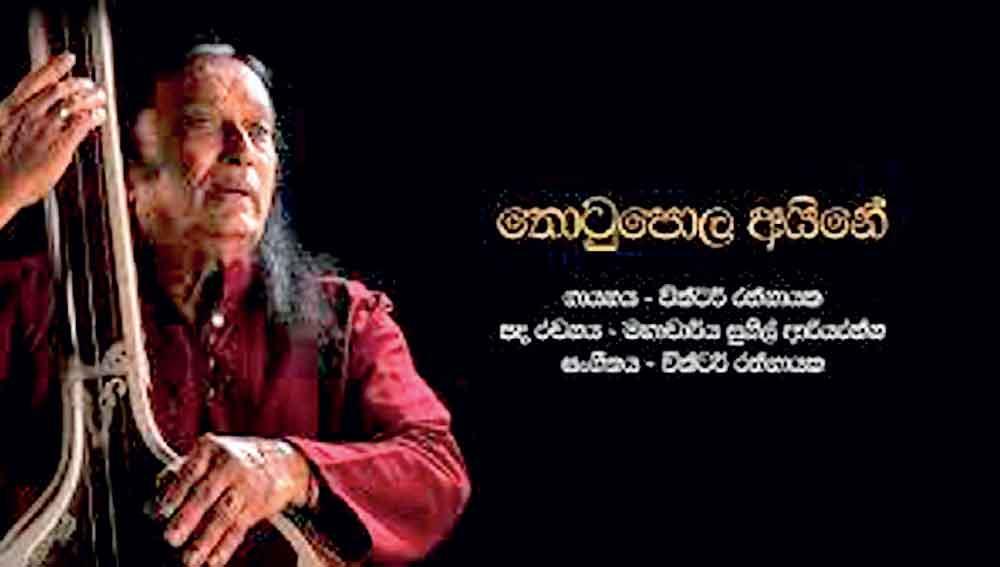
Victor Ratnayake’s ‘Thotupala Aine’ and ‘Viduli Dumriye Chanchala Nadaya’ sung by Rupa Indumathi and Lakshman Rodrigo are rare exceptions when it comes to experimentation with song writing.
 Last week, we looked at a critical evaluation of Swarna Mallawaarachi from Eric Illayapparachchi’s essay ‘The Last Face: Swarna’ from his book ‘In Search of Art.’ This week, we look at his critical evaluation of the Sinhala song as quoted from the same work, which I consider to be seminal as no other Lankan critic has even come close to the depth and scope of his analysis when it comes to music.
I hasten to add that the title of this column is not a quote from the book. But one is tempted to call the Sinhala song virginal because, as far as lyrics and subject matter is concerned, it has not evolved or matured. A comparison with English pop music will make this truth obvious.
While English pop too, deals with the theme of love in a conventional, crowd-pleasing manner, one can think of hundreds, if not thousands, of exceptions – from Glen Campbell’s ‘Bye Bye Mr. American Pie’, ‘Eleanour Rigby’ by the Beatles, ‘Saigon Bride’ by Joan Baez, Tasmine Archer’s ‘Sleeping Satellite,’ ‘Sounds of Silence’ by Simon and Garfunkel, ‘Hotel California’ by the Eagles, ‘Radio Gaga’ by Freddie Mercury and ‘Fernando’ by ABBA etc.
Even when it comes to singing about love, many have taken startling routes (and risks) with lyrics – from Michael Jackson’s Billy jean, Mamma Mia by ABBA, to All That She Wants Is Another Baby’ by Ace of Base and Brother Louis by Modern Talking.
This kind of experimentation with song writing is by and large lacking in the Sinhala song (with rare exceptions such as Victor Ratnayake’s ‘Thotupola Aine’ or Nanda Malini’s ‘Tikiri Tikiri Tik’ or ‘Viduli Dumriye Chanchala Nadaya’ by Rupa Indumathi and Lakshman Rodrigo – these selections are mine, and may not represent Eric’s views and tastes).
But, returning to Eric’s essay ‘An Aesthetic for the Sinhala Song,’ we are shown another limitation – the voice and the music are overshadowed, even overwhelmed by the lyrics. As he puts it in the opening paragraph of his essay: “The Sinhala song, which projects itself as the sole representative of Sinhala music forcefully or by common consent, is now at a crisis point after passing various stages of its artistic development.”
He adds that its present status, which isn’t derived from any massive public approval of its creative output, nonetheless allows it to enjoy considerable power as a profitable way of making a living, with room for instant, overnight popularity and making poets out of songwriters. “Having become ‘simple’ (Sarala) on its own volition, the Sinhala song likes to be known by the ‘sarala (gee)’ or ‘simple (song)’ label. It may be that this definition came from classical musicians of the era who considered the new song medium to be of little or no value.’
The writer sees the following factors as contributors to this crisis :
A. The division of the Sinhala song into two distinct camps, with those songs of a more ‘poetic’ nature being classified as ‘subhavitha’ (distinguished) while others being labelled ‘Peechang’ (cheap or third grade). The latter came to be known as ‘popular’ at a later time.
B. This classification was done with a great deal of cultural prejudice, with both Western and eastern classical music being left out. ‘Karnatik classical music became ‘Saiver’ (as South Indian vegetarian restaurants were called) and even North Indian classical music was treated as alien. All music from Europe and the Americas was dismissed as ‘Western.’ (My note: P. L. A. Somapala was ridiculed as the ‘piththala musician’ because he used brass instruments in his orchestra). Western classical music forms such as opera, cantata and symphony were treated as alien just as birch, willow and oak trees were alien to native soil.
C. Then came the emergence of poets as song writers. The new poetic idiom including both traditional elements and free verse was used as the foundation of the Sinhala song. Those song writers who achieved this level were regarded as poets. Indeed, many of them were poets in their own right and ‘geya padaya’ or the lyric became the song’s foundation, promoting the lyricist over the singer and musician, and the methodology and standards of poetry criticism were applied to the analysis of songs. This was not only an abuse of the canon of poetry criticism but also a means of the song becoming a hostage of the lyrics.
The next step was the creation of an educated ‘fan base’ (rasikayo) who believed that appreciating the lyrics was the main thing in musical appreciation to applaud these ‘distinguished’ songs. This opened the doors of television to various professionals to project themselves as singers.
Poets who thrived in the ‘Kolamba Yugaya’ (Colombo era) faced an uncertain future as that period culminated in the 1960s. But those who achieved the new status as song writers were able to escape this fate. A parallel development was that even some musicians began to see a career in singing as salvation.
Eric Illayappaarachchi argues that this development was an impediment to the development of Sinhala music and the song, instead of being a help. It not only ignored an important historical heritage consisting of Nurthi, Nadagam, Teeter and other musical forms, but allowed the broad sphere of music to be confined to the song, akin to a ‘shorthand’ or censorship.
Today, music appreciation has been reduced to a simplistic ‘it’s a beautiful song.’
Eric Illayappaarachchi breaks down that description as a sentence that is based on a predicate supported by a subject (song), and adjective (beautiful). The validity of the subject rests entirely on the adjective. The whole enterprise of music criticism, discussion, dialogue and social media reactions about music is based on the above premise. He goes on to quote Roland Barthes on this issue. But, further elaboration carries the risk of turning this column into something didactic and esoteric, and may leave readers confused, even disturbed, regarding the basis of their own tastes in music.
Therefore, we will resume this discussion next week by looking at the classic conflict which characterised our modern music history for at least three decades (from the 1960s onwards) - W. D. Amaradeva vs. H. R. Jothipala.
11 Jun 2026 32 minute ago
11 Jun 2026 36 minute ago
11 Jun 2026 40 minute ago
11 Jun 2026 45 minute ago
11 Jun 2026 47 minute ago