20 Mar 2025 - {{hitsCtrl.values.hits}}
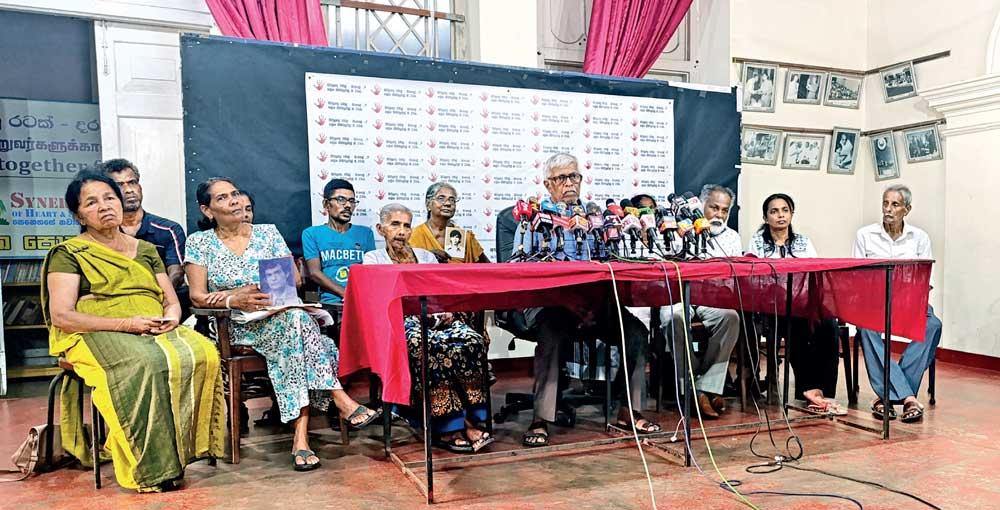
Brito Fernando representing families of the disappeared speaking at the recent media briefing
 We express gratitude to this government for providing the environment to discuss and debate about the contents of this report. The report clearly states the kind of torture and abuse. Therefore this government should now provide a secure environment where these victims could come out and speak about their experiences
- Human rights activist Brito Fernando -
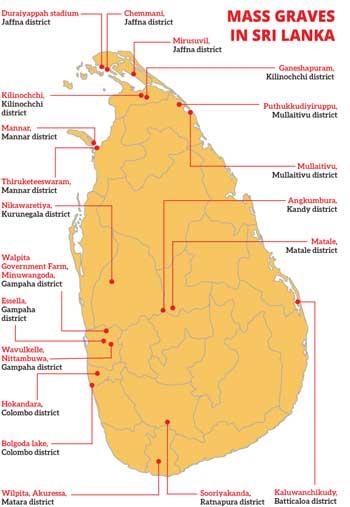 |
| Map of mass Graves across Sri Lanka - Courtesy - CHRD
|
The Report of the Commission of Inquiry into the Establishment and Maintenance of Places of Unlawful Detention and Torture Chambers at the Batalanda Housing Scheme (herein referred to as the Batalanda Commission Report) has gained much traction on media. The report came into the limelight following former President Ranil Wickremesinghe’s interview with Mehdi Hasan on Al Jazeera news channel. Even though many individuals have stated their opinions about the Batalanda torture chamber and the contents of the report on previous occasions, the political environment at the time didn’t support any of these allegations. Following Wickremesinghe’s interview on Al Jazeera and the resurfacing of this Report, the incumbent government announced that it would investigate into the contents of the report. However, in a recent address to the nation, former President Wickremesinghe once again denied allegations levelled against him in connection with the Batalanda torture camp. But in recent times, many witnesses have come forward to share harrowing experiences they encountered at the Batalanda torture chamber while the incumbent government took its first step towards the accountability process by tabling the Report in Parliament. The Parliament debate will be held on April 10.
The infamous report
The Batalanda Commission was established by former President Chandrika Bandaranaike Kumaratunga in 1995 through a Presidential warrant. The Commission, chaired by Justice D, Jayawickrama with N. E Dissanayake as a member, investigated human rights violations in what was believed to be an unofficial Government detention Centre in Batalanda.
The Report states that according to the Warrant dated December 15, 1995, some of the main incidents that the Commission was required to inquire into and report were :
(a) The circumstances relating to the disappearance of Sub-Inspector of Police Rohitha Priyadarshana, on or about the 20th February 1990, and those responsible for the said disappearance,
(b)The circumstances relating to the arrest and detention of Sub-Inspector of Police Ajith Jayasinghe, on or about the 24th February 1990, and those responsible for the said arrest and detention,
(c)The establishment and the maintenance of places of detention at the Batalanda Housing Scheme owned by the State Fertilizer Manufacturing Corporation, during the period of 1st January, 1988 to the 31st of December 1990, and whether persons so detained were subjected to cruel and inhuman treatment (torture)
The 179 page Report provides a detailed account of several individuals and their affiliation to the Police Department, how Douglas Pieris, one of the main suspects of the Batalanda torture camp was promoted to the rank of ASP based on the duties carried out by him during Subversive Insurgency, terminologies used before the Commission such as ‘justifiable homicides’, establishment of the State Fertilizer Manufacturing Corporation, the construction of the housing scheme in 1970s, how the then Minister of Industries Ranil Wickremesinghe instructed the Liquidator the State Fertilizer Manufacturing Corporation to allocate some houses in the Batalanda Housing Scheme to Police Officers, list of houses used as torture chambers and detention centers based on witness testimonies, the fact that the Batalanda Houses were not officially recognised as Police quarters and testimonies of individuals who were unlawfully detained and questioned about subversive activities.
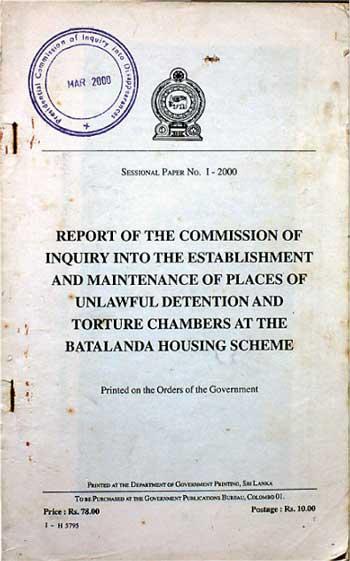 |
| Copy of the Batalanda Commission Report
|
A note of appreciation for the NPP govt.
For decades, families of disappeared persons have been demanding justice for the lives of their loved ones from leaders of successive regimes. However their woes fell on deaf ears. Some mothers who fought for justice have already departed while those who are remaining are feeble, but haven’t given up on their fight for justice. Human rights activist Brito Fernando has been at the forefront, voicing on behalf of thousands of mothers, fathers and relatives of individuals who were subject to enforced disappearances during the height of the JVP insurrections in the South and the ethnic conflict in the North.
Speaking at a recent press briefing, Fernando said that it is a good sign that the Batalanda Commission report has finally become a trending topic after a lapse of 25 years. He thanked former BBC Correspondent Frances Harrison for showing a copy of the report when former President Wickremesinghe attempted to deny the existence of such a Commission during his recent interview with Al Jazeera. “We express gratitude to this government for providing the environment to discuss and debate about the contents of this report. The report clearly states the kind of torture and abuse that the victims had to endure and condemns all forms of torture. According to Wickremesinghe he says that the only allegation levelled against him is the fact that the premises was handed over to these individuals without any prior approval. He justifies this claim by stating that there were many government offices in the vicinity and that he decided to hand over this premises after considering the security of the neighbourhood. But he was fully aware of what is going to happen at the premises when he handed it over to the police and other individuals. So he has no escape. The report states that the Supreme Court should be vested with an additional power to take off civic rights of the politician (without naming Ranil Wickremesinghe) and senior police officers who served at the time. But Chandrika Kumaratunga didn’t oblige to these recommendations. Therefore this government should now provide a secure environment where these victims could come out and speak about their experiences,” Fernando underscored.
Strengthening OMP
Fernando also referred to Foreign Affairs Minister Vijitha Herath’s speech in Geneva where he said that the new government is looking at strengthening local mechanisms to serve justice to victims of enforced disappearances. “He said that the NPP government doesn’t require international investigations. The Office on Missing Persons (OMP) is vested with the task of investigating on disappeared persons. If the government is looking at strengthening local mechanisms the first step should be to fill 257 vacancies at the OMP. Currently it runs on a cadre of 27 staffers. We therefore request the government to strengthen the OMP. The OMP has submitted a cabinet paper to conduct investigations, but for five months it has been laying idle and cabinet approval is pending,” Fernando added.
Justice for missing persons in Matale
Fernando also recalled the mass grave that was discovered at the Matale Hospital. “There were 155 skeletons. We believe that these incidents occurred during 1988-1990. This area came under the purview of Gotabaya Rajapaksa as the military coordinating officer of the Matale District during the second JVP insurrection between 1987 and 1990. The Presidential Commission report indicates that 1041 persons went missing in this area and 700 individuals went missing during his tenure. So we believe that Gotabaya Rajapaksa is responsible for the disappearances that happened in Matale,” he said.
He further said that preliminary investigations revealed that the incidents had taken place during 1988-1999, but added that when samples were sent to USA for further investigations, they concluded that the samples were from a period before 1980s. “How could that be? The samples were sent abroad when Gotabaya Rajapaksa became Defence Secretary. The judge was transferred without any justifications when court hearings regarding the Matale mass grave were underway. When a case is being heard in a Magistrate’s court it’s the Magistrate who issues a verdict as to whether it is a murder or some other crime. Depending on that it would then be referred to the Attorney General’s Department and the case would be continued. This is the usual procedure. But in this case the Attorney General didn’t fully engage in the proceedings,” Fernando claimed.
He further recalled how Mahinda Rajapaksa appointed a commission to escape from any charges of this incident. “This Commission named 23 suspects in connection to the crime and handed over a sealed letter to the then government. But this letter was never released to the public. Throughout the history of this country, documents with names of criminals have never been made public. The Presidential Commission during 1988-1989 recorded 600-900 names of various individuals who were made suspects of various crimes. This sealed document was handed over to Chandrika Kumaratunga after 1994. But this document was never made public and according to the agreement, this document will be released to the public in 2030 after these suspects and victims of enforced disappearances have died,” he added.
Govt. urged to release names of suspects
During the press briefing, Fernando claimed how the cause of death in most death certificates issued on individuals who went missing during this highly volatile period in history were invalid and vague, further highlighting grave injustices faced by victims. Fernando and loved ones of individuals, subject to enforced disappearances, therefore demand the incumbent government to either release the aforementioned document with the names of suspects to the public or hand it over to the Police or Attorney General’s department if at all it was handed over to Mrs. Kumaratunga. “We have some hopes regarding this government, but they should walk the talk. The ongoing Sri Lanka Accountability Project investigates suspects related to various crimes residing overseas. According to this project, the respective countries could file action against these suspects and some of these suspects have been banned entry to other countries. It’s good that the Batalanda Commission Report was released to the public, but we hope it won’t be another political drama. Excavations of certain mass graves are ongoing, but so far none of these skeletons were handed over to respective families after conducting DNA analyses. No legal action has been taken against any of the suspects related to these mass graves as well. This government has a responsibility to serve justice to crimes that had happened back in the day,” he said in conclusion.
11 Jun 2026 1 minute ago
11 Jun 2026 4 minute ago
11 Jun 2026 6 minute ago
11 Jun 2026 9 minute ago
11 Jun 2026 14 minute ago