19 Jul 2025 - {{hitsCtrl.values.hits}}
 For those of us educated in Sri Lanka, where little or no contemporary history is taught, ITAK proposed an inclusive, democratic, and, for its time, progressive alternative for the Tamil-speaking peoples of Lanka within a united federal Sri Lanka
Backroom negotiations were ongoing when a relatively unknown figure, “Para,” entered the scene. A political opportunist with a history of party-hopping, Para filed an action against the election, using a petition drafted by one of the highest-paid lawyers in Colombo
The respected veteran journalist has presented his view—albeit from faraway Toronto—though his source is most likely a close relative and a party to what may be referred to as the conflict within the ITAK (Ilankai Thamil Arasu Katchi), also known as the Federal Party. Founders, S.J.V. Chelvanayakam, Dr. E.M.V. Naganathan, and C. Vanniyasingam, among others, broke away from the Tamil Congress to form the Federal Party in opposition to arguably one of the worst crimes committed by the Lankan state: the disenfranchisement of the Malayaha Tamil people, especially plantation workers—rendering them stateless for over half a century. Then an unpopular cause to support.
For those of us educated in Sri Lanka, where little or no contemporary history is taught, ITAK proposed an inclusive, democratic, and, for its time, progressive alternative for the Tamil-speaking peoples of Lanka within a united federal Sri Lanka.
The Election
So, when two senior leaders of the party broke with tradition and, despite much persuasion from the late Mr. Sampanthan and Mr. Mavai Senathirajah, chose to contest for party leadership, I was not unduly worried. The contest was between:
The ‘Hare’ or the ‘Toiya’: trilingual, well-qualified, educated, sophisticated, and, it must be said, admired by professionals, diplomats, and liberals in the South.
The ‘Tortoise’ or the ‘Bhaiya’: a schoolteacher and son of a colonist agriculturist from Kilinochchi—a people’s politician, emotionally connected to and representative of the Tamil people’s attachment to the militancy through which he grew up.
While both sides tried to influence the electorate and the Electoral College, the tortoise, through two months of intense campaigning and alliance-building, pulled off a surprising victory.
Neither side, including the losing candidate Sumanthiran PC, raised objections before, during, or immediately after the election. A week later, when the General Assembly reconvened to elect new office bearers and a Central Committee, Round 2 of the power struggle began.
Shritharan, seeking to retain Sumanthiran within the fold, agreed to an arrangement where the old Central Committee proposed members for the new committee. Although some opposed this, Sumanthiran and a section forced a vote. The undemocratic proposal passed dividing the Assembly even further. Chaos ensued, leading outgoing President Mavai Senathirajah—maligned as “weak” for seeking consensus—to postpone the convention until the conflict could be resolved amicably.
The Case
Backroom negotiations were ongoing when a relatively unknown figure, “Para,” entered the scene. A political opportunist with a history of party-hopping, Para filed an action against the election, using a petition drafted by one of the highest-paid lawyers in Colombo. It was supported in the Trincomalee District Court by none other than Geoffrey Alagaratnam PC, another top Colombo lawyer.
Interestingly, both Shritharan and Sumanthiran were listed as defendants. It is hard to believe that Para had the wherewithal to retain such legal heavyweights, raising allegations that a defeated candidate with substantial resources was behind the litigation. As a result, the newly elected office bearers, including President-elect Shritharan, were barred by an interim injunction from assuming their positions.
Elections 2024
The Central Committee’s decision—reportedly proposed by Sumanthiran—to support Sajith Premadasa was opposed by many within the rank and file. While in the past Sampanthan’s decisions were usually accepted due to his credibility and authority, the same could not be said for Sumanthiran.
Importantly, the Central Committee, whose legitimacy is now contested due to the ongoing court case, made this decision without consulting other rank and file or attempting reaching consensus—exacerbating the conflict. Several members followed their conscience privately. The situation escalated during the parliamentary elections, where ITAK performed extremely poorly, especially in the North. Analysts say this reflects the Tamil polity’s frustration with the litigation and infighting. Shritharan, seen as the legitimate leader, was the only candidate to secure a sizable vote.
Mavai’s Funeral
The events that followed were disturbing. Former President Mavai Senathirajah—frail and unwell—was blamed for the electoral debacle and humiliated by a group rumoured to be encouraged by a defeated candidate. He was forced to step down via a signature campaign shortly after a stroke, before collapsing again into a coma, from which he never recovered.
M. Senathirajah, respectfully remembered in Parliament recently, was a veteran of over 60 years in Tamil politics—from the ITAK’s non-violent Satyagraha era. At his funeral, a group dressed in black opposed the participation of those they claimed were responsible for his death through humiliation and disrespect. Though efforts were made by Mavai’s son Kalai Amuthan, Shritharan, and local branch leaders—including Chelvanayakam’s grandson Elankovan—to calm tensions, emotions ran high. Some speakers ranted, and a banner naming 18 Central Committee signatories as “murderers” was displayed. Local sources assert that D.B.S. Jeyaraj’s views alleging Shritharan’s role are based on hearsay reports from political opportunists who are fuelling the conflict for personal gain.
Recent LG Elections
It is true that ITAK saw a resurgence in the recent local government elections, winning chairs and mayors in many places—often with minority support, having the largest number of seats but not a clear majority in the north except in two Kilinochchi LG bodies. Shritharan campaigned tirelessly across the North, and even Sumanthiran’s own supporters often preferred to invite Shritharan to events. He remains the people’s choice.
Hidden from outside observers, the election process was marred by allegations that attempts were made to punish dissenters through inducements, threats, and factionalism. It fell to party elders like C.V.K. Sivagnanam and X. Kulanayagam—despite personal tragedies—to keep the peace.
Towards a Kleptocracy
It is alleged that many decisions—from LG nominations to selecting chairs and forming alliances—were made unilaterally by a clique loyal to Mr. Sumanthiran. These decisions were taken without consulting branches, senior leaders, or even MPs. Worse still, the Central Committee, which he has not convened since March, has neither discussed let alone endorsed these moves.
Appointments were made based on personal loyalty rather than merit. It is reliably reported that one such appointee, already accused of murder and corruption, has also been involved in forgery and election malpractice—damaging the party’s credibility. Those who opposed these decisions on principle have been suspended.
Chemmani Protest
One controversial decision involved engaging other Tamil nationalist parties without senior leadership involvement, ending in failure. In desperation, Acting Leader C.V.K. Sivagnanam met with EPDP leader Douglas Devananda—whose party is allegedly linked to wartime atrocities, including Chemmani. Public reaction to photos of the meeting in front of the notorious ‘Shridhar Theatre’ was one of dismay, as it was seen as political opportunism.
Amid this backdrop, an associate of Shritharan verbally abused Sivagnanam at the Chemmani protest. Shritharan has since taken moral responsibility and apologised.
Who Benefits?
One year and three months since the case was filed, the elected president Shritharan and office bearers including K.S. Kuhathasan (now MP from Trincomalee), remain blocked from assuming office. Meanwhile, the losing candidate has skillfully maneuvered himself into control as General Secretary, using patronage and influence in the shadow of the case that drags on.
While it may be difficult to prove who initiated the legal case, the law also considers: who benefits? Clearly, while the popular “Bhaiya” is sidelined, the technocratic “Toiya” has usurped the leadership—making a mockery of intra-party democracy and ITAK’s long-standing consultative traditions. In this light one can only leave it to the readers and the public to discern who is causing the damage.
By Karai Krishnapillai
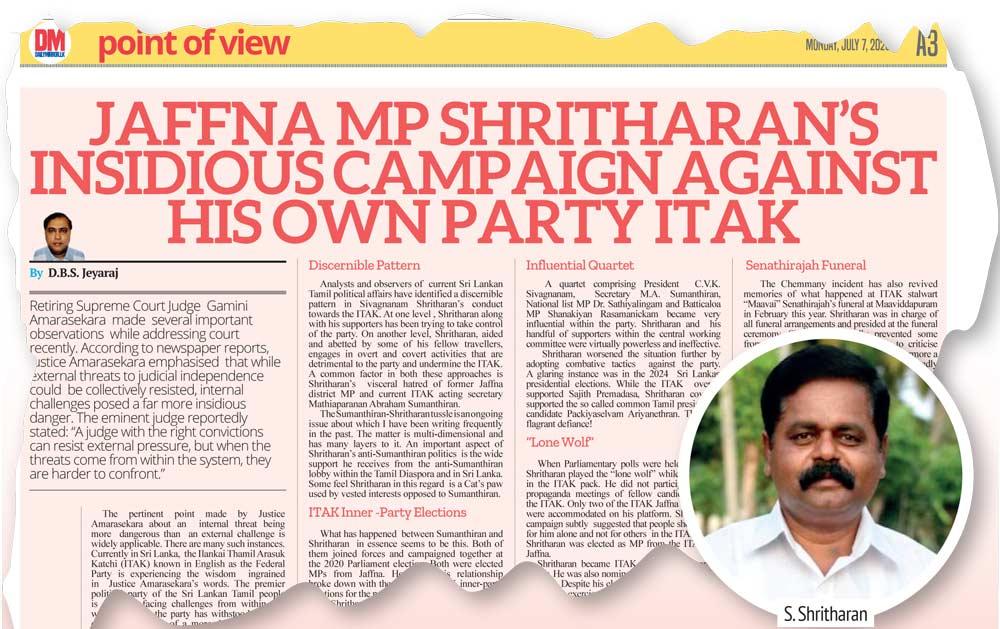
This is a response to DBS Jeyaraj’s column on the 7th July in the Daily Mirror
11 Jun 2026 5 hours ago
11 Jun 2026 5 hours ago
11 Jun 2026 5 hours ago
11 Jun 2026 6 hours ago
11 Jun 2026 6 hours ago