06 Dec 2025 - {{hitsCtrl.values.hits}}
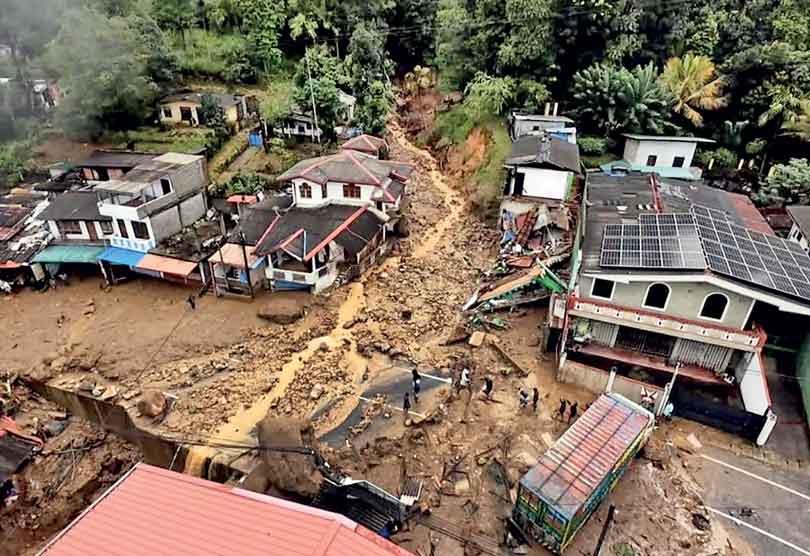
Early warnings systems and agency-village cooperation are essential in dealing with such disasters
- Annual floods and landslides are intensifying. Urban drainage failures multiply losses, especially in Western, Sabaragamuwa and Central Provinces. Deforestation, riverbank erosion, and wetland encroachment worsen impacts.
- Indonesia faces earthquakes, tsunamis, volcanic eruptions, and monsoon floods. Their resilience rests on strong civil–military collaboration.
- Community leaders, clergy, teachers, and youth groups relay alerts instantly, and there is an Evacuation Culture
- The Philippines faces the world’s strongest typhoons yet gets the gold standard for community-level preparedness and saves thousands of lives through localised Early-Warning Networks.
 Sri Lanka is no longer facing isolated natural events. Each crisis now arrives as a multi-dimensional security threat—climate shocks, economic stress, misinformation, cyber disruptions, and social tensions converging at once. This is the new reality across Asia, and Sri Lanka must adapt quickly, drawing from the lived lessons of the Philippines, Indonesia, and regional disaster leaders.
Sri Lanka’s Present Risk Landscape:
Escalating Climate Disasters
Annual floods and landslides are intensifying. Urban drainage failures multiply losses, especially in Western, Sabaragamuwa and Central Provinces. Deforestation, riverbank erosion, and wetland encroachment worsen impacts.
Human Security Under Stress
Rising living costs and fragile livelihoods magnify disaster suffering. Communities lose confidence when warnings are late, inconsistent, or unclear, and Post-disaster health risks (dengue, contaminated water) strain hospitals.
Cyber & Information Risks
Critical systems face cyber vulnerabilities while disinformation during disasters disrupts emergency actions and relief flow.
Lessons Sri Lanka Must Absorb From Regional Experiences
The Philippines faces the world’s strongest typhoons yet gets the gold standard for community-level preparedness and saves thousands of lives through localised Early-Warning Networks.
Community leaders, clergy, teachers, and youth groups relay alerts instantly, and there is an Evacuation Culture.
When the warning level rises, evacuation is non-negotiable, and
national, provincial, district and village roles are pre-defined within a clear, Layered Command System
Sri Lanka’s Takeaway:
Warnings must not stop at the Meteorological Department. They must reach every household, coastal family, hill-country village, and urban flat — in language they understand, through channels they trust.
Indonesia – Treating Disasters as National Security
Indonesia faces earthquakes, tsunamis, volcanic eruptions, and monsoon floods. Their resilience rests on strong civil–military collaboration.
The armed forces support evacuation, logistics, air transport, and rapid medical aid.
Environmental regulation is treated as security policy.
Poor land-use is treated as a direct threat, not a development issue.
Indonesia undertakes regional hazard monitoring by investing heavily in sensors, seismographs, and satellite data.
Sri Lanka’s Takeaway:
Environmental mismanagement—illegal logging, river encroachment, unstable slopes—is a national security threat, not a local administrative problem.
Asia as a Whole – The Era of Converging Crises
Across Asia, disasters trigger secondary threats such as food shortages, Internal displacement, cross-border disease, cyber attacks, social unrest and misinformation.
Sri Lanka must recognise non-traditional threats as core security issues—equal in importance to territorial defence.
What Decision Makers in Sri Lanka Should Prioritise Now Building an End-to-End Early Warning System is top priority.
Early warning must become impact-based, not merely weather-based. Essential components of such a system would be real time rainfall, river and landslide sensors, automated thresholds triggering local alerts, SMS, loudspeaker, TV/radio, mosque/temple/church networks plus pre-signalled evacuation routes and shelters.
Activate Local Preparedness
We should be inspired by how the Philippines handles disaster situations by conducting community drills in schools, religious institutions, and factories. They have established village-level emergency response units and maintain mandatory annual disaster rehearsals in high-risk districts. We should strengthen the National Command Architecture by clarifying provincial vs. district vs. agency roles. A single National Emergency Coordination Centre should issue unified instructions and integrate military, police, health, and disaster officials into joint operations. Social Cohesion should be maintained before and after disasters by
monitoring tensions and misinformation in affected communities. Clergy, teachers, local influencers, and youth groups should be engaged in stabilising narratives. Relief distribution should be transparent to avoid resentment.
Invest in Environmental Security This can be achieved by accelerateing reforestation and slope stabilisation. Wetlands should be used as natural flood buffers laws enforced against illegal land clearing and construction in hazard zones.
Prepare for Secondary Crises
We can do this by stocking essential medicines for dengue and waterborne diseases, by Strengthening cyber incident monitoring and protecting energy and food supply chains during prolonged disasters.
A Strategic Shift Sri Lanka Must Embrace
Disasters are no longer interruptions—they are the operating environment.
The countries that survive and thrive in Asia are those that warn early, respond fast, coordinate clearly, protect the vulnerable and treat environmental protection as national security. Sri Lanka now stands at that strategic crossroads.
Mahil Dole, SSP (Retired), is the former Head of the Counter-Terrorism Division of the State Intelligence Service of Sri Lanka, and has served as Head of the Sri Lankan Delegation at three BIMSTEC Security Conferences. With over 40 years of experience in policing and intelligence, he writes on regional security, interfaith relations, and geopolitical strategy.
07 Jun 2026 16 minute ago
07 Jun 2026 1 hours ago
07 Jun 2026 2 hours ago
07 Jun 2026 2 hours ago
07 Jun 2026 2 hours ago