25 Nov 2025 - {{hitsCtrl.values.hits}}
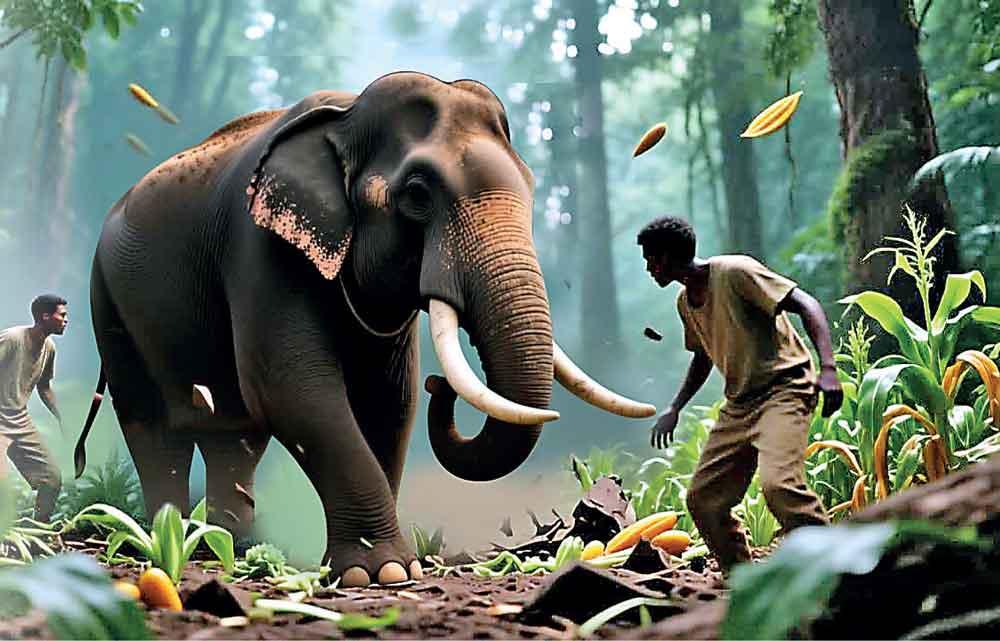
 The National People’s Power Government is moving away from science and repeatedly launching elephant-removal projects designed mainly to please investors. In the “A Thriving Nation, A Beautiful Life” policy framework and the “’Mihikatha’ environmental policy” presented during the last Presidential and Parliamentary Elections, it was stated that a proper study of elephant populations, migration patterns and habitats would be conducted to control the elephant–human conflict, and that public participation programmes would be implemented using biological and new technology. Although the government, that won public support on the strength of these policy statements, promised to resolve the elephant–human conflict through a scientific approach, it has since turned to unscientific measures to satisfy investors’ interests. This is a terrible tragedy because this misguided strategy will create a massive human–elephant conflict in the future, affecting both elephants, tuskers and people.
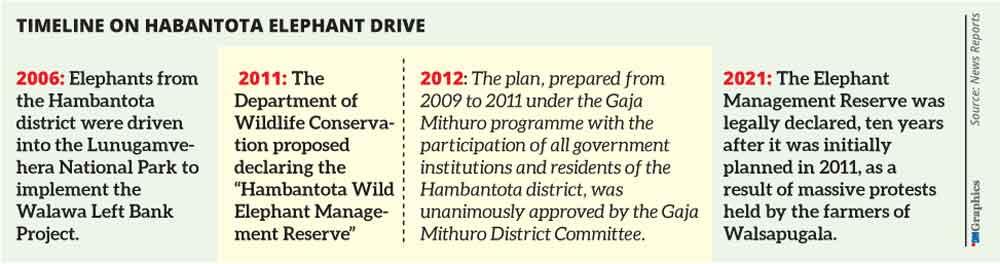
After the current government took office, the already failed elephant drive that began in the Kurunegala district was extended to the Anuradhapura and Hambantota districts. In Hambantota, the main motivation behind the elephant drive is the expansion of the Magampura Port. Among other ventures are the commencement of a Chinese industrial park within the 8000 acres allocated for the the project and the clearing of the Walsapugala forest for solar power projects. For decades, authorities have tried to confine elephants to restricted zones, yet every attempt has failed, resulting in enormous losses of public money. In 2006, elephants from the Hambantota district were driven into the Lunugamvehera National Park to implement the Walawa Left Bank Project. The operation collapsed within days and ultimately triggered the severe human–elephant conflict still seen in the area at present.
The failure occurred for several reasons. It stemmed from multiple factors, including the lack of connectivity between the elephant habitats belonging to the Forest Conservation Department and the Mahaweli Authority around the Lunugamvehera National Park, the use of elephant corridors in the Watahirakanda Nature Reserve, Dahaiyagala Sanctuary and Bogahapattiya area for unauthorised cultivation, the loss of elephant feeding grounds due to more than fifty thousand cattle being illegally driven into the park, the spread of invasive species such as lantana and guinea grass across much of the park severely encroaching on the feeding grounds of elephants and tuskers, the presence of unauthorised cultivation lands and large-scale illegal cannabis cultivation within the park, and the harmful activities carried out by those involved in fishing in the Lunugamvehera reservoir. All of these factors have caused elephants and tuskers to be deprived of protection within the national parks.
Despite this prior understanding, once again attempting to move the elephants scattered across the Hambantota district to the Hambantota Elephant Management Reserve will lead to the same outcome as in 2006. Although 23,746.55 hectares of land belonging to the Department of Forest Conservation, the Mahaweli Authority and the Land Reforms Commission—spanning the Hambantota, Sooriyawewa, Lunugamvehera and Thanamalwila Divisional Secretariat Divisions of the Hambantota and Monaragala districts—were declared the Hambantota Wild Elephant Management Reserve through Gazette No. 2222/62 dated 9 April 2021 as per Section 2 of the Fauna and Flora Protection Ordinance through, elephants have lost their shelter due to numerous harmful activities taking place in and around the reserve.
Dark history
In 2011, the Department of Wildlife Conservation (DWC) proposed declaring the “Hambantota Wild Elephant Management Reserve” with the aim of identifying elephant migratory patterns and controlling the human–elephant conflict in Hambantota by connecting the Udawalawe, Lunugamvehera and Bundala National Parks to ensure the safety of elephants who lost their habitat due to the clearing of about 35,000 acres of forest to build the Hambantota municipal council area under the Walawa Left Bank Irrigation Project and the National Physical Plan.
This plan, prepared from 2009 to 2011 under the Gaja Mithuro programme with the participation of all government institutions and residents of the Hambantota district, was unanimously approved by the Gaja Mithuro District Committee in 2012. According to that plan, measures including the declaration of the Hambantota Wild Elephant Management Reserve, the construction of electric fences and the opening of elephant corridors were to be taken. Nearly fifteen years have passed since the reports prepared by divisional officers of the Department of Wildlife Conservation were submitted to the head office to implement these plans. However, none of them have been implemented to date. The Elephant Management Reserve was legally declared in 2021, ten years after it was initially planned in 2011, as a result of massive protests held by the farmers of Walsapugala. At that time, the Mahaweli Authority and the then government made a major effort to prevent the declaration of this reserve because they were attempting to lease the land to various companies and businessmen.
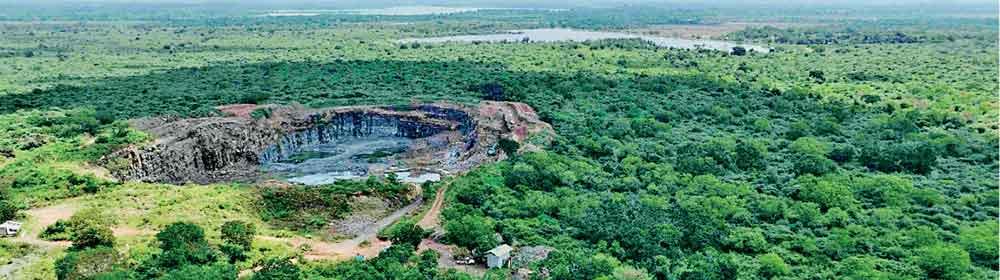
Destruction of the habitats of elephants removed from the Hambantota Elephant Management Reserve
Moreover, because the Mahaweli Authority did not allow the proper implementation of the 2011 plan, the Hambantota Elephant Management Reserve could not be officially declared and the protection of the entire habitat of elephants and tuskers could not be ensured. As a result, forest lands were allocated for the construction of solar power plants, large-scale black stone and soil mining, and large-scale commercial cultivation. Consequently, the habitats of elephants within and around the Hambantota Elephant Management Reserve were severely destroyed.
Land-selling racket
About 600 acres of forest land that were originally proposed to be declared as part of the elephant management reserve in the Buruthankanda and Karuwalawewa areas, but were not allowed to be declared a reserve by the Mahaweli Authority, have been completely cleared to establish solar power plant projects.
The large-scale sale of forest lands belonging to the Hambantota Elephant Management Reserve was organised under the political patronage of the then government from 2011, when plans were first made to declare this reserve. The forest lands belonging to this reserve, which were declared as part of the Walawa Mahaweli Zone by referring to them as Nindagama lands, were sold in pieces accordingly. About 500 acres of forest extending from Panwewa to Gonnoruwa, known as Gonnoruwa Nindagama, were divided into plots of 25 and 50 acres and sold to Colombo-based businessmen. The forest area of Galahitiyawatta Nindagama, located from Ketanwewa to Malala Ara, was also a part of this land-lotting racket.
When the Hambantota Elephant Management Reserve was officially declared in 2021, about 1,000 acres of forest land—from Andara Wewa to Walsapugala, which was removed from the original plan —have since been continuously cleared and allocated to various companies for the construction of solar power plants. This entire forest area is a major habitat for elephants, but the fact that these lands are currently being lost has been a major factor in the increasing human–elephant conflict.
Loss of elephant corridors
As a result of the Mahaweli Authority distributing all the lands of the elephant corridor in Buruthankanda, through which elephants travel from the Elephant Management Reserve to the Madunagala Sanctuary, between 18 and 20 elephants are now trapped in the Madunagala Sanctuary. Because of this, these animals frequently enter the surrounding villages and damage crops.
In addition, about 20 elephants are confined to the remaining 2,500 acres of forest from the 5,000 acres cleared to build the Magampura Port. As these animals enter the villages at night, nearby residents are constantly facing difficulties. The main reason for this is the breakdown of connectivity between the Elephant Management Reserve and this part of the forest.
The route to the Bundala National Park for elephants living in the Gonnoruwa area of the Elephant Management Reserve is now completely blocked. This connection previously existed through the forests in the Galwewa area, but large-scale deforestation there has entirely obstructed this elephant access route. In addition, the elephant corridor in Koholankala, which elephants used to travel from Bundala to the Elephant Management Reserve, has been occupied by a large-scale chilli cultivation project, and the area has been completely blocked with electric fences. As a result of all this, many areas around the Hambantota district have become high-risk zones for elephant–human conflict.
Furthermore, the elephant corridor in Handilla, a major elephant corridor belonging to the Hambantota Elephant Management Reserve, has also been blocked. Elephants living in the forests of Bundala National Park and the Hambantota area used to move through this corridor to the Lunugamvehera and Udawalawe National Parks. A housing complex has been built, blocking this elephant corridor located between Gonnoruwa and Ketanwewa. In addition, another 50 acres of land in Handilla have been allocated by preparing a fake deed claiming it to be Nindagama land, and electric fences have been constructed.
The Elephant Management Reserve and the Udawalawe National Park are connected through the area between the 31st and 32nd kilometre posts of the Udawalawe–Thanamalwila road. Due to the long-standing opposition of local politicians to opening this elephant corridor, no plans have been prepared or implemented so far. As a result, it has not been possible to connect the Hambantota and surrounding elephant habitats as originally planned.
Illegal cultivation and quarrying
Forest lands belonging to the Mahaweli Authority within the Elephant Management Reserve are being cleared on a large scale, and unauthorised cultivation is being carried out. These activities are taking place in the Hamuduru Wewa, Ihala Andara Wewa, Seenukkugala, Pahala Andara Wewa, Dimuthugama and Weli Wewa areas. In addition, forests belonging to the Forest Conservation Department within the Elephant Management Reserve are also being cleared, and unauthorized cultivation is being carried out on a large scale in several locations. These include the areas of Rathukurusa Wewa, Dakshina Wewa, Aluth Wewa, Kadawara Wewa, Bandagiriya Wewa, Maha Aluthgangara Wewa, Ranawarunawa Wewa and Devranvehera Wewa. Large-scale soil cutting is being carried out in the Mayurapura and Nagara Wewa areas, and during the construction of expressways, forests were cleared and soil was extracted from multiple locations.
Large-scale quarrying is also being carried out by clearing forest lands belonging to the Department of Forest Conservation and the Mahaweli Authority within the Elephant Management Reserve. Forests belonging to the Department of Forest Conservation in the Weheragala and Maha Aluthgangara areas have been used for this purpose. In addition, forests belonging to the Mahaweli Authority in the Mayurapura, Seenukkugala, Ketanwewa, Ihala Andarawewa, Kuda Indiwewa, Galahitiya and Gonnoruwa areas have been cleared, and large-scale quarrying operations are ongoing.
Currently, about 2,000 acres of land in the catchment area of Hamuduru Wewa, situated between Maha Andara Wewa and Pahala Andara Wewa of the Elephant Management Reserve under the Suriyawewa Divisional Secretariat, have been cleared and are being extensively cultivated with bananas. Eight people are maintaining these cultivation lands. Due to the obstruction of elephant habitats caused by these unauthorised cultivation areas, which are protected by electric fences, the damage caused by elephants to farmers’ cultivation lands in the Maha Andara Wewa, Walsapugala, Karuwala Wewa, Thissapura and Ranamayurapura areas has increased. The movement of elephants to Weera Wewa, Galahitiya Wewa, Elalla Wewa and Pusgale Wewa has also been completely blocked due to electric fences and cultivated lands. Furthermore, due to the large-scale withdrawal of water from the Andara Wewa using 81 water pumps and its unauthorized use in cultivation areas, farmers cultivating using water from this tank are now facing an acute water shortage.
In the past, the Mahaweli Authority developed about 6,000 acres of forests belonging to the Elephant Management Reserve, spread across the areas of Kaliyapura, Gonnoruwa, Ketanwewa, Pahala Andarawewa and Kudaidiwewa, and allocated them as commercial lands. As a result, a large part of the Elephant Management Reserve has been lost to elephants, causing numerous problems.
Forests belonging to the Mahaweli Authority
About 40 percent of the elephant management reserve, which is being misused in this way, consists of forest lands belonging to the Mahaweli Authority. In accordance with Section 3 (1) of the Sri Lanka Mahaweli Authority Act No. 23 of 1979, a large area of land was transferred to the Mahaweli Authority under the Walawa jurisdiction by Gazette No. 137 of 16 April 1981. This transfer wasn’t made for the purpose of clearing and developing the entire forest area.
As a result of deforestation during the implementation of the Mahaweli Rapid Development Project, many protected areas, including national parks, were declared to ensure the safety of all wildlife, including elephants and tuskers, that lost their habitats, as well as to protect the watersheds and water catchment areas. However, to ensure the safety of the biological community and watersheds, including elephants that lost their habitat during the implementation of the Walawa project, only a very small portion of the forests belonging to the Mahaweli Authority has been made a reserve. Most of these lands have been allocated for development purposes. This situation has caused the elephant–human conflict in this area to become acute.
Six forest areas belonging to the Mahaweli Authority within the Elephant Management Reserve are currently unprotected. The main one is the Karambagasmulla Oushada Forest, which covers about 300 hectares in the vicinity of the Madunagala Sanctuary. In addition, the Konketi Ara Forest, spread around Wewe Gama, Weli Ara, Bedi Wewa, Bogaha Indi Wewa and Kuda Indi Wewa, covers about 700 hectares. This dense forest is home to a large number of elephants and serves as the catchment area for many canals associated with the Mawu Ara project.
About 120 hectares of forest located in the catchment areas of Maha Indiwewa and Upper Kumbuk Wewa are under the control of the Mahaweli Authority. Among them, about 20 hectares of the Suriyamara forest plantation located in the catchment area of Maha Indiwewa has become very well naturalised today. The forest area of about 400 hectares located between Gonnoruwa Road and Malala Ara, and the Elalla forest area of about 200 hectares located near the villages of Pahala Andara Wewa, Hembilla and Ketan Wewa, are also under the control of the Mahaweli Authority. All these forest areas must be immediately transferred to the Department of Wildlife Conservation and protected. Otherwise, all these forests will be completely destroyed by the Mahaweli Authority in a very short time.
Forests of the Forest Conservation Department
Several other forest areas belonging to the Forest Conservation Department, which are not under the Mahaweli Authority, form part of the Elephant Management Reserve. The Thammanna–Bandagiriya Residual Forest of about 600 hectares, the Bundala–Siriyagama Residual Forest of about 500 hectares, the Ranmudu Wewa Forest Reserve of about 2000 hectares and the Keligama–Koholankala Residual Forest of about 600 hectares are the main ones. These forests are also under severe threat at present.
During the previous 2010–2015 government, 1000 acres of forest in the Keligama–Koholankala Residual Forest were acquired to be transferred to the Urban Development Authority. This forest area is a very important region considered to be the Koholankala elephant corridor. The destruction and development of forests in this area have led to the loss of traditional elephant corridors, creating many problems.
The Thammannawa–Bandagiriya remnant forest, located above the Malala Ara, is a major elephant corridor between the Lunugamvehera National Park and the Bundala National Park. Various individuals are attempting to release forest lands by claiming that there are lands belonging to the Land Reforms Commission in this area. Efforts are currently being made to acquire 50 acres of land in this forest area for cashew cultivation, and the Land Reforms Commission is also taking steps to release those lands. In addition, alternative lands have already been provided to people displaced during the construction of the Bandagiriya Reservoir, but an organized group in the area is attempting to release forests belonging to the Land Reforms Commission by using land deeds for areas submerged by the reservoir.
Unplanned development in Hambantota
Due to this deforestation, elephant killings caused by shooting or electrocution have increased in the Hambantota Wild Elephant Management Reserve and surrounding areas including Ketanwewa, Kuda Indiwewa, Nagarawewa, Panwewa, Walsapugala, Thalawilla, Ilukpalessa, Seenukkugala and Matigathwewa.
The elephant deaths and human deaths from elephant attacks in this area directly result from the unplanned development activities carried out in Hambantota without proper strategic planning. Five thousand acres of the extensive forest system in Mattala, which served as a major elephant habitat, were completely used for constructing Sri Lanka’s second international airport. Afterwards, large areas of forest were cleared to upgrade road systems and related infrastructure, to build the Magampura Port, the Hambantota International Conference Hall, the Mirijjawila Investment Zone, the Hambantota Administrative Complex, the expressway network and the cricket stadium. With these developments, elephants that lost their habitats began entering Pahala Andaragaswewa, Dimuthugama, Elalla, Pahala Mattala, Uda Mattala, Punchiappu Jadura, Badagiriya and the hamlet 5 and 6 developed under the Lunugamvehera project, creating severe human-elephant conflict. The resulting damage to cultivated lands and property has been significant, and some farmers have even been forced to abandon their agricultural activities.
This deforestation has caused human-elephant conflict to spread to many areas where such incidents had never occurred before. It has also been a major contributor to the severe droughts experienced in recent years and the serious water shortages that followed.
At present, a large number of elephants are isolated within the Hambantota Port complex, the Mirijjawila Investment Zone, the forest area behind the Hambantota Administrative Complex, the Nugegalayaya area near the playground, the Edison Kanda area and the fragmented forest blocks left behind by these development projects namely Manajjawa Forest, the Madunagala Forest, the Nagarawewa area, Ihala Kumbukwewa and the Kumaragama Forest areas. All these animals have been stranded as a result of Hambantota’s irregular development.
The expressway from Matara to Hambantota was built by cutting through the Elephant Management Reserve, while the expressway from Matara to the Mattala Airport via Ihala Andara Wewa and the expressway entrance from the Magampura Port to Ihala Andara Wewa have severely fragmented the reserve’s forest systems. To construct the expressway, a forest belt approximately 150 metres wide and nearly 8 kilometers long has already been completely removed. Because of this expressway, the Seenukkugala, Walsapugala and Karuwalawewa forest areas of the Elephant Management Reserve have become fully isolated along with the elephants. The lack of attention by planners has caused people living nearby to suffer increasingly from human-elephant conflict.
Because of the haphazard development projects pushed through for political gain in the Hambantota District, elephant habitats have been fragmented, leading to critical levels of human-elephant conflict in Walsapugala, Karuwalawewa, Madunagala, Hadilla, Karambagahamulla, Nabadagaswewa, Katu Wewa, Pathalayagama, Arabedda, Keligama, Galwewa, Hondwel Pokuna, Ballagas Wewa, Baragama, Ambalantota, Manajjawa, Wewegama, Weli Ara, Weli Wewa, Meegahajadura, Mattala, Udamattala, Gonnoruwa, Bandagiriya, Thammennawa, Kerusa Wewa, Julgamuwa, Yahangala, Andarawewa, Panwewa, Seenukkugala, Nagarawewa, Kuda Indiwewa, Ketanwewa and Unudiya Pokuna.
Protecting wild elephant reserve, elephants and farmland
There are about 25 tanks located within the forest areas managed by the Forest Department inside the Elephant Management Reserve. These include Matigath Wewa, Swarnamali Wewa, Lolugaswekada Wewa, Keligama Wewa, Parengi Wewa, Weerasinghe Wewa, Dosarwatta Wewa, Thammenna Wewa, Bandagiriya Wewa, Kadawara Wewa, Udamattala Wewa, Orukengala Wewa, Pan Wewa, Katu Wewa, Lunuweraniya Wewa, Ranmudu Wewa, Maha Aluthgangara Wewa, Maha Wewa, Maha Gal Wewa, Kuda Wewa, Galapita Wewa, Rathu Kurusa Wewa, Dakshina Wewa, Serunkeliya Wewa and Aluth Wewa. Bandagiriya Wewa is the largest among them. There are also about 17 tanks located in the forest areas belonging to the Mahaweli Authority within the Elephant Management Reserve. These are Kikili Idda Wewa, Gal Wewa, Divulpelessa Wewa, Ilukpelessa Wewa, Ketan Wewa, Galahitiya Wewa, Thekka Wewa, Hamuduru Wewa, Andara Wewa, Usgala Wewa, Wewegam Wewa, Kuda Indi Wewa, Elalla Wewa, Hadilla Wewa, Pahala Andara Wewa, Karametiya Wewa and Muttagalara Wewa. The water security and agricultural security of all these tanks, as well as the safety of the biological community including elephants, depend entirely on the existence of the forest system of this reserve.
Therefore, the Elephant Management Reserve isn’t only a home for elephants. It contains a range of unique ecosystems. Dry mixed evergreen forests, thorn forests and wetland systems including tanks are all found within it. An elephant population of about 450 lives in these ecosystems, along with a rich biological community. This area supports a large population of wetland resident birds and also serves as a major feeding ground for migratory wetland birds. In addition, there are many archaeologically valuable sites scattered throughout the reserve. However, all of these are being lost due to the lack of proper protection.
Incorporate surrounding forests into the reserve
The first step in bringing the elephants living in Hambantota into this Elephant Management Reserve is to incorporate all surrounding forests into the reserve. At the same time, all the elephant corridors connected to the reserve should be reopened. Measures should be taken to reconnect the isolated forest patches. In particular, the routes for elephants to enter the Bundala, Lunugamvehera and Udawalawe National Parks should be opened without delay. Unauthorized cultivation lands and all quarries within the reserve should be removed. After this, every illegal activity taking place within this forest system must be brought under control. These steps will improve the safety of elephants in the Hambantota Elephant Management Reserve.
It is not possible to drive the elephants living in the Hambantota District into this reserve and confine them with electric fences simply to provide investors with land, as planned by NPP Hambantota District MP Nihal Galappaththi to suit the government’s wishes. Attempting to do so would only push the elephants, now scattered across the forests of the Hambantota District, into the cultivated lands surrounding the Elephant Management Reserve, displacing farming communities. Nihal Galappaththi should not be permitted to create such a situation through unscientific planning.
06 Jun 2026 10 minute ago
06 Jun 2026 56 minute ago
06 Jun 2026 2 hours ago
06 Jun 2026 2 hours ago
06 Jun 2026 3 hours ago