06 Aug 2025 - {{hitsCtrl.values.hits}}
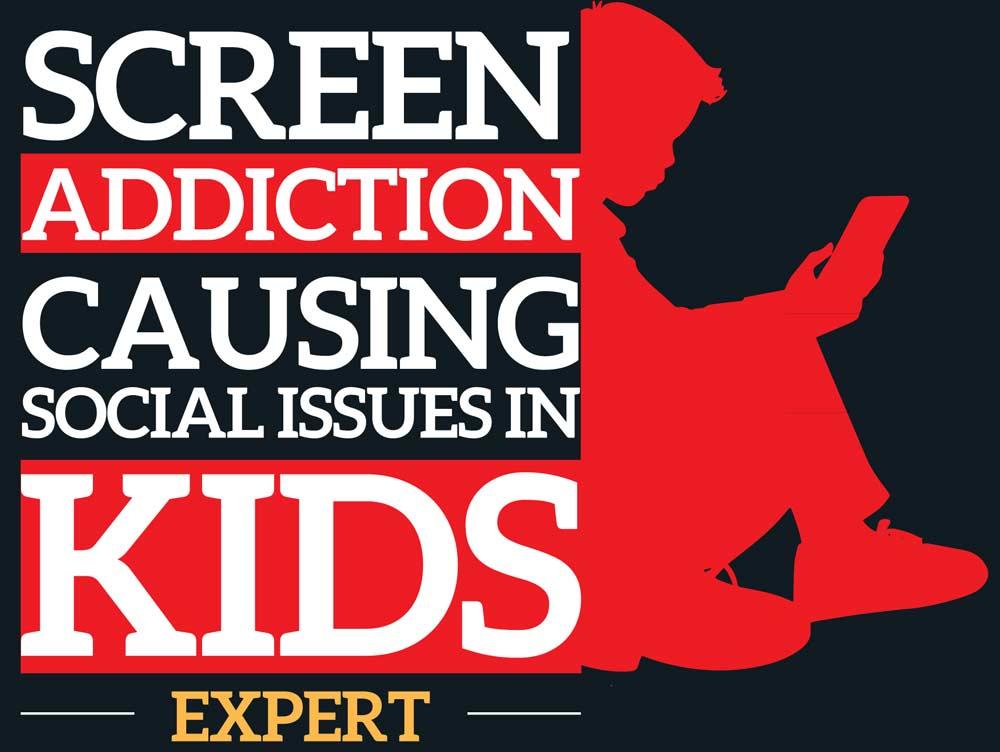
 No screens before age three is advised, as it’s a critical period for brain development
By Tahaan Jayewardene
Consultant Paediatrician Dr. Deepal Perera has raised concern that children are increasingly facing social and developmental challenges, rather than medical problems, due to excessive screen exposure.
“Now, we see more and more social issues rather than medical issues,” Dr. Perera said, strongly advising against giving mobile phones to children under the age of three, as it is a crucial time for brain growth and development.
He adds, if children are addicted to screens (either to video games, phones or watching TV), their ability to keep eye contact with people, and their speech development becomes impaired and delayed. He also mentions that some children may develop speech regression.
Dr. Perera presents two main issues regarding children’s screen use: “What we see is, when the parents are busy, they give them [the] phone. If the children don’t eat, again they give [them] the phone.”
He compares this to the past when children didn’t have phones and went outside to play, but now parents instead of letting children become exposed to the outside world, keep children inside resulting in prolonged screen time. He adds that it’s “better to go back to nature.”
He also mentioned that society is completely different today, where people don’t talk to each other or look each other in the eye. He emphasized the importance of talking about this issue now rather than “postponing it for the next decade.”
A 2025 study published by the American Psychological Association (APA) titled, ‘Electronic screen use and children’s socioemotional problems: A systematic review and meta-analysis of longitudinal studies’ in the Psychological Bulletin “found that screen use can contribute to socioemotional problems, and children with these problems are more likely to use screens as a coping mechanism.” It also adds, “the effects appeared stronger for gaming.”
The Psychological Bulletin reviewed 132 studies, of which 292,739 children in 117 of the studies, were analyzed.
The APA study elaborates about the level of risk involved with screen time, mentions “If screen time is well above guidelines, or predominantly gaming, then there appears to be a substantial increase in risk, for both externalizing and internalizing problems.” However, it also mentions that if children are engaging in modest amounts of screen time, and it’s educational, and protective factors (like sleep, physical activity, and social interactions) are not being displaced, “then there may be few risks of increased socioemotional problems.”
The APA study, supports the use of screen time guidelines, “that not only limit exposure time but also emphasize content quality and a positive social context.” It adds that parents should not only monitor screen time but also what their children are doing and with whom they interact with. It states, “Parents may be able to avoid a cycle of screen use by supporting their socioemotional development in other ways.”
11 Jun 2026 5 hours ago
11 Jun 2026 5 hours ago
11 Jun 2026 5 hours ago
11 Jun 2026 6 hours ago
11 Jun 2026 6 hours ago