17 Sep 2025 - {{hitsCtrl.values.hits}}
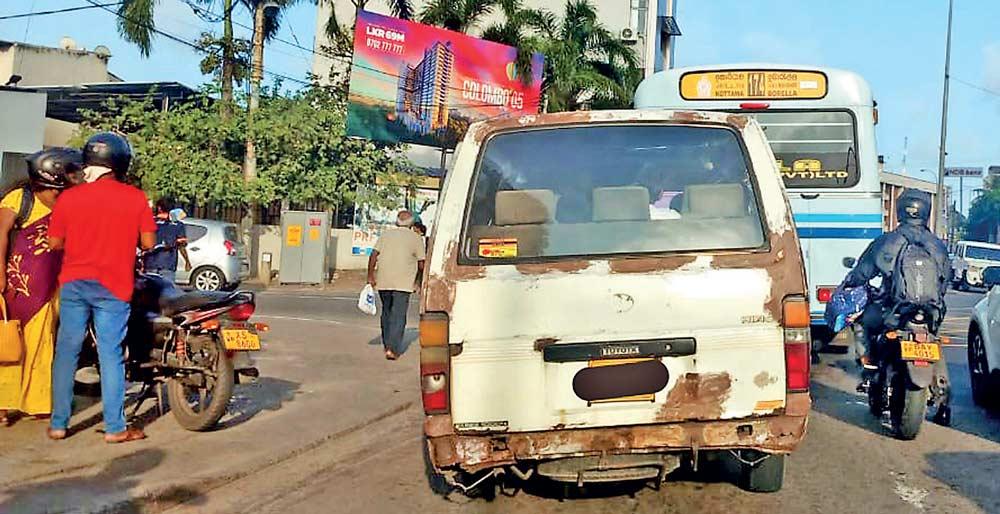
Seen in this photo is a school van undergoing repairs but still transporting children
|
|
Two school children succumbed to injuries during the fatal accident that took place in Kuliyapitiya when a school van collided with a tipper truck in late August. Photos of the school van that went viral on social media highlighted the need to standardise school transport services with vehicles in better conditions. The government too had taken several steps such as restricting the entry of heavy vehicles into the city during school hours to minimise accidents. But demands to standardise school transport services are getting louder by the day.
Individual challenges
Samith Dhanushka had been operating a school transport service for the past 20 years. He travels from Kalutara and the children travelling in his school bus attend several schools in and around Colombo. Since most vehicles used for school transport are occupied during the week, their drivers try to attend to vehicle repairs during school hours. Sometimes they have to wait till the school holidays as the time available during the weekend isn’t enough for mechanics to fix all defaults in vehicles.

 “Many people feel that operating a school transport service is one of the easiest post-retirement job opportunities. Initially, many people had no clue about the quality of services that need to be provided. As a result, several associations were established to regulate the standard of school transport services”
- Lalith Chandrasiri, Secretary of All Island School Transport Association
“It is only if we take some private hires that we could pump fuel and earn an extra income,” Dhanushka said speaking to the Daily Mirror. “We are doing a service, but during peak traffic hours, nobody gives us space. We have to send children to school on time and parents have vested that responsibility in us,” he added.
Responding to a query about old vehicles, Dhanushka said that school transport vehicles are usually being maintained to ensure the safety of passengers who are mostly children. He said that even after 20 years of driving, he had still been unable to settle his lease. “This is the reality we all face. From the little that we earn, we have many expenses to bear,” he further said.
School transport associations present demands to govt.
The Daily Mirror learned that school transport services are self-employment opportunities for most individuals. “When a person starts a business on his own, he doesn’t have enough capital,” said Lalith Chandrasiri, Secretary of All Island School Transport Association. “Many people feel that operating a school transport service is one of the easiest post-retirement job opportunities. Already former zonal educational directors and those who have retired from forces operate school transport services. Initially, many people had no clue about the quality of services that need to be provided. As a result, several associations were established to regulate the standard of school transport services,” he explained.
He said that initially there were old vehicles; some that had to be pushed in order to start and some that were not suitable for use at all. But the former IGP and RMV Commissioner had assisted them in obtaining a loan scheme to repair the vehicles.
 “Right now we are in the process of drafting regulations for each vehicle. Because if we take a bus for instance, the size and number of passengers taken is different to that of a school van. But we will have these regulations drafted soon,”
- Dr. Prasanna Gunasena, Deputy Minister of Transport and Highways
School transport associations are not against regulating school transport services. “According to the Police Motor traffic division, school transport services have the lowest incidence of road accidents. During the Kuliyapitiya incident the school van driver did his best to steer the vehicle away from the heavy vehicle. The photos released indicate that the vehicle has an old number plate, but they had to take the cover off in order to rescue the children. Even though it had an old number plate it was in good condition. Some vehicles operate while tinkering work hasn’t been completed yet,” he further said.
Chandrasiri explained why it is difficult to repair school vehicles on weekends. Most school vans and buses operate throughout the week and drivers wait till school holidays to repair vehicles. But some drivers are unable to pay the amount in full. “When we obtain charges we divide the annual fee by 12. Despite a difference in Rs. 100-200 we don’t charge parents in an unfair manner. The charges we obtain for a month are barely enough to feed our families and pump fuel. We don’t have savings as such. There are only 4-5 individuals who operate buses as a business. I have to repair my vehicle and it costs Rs. 58,000 to replace the turbo. So I have to beg from parents to pay me the next month’s fees in order to do the necessary repairs. This is not a profit-making business,” he added.
One of their main demands is to provide them with a car park in the proximity of Colombo equipped with sanitation facilities. “None of the regimes were able to do this, but they talk about regulating the services,” Chandrasiri continued. “Another request is to provide us two days off per month. It was only Ranil Wickremesinghe who provided us with a loan to obtain buses for school transport services at 3.25% interest rate. The Transport Ministry should do a census to find out the number of old vehicles and the type of vehicles operating as school transport services. When we use existing car parking facilities, the parking fee for a school bus is Rs. 1000 while a van driver should pay Rs. 600,” he said.
A new circular issued by the IGP states that school transport services can only take children in keeping with the number of seats or as permitted in their vehicle permit. Several other mandatory conditions mentioned in the circular are as follows;
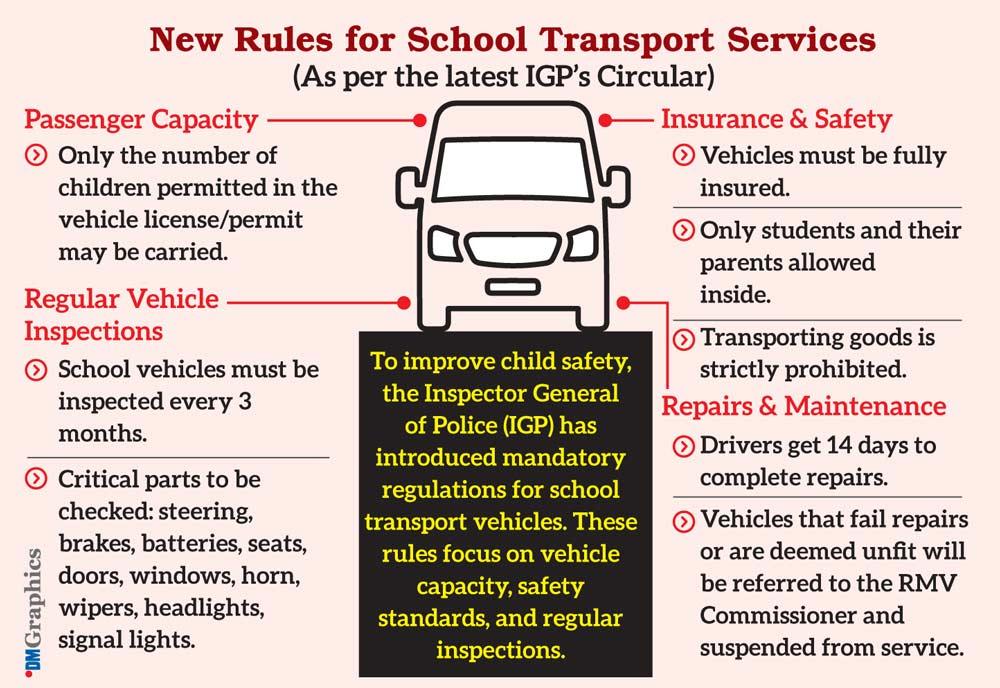
“A majority of vehicles in this sector are dual-purpose vehicles. Some have either 3 or 5 seats. So the government should firstly discuss these matters with us prior to implementing laws,” Chandrasiri said in response to conditions mentioned in the latest circular.
Suggestions to improve school transport services
According to Joseph Stalin, General Secretary of Ceylon Teachers’ Union, school transport services were managed by the Ceylon Transport Board (CTB). “But since the CTB doesn’t function properly, the government lost its focus on school transport services. In other countries, children are being taken to school in the best vehicles. But 90% of vehicles in Sri Lanka’s school transport services include condemned vans and buses. Some have very old registration numbers. The government should standardise these vehicles and allow vehicle owners to import vehicles with tax concessions or provide them with a loan to obtain new vehicles. If not they should strengthen these services via CTB. Some vehicles don’t have proper seating, the doors are unstable and some vehicles have Shri (very old in the series) number plates. We don’t blame these drivers or owners, but this sector needs to be standardised. If the best is meant for the children then they should have the best vehicles too. On the other hand, there’s no regulation with regards to school transport fees. Some drivers charge money from parents during school holidays as well. If three children go in school transport it costs Rs. 45,000 and this is a burden on parents. Therefore the government should look at implementing practical solutions over popular solutions,” he underscored.
Previously, the monitoring of public transport services came under the purview of the National Transport Commission (NTC). But under the present NPP regime, the NTC Act had been recently amended. At present, the regulation and monitoring of public transport services comes under the purview of the government. “This includes school vans and buses, office transport vehicles, Ceylon Transport Board (CTB) buses and even three-wheelers,” said Deputy Minister of Transport and Highways Dr. Prasanna Gunasena. “Right now we are in the process of drafting regulations for each vehicle. Because if we take a bus for instance, the size and number of passengers taken is different to that of a school van. But we will have these regulations drafted soon,” he added.
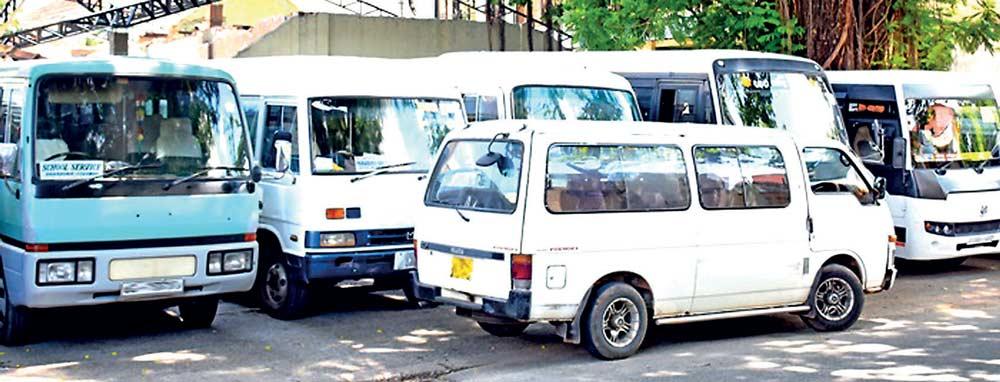
School transport associations are complaining against exorbitant parking fees charged from school buses
08 Jun 2026 8 minute ago
08 Jun 2026 24 minute ago
08 Jun 2026 29 minute ago
08 Jun 2026 31 minute ago
08 Jun 2026 46 minute ago


 With fatal accident taking place demands to standardise school transport services are getting louder by the day