08 Sep 2025 - {{hitsCtrl.values.hits}}
 Two important places of worship in the Eastern province are Seruwila Maha Viharaya or Mangala Maha Seya, and Hirigadu Seya. Seruwila is a place of worship situated in an Indian Ocean island to the East of Trincomalee. To reach this sacred place, one should sail to Muthur from Trincomalee and travel by road from there to Seruwila. After the construction of a bridge over Mahaweli Ganga, the place is accessible through Kantale. There is yet another route to Muthur from Chavakachcheri.
Chronological Information
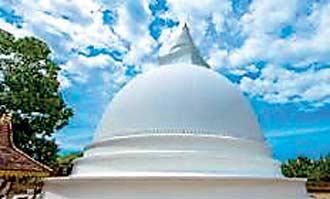 According to the chronicles, viceroy Mahanama had recovered the forehead relic of Gautama Buddha from Mahakala, the head of a rich family in Hattota colony. King Kavantissa had built Seruwila Maha Seya and placed the forehead relic in the relic chamber. It is generally accepted that the recently constructed massive tope is the Mangala Maha Seya. This tope with its commodious courtyard and other structures such as main halls, shrine rooms, alms halls etc. spread over a number of Acres gives a sacred aura to the area. There are facts to believe that this tope had been reconstructed from time to time. Ruins of Buddha statues found from the sacred area are of archeological value.
Evidence That SERUWILA had been a place of worship
Remnants found close to Mangala Maha Seya and the environment are evidence to the fact that this had been a developed and fully fledged place of worship in the past. The fact that this place of worship had been reconstructed from time to time is a matter of paramount importance. However, King Kavantissa built this sacred place originally. He was the King of Ruhuna and his capital was Magama. The ruler of the Northern part of the Kingdom was King Siva. According to the Dhatuwansa, he ruled from Seruwila. A detailed account of this King has not been recorded. Prince Giri Abhaya was a nephew of the King of Kelaniya. He got married to King Kawantissa’s sister. He had gone to Serunuwara due to the friendship he maintained with King Siva. Thus, during the early part of King Kawantissa’s reign, there were at least two independent states in the Northern region of the Rohana Kingdom.
Seruwila Reconstructed By King Kawantissa
King Kawantissa brought both these regions under his control. He had gone to Seruwila with his followers to construct Mangala Maha Seya and to enshrine the forehead relic. Much information is not available about the king’s route to Seruwila. However mention is made about two places. Out of these, “Deeghavapiya” has been identified but the second place is yet unknown. According to the available information, there had been a route from Magama to Trincomalee along the coast. On his way to Seruwila from Magama, King Kawantissa had constructed a relic depository and a conical building containing the relics of Buddha’s bones at a place known as “Warahasonda.”
Material Required For The Construction Of Mangala Maha Seya
Historically, it is interesting to inquire about how various materials required for the construction of Seruwila Mangala Maha Seya had been obtained. Four shipments of Silver had been sent from Madawa Patuna, Modara, together with another four shipments of gold from Suwarnabhumi. Dharmapala, the ruler of Patuna Modara, had informed the King about these consignments. It is evident that these shipments had been used for the construction of Seruwila Mangala Maha Seya.
The manner in which the required quantity of bricks had been obtained is marvellous. Placing of the foundation stone for the Dagaba had been done ceremonially. The relics had been treasured up in a grand scale. According to the chronicles, marvelous and surprising incidents had been taken place while constructing the relic chamber of Mangala Maha Seya by King Kavantissa, similar to what happened during the construction of Ruwanweli Maha Seya by his son King Dutugemunu. It is therefore evident that both these occasions had been of paramount importance for the subjects of these kings.
Participation Of Regional States
Mention has been made in the chronicles about a number of regional states of Ruhuna. Soma Nuwara, Loma Nuwara and Seru Nuwara are some of them. The rulers of these regional states had participated personally in festivities and construction work in places of worship. All the regional states had participated in all the work cordially and without any dissention. This shows the unblemished heritage of Sinhala Buddhists during these periods. There is sufficient evidence to believe that this sacred place had been maintained and reconstructed by the descendents of King Kawantissa, and that this area had been under the administration of Magama. Ruins found in an area covering a number of acres provide evidence to this fact.
Unavailability Of Epigraphical Evidence
The unavailability of sufficient epigraphical evidence is a matter of concern. According to the historical importance of the area, there should be a number of stone inscriptions available for research studies by archeologists. Presumably they had been buried in the earth, or destroyed. However, wwo small inscriptions had been recovered recently. Although comprehensive information is not available in these inscriptions, it was possible to identify the original names of Seruwila sacred place. In this rock inscription it is stated that the earliest name of this place was “Tismaha Vehera”. This rock inscription was recovered from a rock surface near the Dagaba. Part of the inscription is not readable. However, fortunately the date on which the engraving was done is stated. That part is as follows:
“Sirigabo Mapurmuka Duruthu Masa Ava Dasawak dawas”
This means that the engraving had been done during the month of January in the fifth year of King Sirisangabo’s reign. “Sirisangabo is an honorary degree conferred on kings in the past. Presumably the king known in this inscription as “Sirisangabo” is King Kassapa the Fifth.
The names of two Sanghanayake theras, Ananda Thera and Mahina Thera are also mentioned in this rock inscription.
Badly Damaged Inscriptions And Ruins
The inscriptions and other ruins have been badly damaged while moving the earth to level the courtyard. This rock inscription was recovered during the recent reconstruction. Both ends of the rock inscription had been torn off. The rock inscription in which the names of two Sanghanayake theras are mentioned is presumably a “katikawata”, a book of rules for Buddhist priests. The engraving had been done during the reign of King Abhasalamevan presumably King Kassyapa the Fourth. The part of the rock inscription where the name of the place is given is torn off.
According to these rock inscriptions and ruins recovered from the Eastern coast, it is clear that the whole area had been inhabited by Sinhalese who were governed by Sinhala kings. During the course of time the whole area became overgrown with jungle. During the recent past, the area had been damaged by non Buddhists and non Sinhala communities. However, Dambane Sumanatissa Thera had renovated the place for the devotees in face of serious obstacles. Efforts have been taken by him to make the place sacred.
Annual Religious Festivals Of Seruwala Maha Viharaya And Hirigadu Seya
Annual religious festivals of Seruwala Maha Viharaya and Hirugadu seya in the East are conducted during the month of Binara.
Hirigadu seya has a long history. Gautama Buddha spent the seventh week after His Enlightenment at the Rajayatanaya tree sitting in one posture for seven days enjoying the bliss of emancipation. At that time, two merchant brothers who were travelling to their native town Ukkala happened to pass the place and a Devata (diety) who happened to be a blood relative of the merchant brothers requested them to offer honeycomb and flour they had with them to the Buddha who was dwelling at the foot of Rajatarana tree. They offered honey comb and flour to the Enlightened One in four stone bowls offered by the four Great Kings. The Blessed One accepted the offerings. The two merchant brothers then took refuge in Buddha and Dhamma, and they were the first two disciples who took the twofold formula. These first two converts requested for some relics for them to worship and the Blessed One gave them Hair Relics – Kesa Dhatu. These Hair Relics received by the two merchant brothers Tapassu and Bhalluka were brought to Sri Lanka by them and enshrined in Hirimuthu Maha Seya.
08 Jun 2026 40 minute ago
08 Jun 2026 51 minute ago
08 Jun 2026 1 hours ago
08 Jun 2026 2 hours ago
08 Jun 2026 2 hours ago