05 Aug 2025 - {{hitsCtrl.values.hits}}
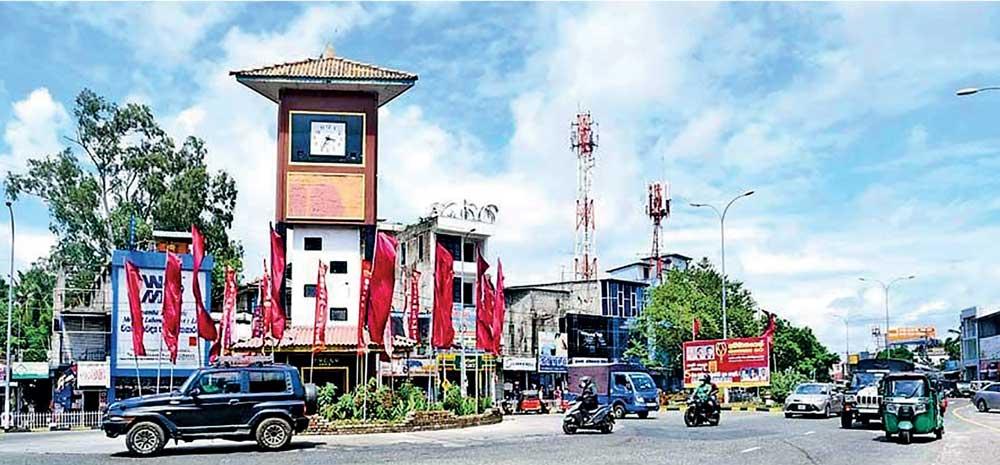
Dambulla town is in the spotlight due to land grabbing activities
By Prageeth Sampath Karunathilaka
A powerful politician from the Dambulla Municipal Council has been accused of being involved in these illegal activities
These racketeers operate a land kachcheri that enables them to create notarial deeds showing a transaction history of fifty years for any land. With the Divisional Secretary withdrawing the land from state ownership, they began to link the ownership of the state land to a praveni pangu of the Dambulla temple title plan
The course of Thammenna Ela was slightly realigned in 2011 to help control flooding in the city of Dambulla. As a result of this realignment, a 24-acre plot of land was created and later sold in 2024 for Rs. 109 million. This high valuation was made possible by removing the state’s absolute ownership and attaching a Praveni Pangu (Hereditary share) to the Dambulla temple’s title deed. Naturally, only land smugglers skilled in the art of forging notarial deeds could pull off such a scheme. The foundation for this large-scale transaction was laid in 2009, under the guise of flood control measures in Dambulla. Thammenna Ela was rerouted past the 73/2 bridge on the A9 road and reshaped into a spiral, curving around a plot of land belonging to an elderly resident who lived near the central bus stop and the town’s Dedicated Economic Centre. A discussion regarding the change of the canal’s course was held at the Dambulla Divisional Secretariat on 19.03.2009, with the resident being summoned to attend the same. He was informed in writing that there would only be a ‘minor change’ to the canal.
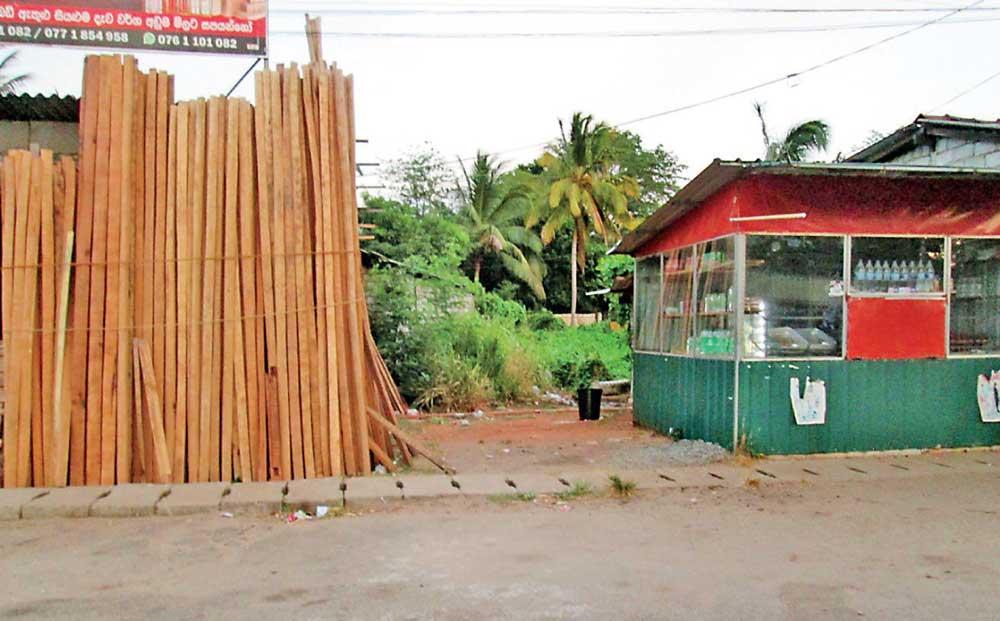
How the controversial land can be seen from the Kandy Road
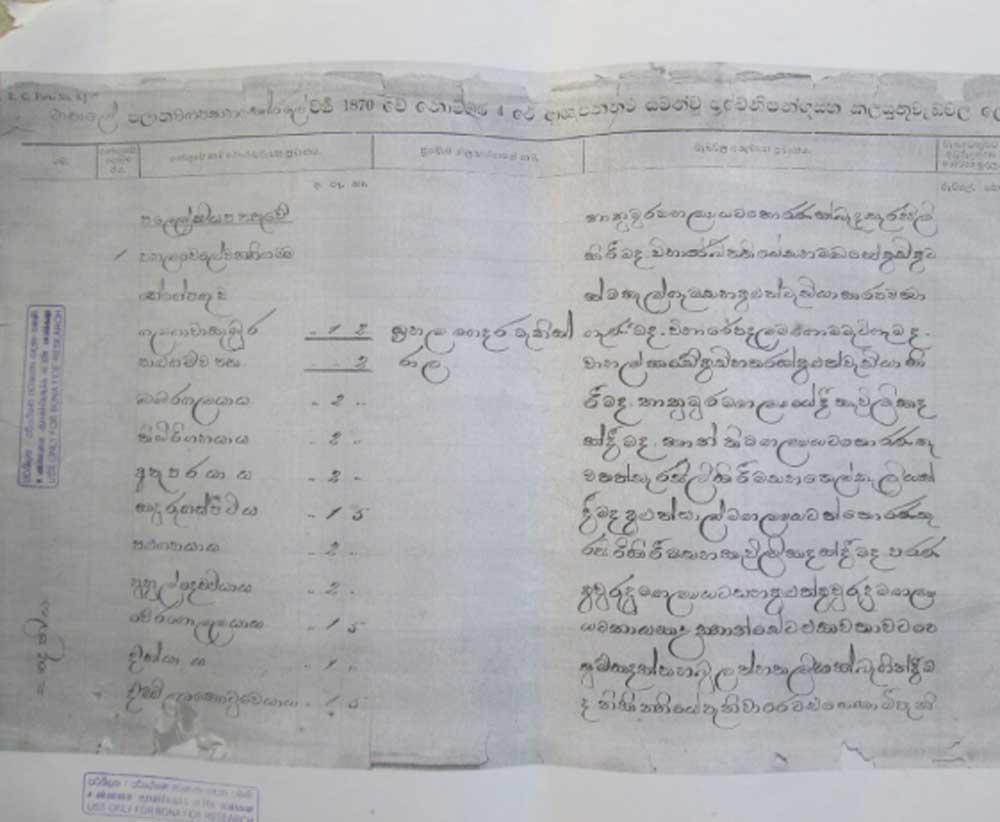
The Komasaris Potha (Commissioner’s book)
Although he was told that it would be a minor adjustment, what ultimately happened was that this elderly man had to risk his life to protect the land he had lived on for 40 years, in the face of politically backed thuggery. Under the name of the Thammenna Ela Development Project, he was forced to confront the criminal politics behind the illegal removal and sale of soil, sand, and Kumbuk trees from the canal. He and his family could do nothing, but watch helplessly as thugs filled parts of the old canal left behind after the diversion and seized a portion of their land.
A powerful politician from the Dambulla Municipal Council has been accused of being involved in these illegal activities. The land was acquired by an individual who operated liquor stores in the city, under the patronage of a cabinet minister from the area. After the 1999 murder of a man named ‘Sohmeh’-who was hacked to death in the city centre in a Chicago style murder-a notorious gangster’s underworld influence was brought into play. The Criminal Investigation Department (CID) has launched investigations into these fraudulent activities. According to letter No B.C. 1485/2023/B10, dated 05.12.2023 and issued by the Commission to Investigate Allegations of Bribery or Corruption, further investigation was transferred to the Commission after 10.07.2023.
Notably, the former Divisional Secretary had taken steps to safeguard government ownership by ensuring that the plot of land targeted by the land smugglers remained connected to government Lot No. 22, as shown in Preliminary Plan No. 968, which outlines the land demarcations of Dambulla city
 The Presidential Investigation Unit initiated its own investigation in 2013 after receiving a complaint regarding the forcible seizure of land from the elderly resident. The investigation unit took into custody file number 5/3/9/3/15, which contained written evidence related to this unlawful land acquisition. On 30.01.2022, the Sunday Lankadeepa newspaper reported a land fraud involving a powerful Municipal Council politician who had allegedly forged the thumbprint of an elderly resident in the Pidurangala area of Sigiriya to unlawfully claim a piece of land. A cabinet minister of the area requested the then-Director of the CID to initiate an investigation into this matter through letter No MPSPL/MOS/MSO/505/1022/07 dated 31.01.2022. The final paragraph of that letter addressed to the CID reads: “I condemn with the utmost disgust the shameful looting of the lands belonging to the government, the Dambulla Temple, and the helpless farming community.”
Strong evidence
The file taken into custody by the Presidential Investigation Unit contained a document that included strong evidence regarding the seizure of the government land. The officer who was serving as the Dambulla Divisional Secretary at the time had requested a survey report under Survey Order No. 5/1/11/422, dated 12.10.2011. The government surveyor conducted the survey on 02.12.2011 and marked in red on the plan the portion of government land that had been forcibly seized by the liquor store owner, an associate of the politician.
Notably, the former Divisional Secretary had taken steps to safeguard government ownership by ensuring that the plot of land targeted by the land smugglers remained connected to government Lot No. 22, as shown in Preliminary Plan No. 968, which outlines the land demarcations of Dambulla city.
Despite the politician’s significant power and clout, the Divisional Secretary exercised her authority over land administration and officially declared that the land in question was fully government-owned and had not been divided in any form. Letter No CPC/ACLG/M9/60 dated 06.07.2015, sent by the Assistant Local Government Commissioner of Matale to the Dambulla Municipal Commissioner contained details obtained from the former Divisional Secretary following an inquiry.
The foundation for this large-scale transaction was laid in 2009, under the guise of flood control measures in Dambulla
A challenge to the government’s ownership of the land, as previously confirmed in the 2011 survey report, arose during the tenure of the Divisional Secretary, who assumed office in 2019. This was after the previous officials were transferred. The elderly resident submitted a written request for a long-term lease. The Divisional Secretary, referring to the survey report under Survey Order No. 2022/190 to identify government land within the city, issued letter No. DSM/DB/LND/255 dated 23.02.2023 stating that the land belonged to the Dambulla Temple’s title plan No. 87076. The letter further noted that administrative matters related to the land listed under the Dambulla Temple’s title plan are handled by the Dambulla Temple Trustee’s Office.
In a context where the former Divisional Secretary, in 2011, obtained a report from the Government Surveyor and declared that the land in question was under absolute government ownership, the documents used by the Divisional Secretary, who took office in 2019, who called for survey reports and claimed the land belonged under Title Plan No. 87076, should be closely examined, critics opined.
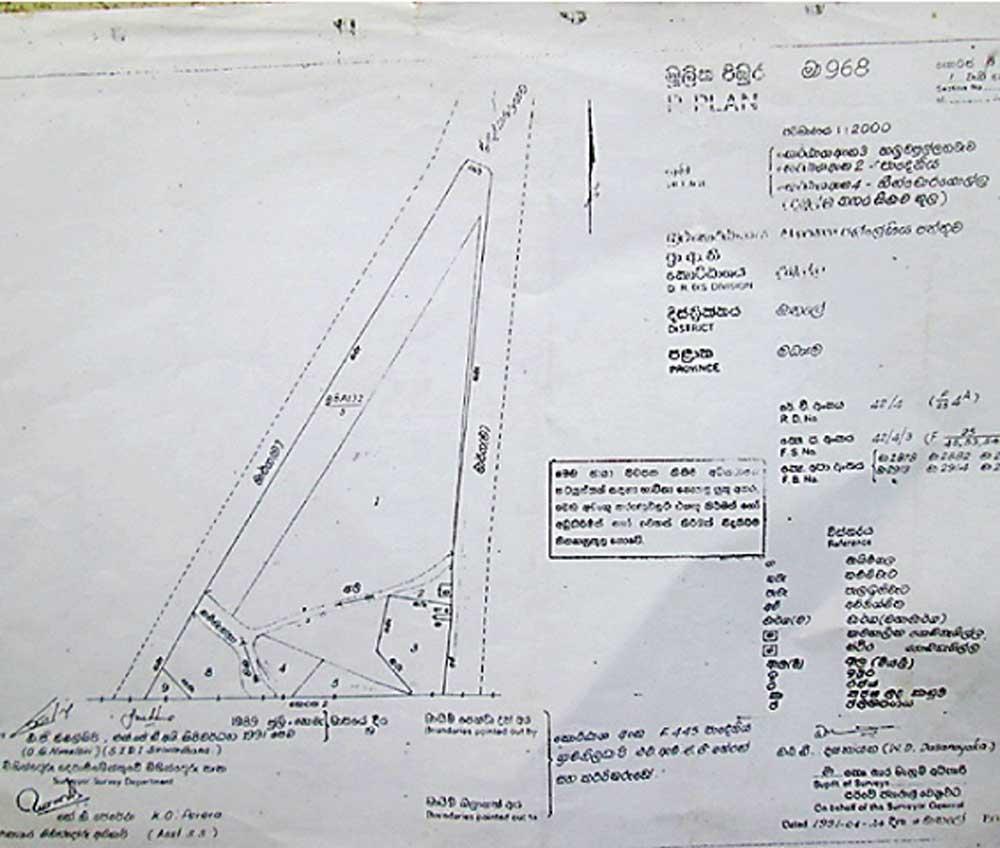
In the city’s title plan a portion of land in the middle marked in the shape of a triangle had been reserved for government use
This particular plot of land is first referenced in Title Plan No. 87076, which records ownership under the rajakari praveni pangu (Share under Feudal System) lands belonging to the Dambulla Rajamaha Viharaya. That plan was created 162 years ago under the imperial survey regulations. It was approved by the Surveyor General on 09.06.1872, and was prepared in 1863. The second document is preliminary plan No. A.132, prepared in 1933 to demarcate the city’s health authority boundaries. The third is preliminary plan No. 968, prepared between 1989 and 1990 for the purpose of land acquisition for city development.
The Criminal Investigation Department (CID) has launched investigations into these fraudulent activities
Colombo–Trincomalee A6 road and Jaffna–Kandy A9 road both pass through Dambulla town, near the clock tower. These two main highways intersect at this location, forming a triangular section in the heart of the city and extends toward Colombo and Kandy. When the British administration drafted the city’s title plan, a note on the plan indicated that a portion of land in the middle of this triangle had been reserved for government use. This reservation was marked using the letter ‘A’. However since the title plan is old, the extent of the land marked as ‘A’ is now difficult to determine. It is estimated to be approximately 110 acres in size.
It is stated that the ownership of the plot occupied by political thugs—including Lot No. 22 within the preliminary plan boundary 968 of the city development plan, which includes plots from Preliminary Plan A132—belongs to the state, and that the elderly resident is occupying it illegally.
Senior citizen of the area forced to face politically backed thuggery under the name of the Thammenna Ela Development Project
The book compiled by the Public Works Department (1796–1913, P.M. Bingham), which operated under British rule and contains records of road construction across the island, highlights the benefits of constructing the A9 and A6 roads through Dambulla. The road extending from Colombo to Dambulla is described at one point as the “Military Road from Colombo to Dambulla”. It is also evident that lands near the A9 road were allocated for health-related purposes, supporting the view that the road was constructed in part to facilitate the transportation of Indian Tamil laborers to the central highlands.
State owned land sold by land smugglers skilled in the art of forging notarial deeds
The triangular section of land, which had been removed from the Dambulla Rajamaha Viharaya title plan 162 years ago, has since been protected by the British administration and used consistently to serve the public. By the 1950s, Dambulla’s urban land had fallen under the control of timber smugglers. A review of Matale District Secretariat File No. LF/6/310 reveals that the Matale District Secretary had taken firm legal action against the smugglers.
In 1867, a vaccination centre was established in the centre of Dambulla to combat a smallpox outbreak that had spread across the region during the 1860s. This facility has since evolved into the present-day Dambulla General Hospital. Furthermore, during the First World War, the area saw the establishment of an air base along with a light aircraft runway. Two underground gunpowder bunkers were also constructed on either side of the A6 road, approximately one kilometre from the town centre.
Crucial decision
The British Government had used the lands allocated from the temple’s title plan sparingly for public purposes or matters of national security. Now, 162 years later, a decision has been made to the effect that the limited plots of land located in a city with such a history will no longer to be considered as government property. This decision was made after examining the reports obtained in response to Survey Request No 2393, submitted on 29.03.2022 by the Divisional Secretary who assumed office in 2019, to the Matale Senior Superintendent of Surveys, stating that identification of those lands was necessary. Upon seeing this letter from the Divisional Secretary, it is assumed that the elderly resident may have said, “So all the lands that the land smugglers are holding onto in the town must be temple lands, then.”
With the claim that the land, which had been held by political thugs for 12 years, belonged to the temple’s title plan, the sale and financial transactions began swiftly. By that time, a fuel station owner who had entered into an agreement with a powerful politician of the Dambulla Municipal Council and was operating businesses on the land claiming it belonged to the Municipal Council also got involved in the sale. Additionally, a person in charge of documentation for a former high-ranking cabinet minister also became involved in the transaction.
Racketeers operating a land kachcheri
These racketeers operate a land kachcheri that enables them to create notarial deeds showing a transaction history of fifty years for any land. With the Divisional Secretary withdrawing the land from state ownership, they began to link the ownership of the state land to a praveni pangu of the Dambulla temple title plan.
Linking a government plot of land to the temple’s Komasaris Potha (Commissioner’s book) is not an easy task. The Komasaris Potha is a document that records the praveni pangu lands belonging to the Rangiri Dambulla Cave Temple. It also specifies the traditional services that generations must perform for the temple in return for these lands. Created through a formal commissioner’s inquiry under regulations of Ordinance No. 04 of 1870 during British rule, this document remains widely known among locals today as the Komasaris Potha.
In this transaction, the smugglers found it easier to link the plot of land to the Komasaris Potha by locating a praveni pangu holder through the husband of a female municipal councilor. Through this councilor, her husband was connected to the land smuggling network as a temple praveni pangu holder. Using this connection, the smugglers arranged to transfer ownership of the state land to a third-generation praveni beneficiary descended from the original “Pahalawele Guruhamige” mentioned in the Komasaris Potha. It was noted that the plot of land was inherited from the maternal side known as “Kiri Manika.”
Under Notary Deed No. 330, this forged document was created. Although the deed no 330 was prepared using the name of a notary who passed away in 2024, the land registry records confirm that the deed was registered in 1978. This demonstrates the high level of skill of the smugglers’ land kachcheri operations.
After obtaining a connection to the pangu (Share) holder in the Komasaris Potha, the praveni landowner re-registered the plot in 2008 under Deed No. 6901 and sold it. This transaction is recorded in the Matale Land Registrar’s Office under extract number 263.
This document holds particular significance because, in letter no 5/3/9/3/255 dated 25.12.2017, the former Divisional Secretary, Lakshmi Hewapathirana, wrote to the Director of the Presidential Investigation Unit. In this letter, she identified both the liquor shop owner—an associate of the politician accused of forcibly occupying the land—and the wife of the elderly man residing on the land.
The Divisional Secretary said to the Director of the Presidential Investigation Unit that the file no 5/3/9/3/15, related to the land dispute, was handed over to the Investigation Unit on 08.01.2013and that an investigation was initiated. However, the file was later returned, and she has not been informed of any action taken thereafter. Her letter requests the Unit to inform her of any measures implemented to resolve the land dispute. Ultimately, what happened was that both parties involved in the state land dispute were linked to a notarial deed fabricated in 2023 by the land racketeers, thereby creating the necessary background to sell the land.
A close examination of this notarial deed clearly reveals several issues. First, the names of deceased notaries have been used to document the land transactions as they pass down to current occupants. Second, the name of a deceased praveni pangu holder listed in the Commissioner’s register has been included. The praveni holder of this land had passed away on 2010.12.09, yet the land was sold under Deed No. 6901 two years before his death.
Subsequently, the land ownership was transferred through a third deed to a person who held the position of Parliamentary Affairs Secretary to a powerful politician in Dambulla. The final transaction occurred in 2024. Specifically, on 03.02.2023, plot number 9981—surveyed by a private surveyor—was sold to a prominent agrochemical and seed trader in Dambulla town for a staggering sum of Rs. 109 million. This transaction is officially recorded at the Land Registrar’s Office under extract no L 134.
Over a 10-year period, from 2015 to 2025, these land smugglers are believed to have illegally sold more than 8 acres of government land using forged documents. The total profit from these sales is estimated to be nearly Rs. 800 million. According to information uncovered within the land smuggling network, over Rs. 200 million of that amount is said to have been paid to certain government officials and members of the security forces.
When questioned on this matter, former Dambulla Divisional Secretary Piyal Jayasuriya who issued a letter declaring that the disputed land was not state property responded as follows:
“The land was not state land. I examined the relevant documents and concluded that it was not state land. A presidential inquiry was conducted into the issue, but as far as I know, it is not state land. If it is not state land, then it must be private. If fraudulent deeds were created for this land, that is a separate matter that should be investigated independently,” said the former Divisional Secretary.
11 Jun 2026 5 hours ago
11 Jun 2026 5 hours ago
11 Jun 2026 5 hours ago
11 Jun 2026 6 hours ago
11 Jun 2026 6 hours ago