10 Nov 2025 - {{hitsCtrl.values.hits}}
 Now the election for a Diyawadana Nilame is over and with the annexation called by the Mahanayakes, it goes to prove that amendments are really necessary for the Buddhist Temporalities Act.
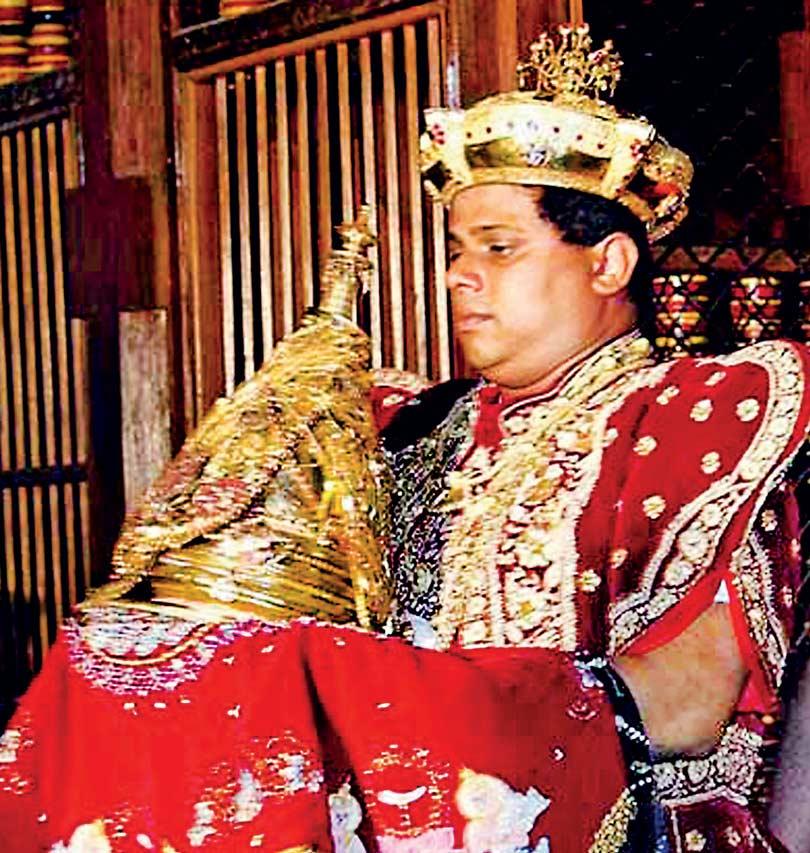
 Incumbent Diyawadana Nilame Pradeep Nilanga Dela was re-elected to the prestigious position of Chief Custodian of the Sri Dalada Maligawa (Temple of the Tooth) in Kandy on November 07, securing another 10-year-term that will see him serve in the post until 2035.
The election was held at 2.00 p.m. at the Kandy Buddhist Balamandala Hall under the supervision of Gamini Senarathna, Commissioner General of Buddhist Affairs, with 263 eligible voters including members of the Maha Sangha (Clergy) participating in the process.
|
Pradeep Nilanga Dela re-elected as Diyawadana Nilame: |
Dela, who has served as Diyawadana Nilame for the past decade, faced competition from six other candidates in the likes of Daminda Bandara Udurawana, Chief Custodian of the Kataragama Maha Devalaya and Pasgama Sri Natha Devalaya, and A.W.S. Bandaranaike, Chief Custodian of the Natha Devalaya and Embekke Sri Kataragama Devalaya.
One would be surprised that the Sri Dalada Maligawa was open for any vilification had it not been brought under the Antiquities Ordinance which was only in 1962 by Madam Bandaranaike through her Minister of Cultural Affairs Maithripala Senanayake. She also gifted through the Japanese Saghanayake a Bullet Proof glass cubicle which withstood the Bomb Blast of 1989. Most do not speak of what she had done for the Sri Dalada Maligawa to make it the Palladium of the Buddhist world.
Now into this Sacred Shrine comes the election of the Diyawadana Nilame - some say the 20th- but records show the position is that of the 35th. The first title holder was “Hiripitiye Rala” Diyawadana Nilame in 1720.
It was only recently that President Anura Kumara Dissanayake said at the offering of the scroll to the Anu Nayake of Asgiri Maha Vihre that the Mahanaykes have prompted him for an amendment to section 41 and 42 of the Buddhist Temporalities Act. He said that the amendments after they were submitted to the Mahanayakes are with the Legal Draftsman. This amplifies that the Buddhist Temporalities Act needs amendment.
There is an amendment given to the former President Mahinda Rajapakse by the then Mahanayake of Asgiri Ven. Udugama Buddharakkita Thera at the Janadhipathi Mandiraya when there was an alms giving for 100 Bhikkhus. It was accepted and tabled in Parliament, but never taken up for discussion.
The Buddhist Temporalities Act was prepared by the two Karaka Sangha Sabhas and the only layman was the former Basnayake Nilame and then Acting Diyawadana Nilame Rohan Salinda Paranagame, considered to be the only layman who is well-versed with the Buddhist Temporalities Act.
Now the election for a Diyawadana Nilame is over and with the annexation called by the Mahanayakes, it goes to prove that amendments are really necessary for the Buddhist Temporalities Act.
The Commissioner General of Buddhist Affairs has only limited powers, which has led to much controversy. For example if a Basnayake Nilame occupies positions in two Devalayas, the Commissioner General has no power to request the Basnayake Nilame to vacate one Devalaya. Though he holds positions in two Devalayas, when an election is in force, he has only one vote. Therefore the Commissioner General has limited powers and thereby much ‘mudslinging’ is in force.
The two Mahanayakes in a joint statement had called the contestant and the others that this type of mudslinging brings disrepute to the Sacred Shrine.
During the last few months prior to the election of a Diyawadana Nilame, there was much mudslinging.
There was so much mudslinging regarding this sacred position that the Two Mahanayakes of the Two Maha Viharayas had sent out a letter signed by them calling all the contestants and those involved in this election, to avoid ‘mudslinging’ in their campaigns and bring the Sacred Shrine and the election of the Diyawadana Nilame into disrepute.
Out of the candidates for the post who were seeking election were a University Don, a retired Army personnel, a Gem Merchant and the incumbent Pradeep Nilanga Dela.
None should submit an application, but was able to present himself as the contender, when elections would commence.
But, there were only 189 votes in the Electoral College composed of the Divisional Secretaries, Trustees of Temples, monks from the former Kandyan Realm of 1815. The voters were from the length and breadth of the country; from Hinidiuma to Vauniya , Kurunegala and the suburbs where the Kandyan Realm is covered.
It was no easy task for any contest to cover and win over the voters and various allegations were made on Social Media.
The women Divisional Secretaries numbering 79 had no votes. The voting was based on the former Kandyan Realm and the Ratemahattayas, later Assistant Government Agents, were all male and there were no women. Whether this should remain or amended should be a decision made in Parliament.
If the women voters are removed, yet the rest could vote as the voting system is based on the Kandyan Realm
There was speculations that even before elections some quarters would be seeking legal opinion regarding the winner. But, there were no legal challenges made in this manner.
The Diyawadana Nilame, before reelection, was in office for twenty years as much as the former Neeranjan Wijeyaratne who had also held office for twenty years.
Let us examine the position of the Diyawadana Nilame.
In the past there had been three Diyawadana Nilames, The “Maha Diyawadana Nilame” the most trusted Nilame, the Chief Diyawadana Nilame ‘The Maligawe Diyawadana Nilame’ and “Palle waasala Diyawadana Nilame (the Great Rebellion 1818).
The Diyawadana Nilame also had the authority to punish by reading out the order of the King. It is believed that the Diyawadana Nilame read out the order on Ehellepola Kumarihamy and the family, but yet some point out that it was Molligoda Nilame. However, it has been accepted that the Maha Diyawadana Nilame had constantly been the most trusted official of the king.
Until 1936, the position of a Diyawadana Nilame was appointed by Prince Dantha, who was the Diyawadana Nilame of King Guveesha. After the Sacred Relic was bought into the country by Prince Dantha and Princess Hemamalee the King himself guarded it and enstrusted the duty of conducting rituals to the Temple of the Tooth.
During the period of the Portuguese, the King appointed Hiripitiye Rala or Hiripitiye Ekanayake Rajapakse Rajakaruna Mudiyanse who was known as Hiripitiye Rala. From this point flows the Diyawadana Nilame tradition. Hiripitiye Rala took the relics away to Sabaragamuwa and handed it to a monk to keep it until the Portuguese were driven away.
In the Royal Household he became an important person who looked after the scented bath. He took the temperature with the right hand elbow and then called on the King to bathe. His duty was over and the Saluwadana Nilame took over to dress the King. But, the King trusted the Diyawadana Nilame, his favourite Nilame.
This position continued and even during British rule after the Kandyan Conference appointed the former Diyawadana Nilame of the King who was Kappuwatta Adikaram in 1815.
Subsequently, in order to protect the lands of the Temples, various measures were taken to protect the Scared Tooth Relic. This position continued until the position was drawn as the Buddhist Affairs Committee headed by Dr. T.B. Kobbekaduwa (the first Kandyan Medico to be trained in England) During his tenure, he insisted that the position of the Diyawadana Nilame should be contested, and that marked the beginning of the elections for the post of the Diyawadana Nilame.
07 Jun 2026 12 minute ago
07 Jun 2026 18 minute ago
07 Jun 2026 2 hours ago
07 Jun 2026 2 hours ago
07 Jun 2026 2 hours ago