13 Sep 2025 - {{hitsCtrl.values.hits}}
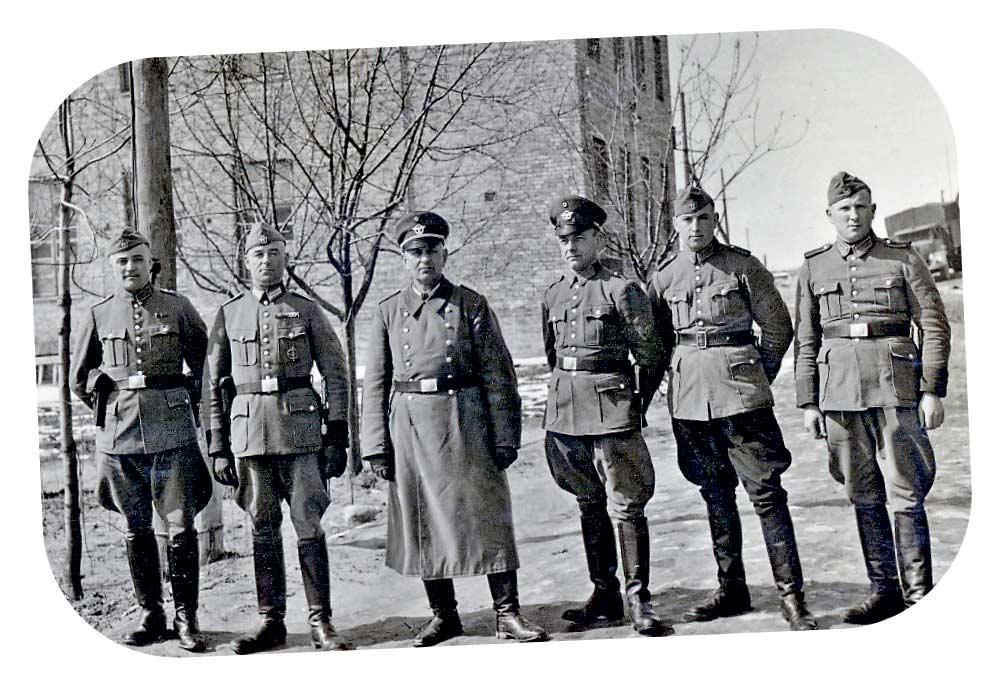
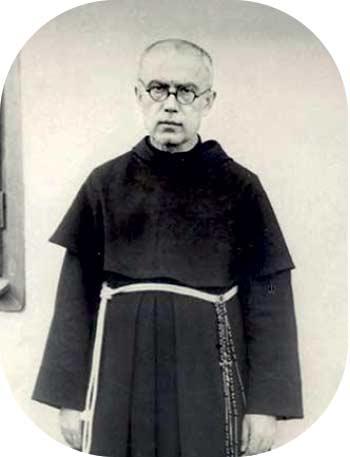
Nazi Officers standing in front of Niepokalanów
Photo courtesy: reproduced with the permission of The Archives of MI Niepokalanów (Archiwum MI Niepokalanów), Teresin, Poland
This is the final article in the series of articles written about St. Maximilian Kolbe—The Saint and Hero at Auschwitz in view of his 84th death anniversary.
Visit to Nippon Restaurant (now Nippon Hotel) in 1933
By Prabhath de Silva
‘We wanted, however, to visit also a Pole who had been residing there for a long time, Mr. Roszkowski, proprietor of the Nippon Restaurant. We left the harbour, therefore, turned right, and, after some minutes of walking in the midst of the continuous importuning of the merchants, we arrived at a row of small, waiting buses. We looked for one of the fullest-close, therefore, to departing-marked Slave Island, and we climbed up through the back door, into the middle of dark-skinned people, more or less dressed, residents of the area. Barefoot and indistinguishable from the other travellers, the conductor or the owner collected 3 cents from each person, and so, without losing time bothering with tickets, which in any case are a sign of mutual distrust, we get off in front of a recently constructed church, and from there, after barely 15 steps, we reach the Nippon Restaurant.’
Vases of flowers in front of the restaurant. We entered. On the wall, a picture of Our Lady of Częstochowa, and in front of it a small lamp; it was clear that it was the house of a Pole. Then, on top of a small cabinet, there was a statue of the Immaculata sent over from Niepokalanów: he was, therefore, also a reader of Rycerz. The proprietor was seated at a table and was finishing his midday “dinner” (the evening meal is called “supper”), a red dish of a gelatinous type. He immediately stood up: we greeted him and he invited us to eat with him. We drank coffee, ate some sweets, and lost ourselves in conversation. He tells us that he had just returned from hunting.
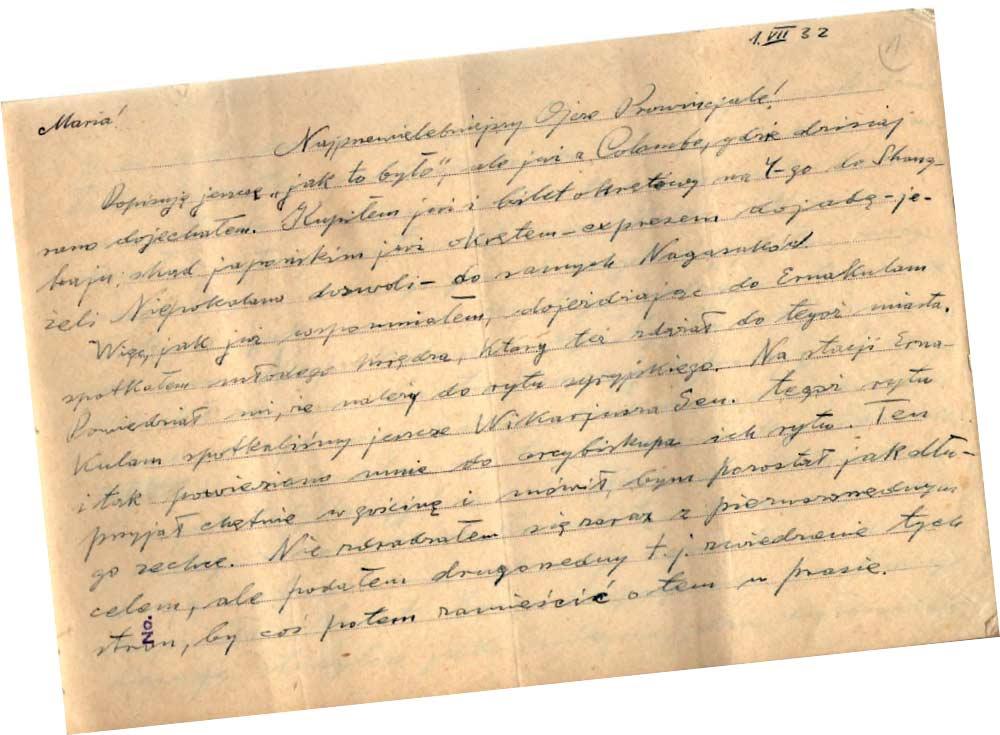
First page of a Letter of St. Maximilian Kolbe dated July 1, 1932, written in Colombo
Photo courtesy: reproduced with the permission of The Archives of MI Niepokalanów (Archiwum MI Niepokalanów), Teresin, Poland
[When asked] “What kind of game is there in Ceylon?”
[Mr. Roszkowski, proprietor of the Nippon Restaurant, had replied]:
“The most diverse. Yesterday evening, at the house I was at, we captured a small boa in the kitchen. A boy crushed its head, and it made such a noise. Fortunately, it was not a poisonous serpent. I gave it, still alive, to the Japanese consul. After four in the evening, the reptiles come out of their hiding places; they bask in the heat of the setting sun, and then in the dark of the night, they go hunting. At dawn, they again enjoy the warmth of the sun until about eight, when the heat forces them to find shelter in the shady forests. In the evening or morning, it is easy to spot crawling serpents in the countryside. Some time ago, I saw a white serpent, a rarity; I was taking aim with my gun, but a Hindu put his hand on my arm, preventing me from shooting because it was a sacred serpent. There is also a great quantity of wild cats of several sizes: some lurk in the trees, leaping from high onto the necks of passers-by. There are also many bears, leopards, and antelopes. The proprietor of the reserve where I went some time ago to hunt had ordered a boy to bring down something heavier: so, he killed an enormous crocodile”.
We listened with astonishment to the stories of the old man, since we had never imagined the woods and shrubs we had so admired from the ship could hide so many dangerous surprises.
Meanwhile, Mrs. Roszkowska, Japanese by birth, brought us a Japanese delicacy, “mochi” (pastries made of rice flour) with “hashi” (the chopsticks that the Japanese use to eat). We greeted the lady, and while we talked about religious matters regarding Japan, we ate some of those “mochi,” one of us two using the chopsticks, the other a fork.
She thanked us in Japanese for Kishi, who pays her a visit every month. In this house, midway between the Polish Niepokalanów and the Japanese one, Polish Rycerz meets with Japanese Kishi every month. Only in the local language does the Knight still not exist... May the Immaculata guide everything.
The Polish man and the Japanese lady said goodbye to us on the porch of the restaurant, while we left to make our way back to the harbour.
On our way there, we entered the recently constructed church. It is absolutely beautiful, and it is dedicated to the Blessed Mother. Then again, to the bus. In the harbour zone, we come across our Polish crows-only they had forgotten how to croak.
Immediately after, we went to the ship by motorboat. During the crossing, a Hindu, working as an assistant on the boat, showed us some signs on the skin of his hand, which were supposed to mean that he belonged to the Catholic Church, and for this, he wanted... money. Poor con man, scrounger! These kinds were not lacking there either!
At about six, the ship moved out of the harbour, passing by the breakwater, pitching to the movement of the waves that hit uselessly against the barrier that prevented them from entering the harbour; foaming, they rose several metres high and broke and fell back into the sea, to rise immediately and hit again, and again, fall, breaking.
The city lights grew fainter. Only the lighthouse still saluted us with its strong and intermittent streaks of light.
|
St. Maximilian Kolbe—The Saint and Hero at Auschwitz
|
Conclusion
When World War II broke out in 1939, St. Maximilian Kolbe was in charge of Niepokalanów. The Nazis invaded Poland. According to the Nazi doctrine, the Poles were racially inferior to the Germans. In their invasion of Poland, Nazi forces launched mass killing operations against the Polish civilians and intelligentsia. Upon capturing Poland, the Nazis took over the Polish banks, businesses and properties. They forced about 1.7 million Poles out of their homes. Among them were about 1500 Jews. The Nazi forces soon took control of Niepokalanów and used it as a temporary internment camp for 3500 Poles forcibly displaced by them. The Nazis first arrested St. Maximillian Kolbe in September 1939 and released him in December 1939. He refused to sign the Nazi declaration Deutsche Volksliste, which would have granted him rights similar to those of German citizens. Although he was not an ethnic German, his surname ‘Kolbe’ sounded German, and he was fluent in the German language. After his release in December 1939, St. Maximilian Kolbe resumed his work at Niepokalanów. At the end of 1940, the Nazis granted him a one-time permission to publish an issue of Rycerz Niepokalanej magazine, albeit on a significantly reduced scale. They considered him a threat to their regime. On February 17, 1941, the Nazis arrested St. Maximilian and four other friars. On 28 May 1941, they transferred him to Auschwitz as prisoner 16670, where he died on August 14, 1941, in the supremely heroic act of love and sacrifice to save the life of a fellow prisoner, as we already read in the first few paragraphs of this article.
His vision for India, which also included Sri Lanka, began to be realised fifty years later in 1980, when at the invitation of the Bishop of Kanjirappally (Syro-Malabar rite), OFM Conventual friars from Malta arrived in Kerala to establish the Order in India. At the 2007 General Chapter, the work of the mission in India was elevated to the administrative status of a Province (Province of St. Maximilian M. Kolbe in India). The work of the Province, in addition to its work in Kerala, today, comprises a Delegation in Andhra Pradesh-Telangana (the Delegation of St. Joseph of Cupertino), a mission in Calcutta and another mission in Sri Lanka. Currently under its jurisdiction, there are one hundred twenty-three solemnly professed friars, fifty-eight simply professed friars, seventeen friaries and seven filial houses. In Sri Lanka, the Order of Friars Minor Conventual has four friaries in Katana, Battaramulla, Kandy and Jaffna and two Minor Seminaries.
The Militia of the Immaculata, which St. Maximilian founded in 1917 with six other friars, has spread throughout the world. It is present today on five continents and in forty-six nations with a membership of around four million. It received its first official approval from the Church in 1922. On October 16, 1997, the Holy See erected it as an International Public Association of the Faithful. The MI International Centre has its headquarters in Rome, Italy. Its membership is open to the clergy, consecrated and laity. Whilst prayer is its main weapon in the spiritual battle with evil, members of the Militia Immaculata also immerse themselves in apostolic initiatives throughout society, either individually or in groups, to deepen the knowledge of the Gospel and Christian Faith in them and in others. St. Mother Teresa of Calcutta was among its notable Knights of the Immaculata (as its members are called)
In Sri Lanka, there is one church consecrated to St. Maximilian Kolbe at Vishaka Watta in Ja Ela.
The writer expresses his sincere gratitude to Fr. Krzys Flis, Director of MI Niepokalanów in Teresin, Poland and Sister Annamaria Mix, Archivist, Archiwum MI Niepokalanów in Teresin, Poland, for providing him with access to the writings of St. Maximilian Kolbe relating to his visits to Sri Lanka and the photographs with permission for reproduction.
08 Jun 2026 41 minute ago
08 Jun 2026 52 minute ago
08 Jun 2026 1 hours ago
08 Jun 2026 2 hours ago
08 Jun 2026 2 hours ago