25 Mar 2025 - {{hitsCtrl.values.hits}}
 By Aakil Riyaz
The budget does not serve as an outright testament to the NPP’s ability to govern. Rather, it signals the evolution of a movement once marked by a turbulent history, now seeking to reinvent itself into a disciplined political entity. This is a promethean responsibility for a party that holds a 2/3 majority within parliament and is a responsibility that should not be dealt with lightly.
The budget presentation by President Anura Kumara Dissanayake, for the annual year 2025 was a highly anticipatory spectacle for many a Sri Lankan. As the interim government’s financial blueprint for the upcoming fiscal year, it seeks to address immediate economic concerns while laying the groundwork for long-term stability.
As of now, two parliamentary readings for the 2025 budget have been completed. The first reading was held on January 9, 2025, where the Prime Minister presented the, ‘2025 appropriation bill’, to parliament. Following this, the second reading was held on February 17, 2025, where President Anura Kumara Dissanayake delivered the budget speech. The second reading debate spanned a period of 07 days (February 18 to 25), with the voting taking place on February 25.
The third and final reading, also known as the committee stage debate, is scheduled for a period of 19 days (February 27 to March 21), with the final vote arranged for the 21t of March. With the third reading of the budget currently underway, here are some key takeaways from the 2025 budget.
Economic and Fiscal Outlook
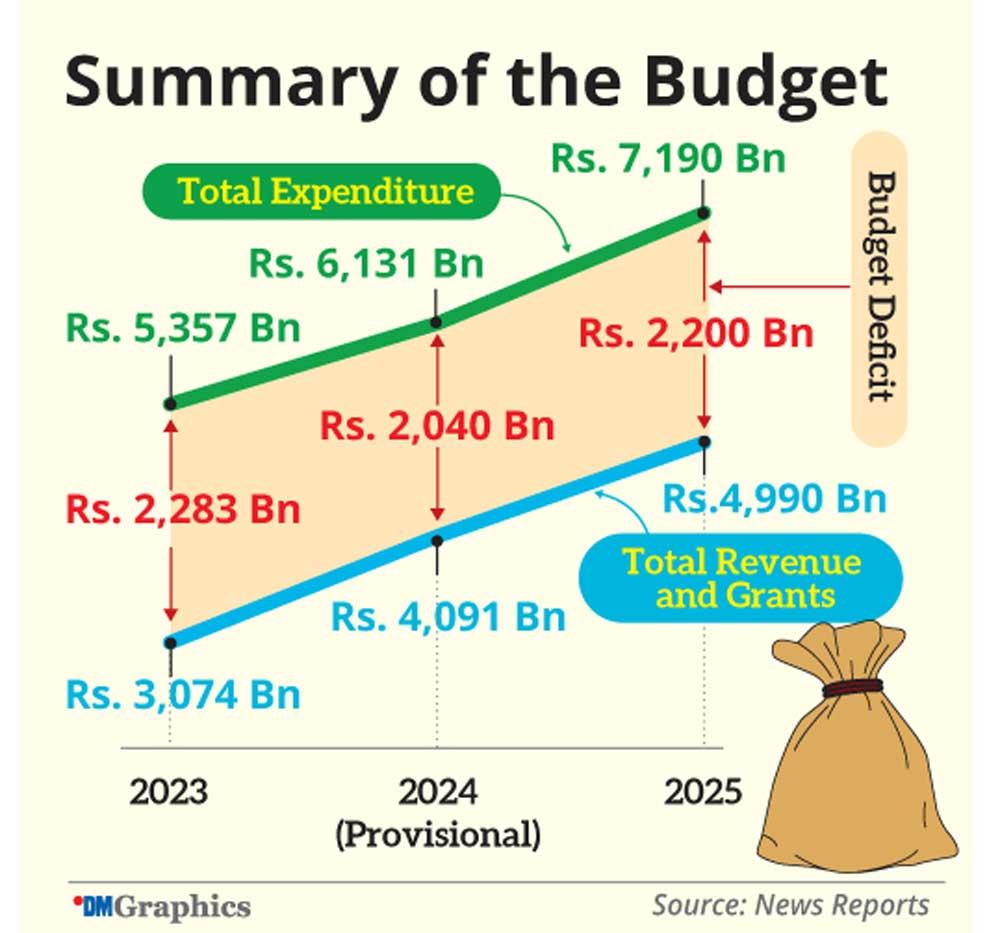
The 2025 budget projects a 23% increase in total revenue, reaching Rs. 4,990 billion, largely driven by tax revenue growth. Government expenditure is expected to rise by 17% to Rs. 7,190 billion, with significant allocations toward infrastructure, energy, and digital transformation. However, the fiscal deficit remains a pressing concern at Rs. 2,200 billion, necessitating a combination of domestic and foreign financing to bridge the gap.
Digital Transformation
A key initiative in the budget is the introduction of the Sri Lanka Unique Digital Identification (SL-UDI) system, aimed at enhancing cybersecurity and data privacy. Additionally, efforts to expand digital payment systems reflect the government’s goal of reducing cash dependency.
Taxation reforms
The budget proposes an increase in the tax-free threshold for personal income tax while removing VAT on essential food items such as fresh milk and yoghurt. However, new VAT impositions on digital services and increased corporate taxes on cigarettes, alcohol, and gaming have been introduced.
Trade and export development
The government plans to implement a National Export Development Plan (2025-2029) to stimulate export growth. Additionally, an expansion of Free Trade Agreements (FTAs) is expected to enhance Sri Lanka’s economic integration with key trade partners.
Infrastructure and transport
Modernisation of logistics remains a priority, with projects such as the completion of the East and West Container Terminals and the establishment of the Internal Container Dry Port at Veyangoda. Public transport will also see improvements, with Rs. 3,000 million allocated for the procurement of 100 low-floor buses.
Agriculture and land
The agriculture sector will focus on modernisation, climate resilience, and strengthening value chains. Fertilizer subsidies and the maintenance of a rice buffer stock remain central to the government’s strategy.
SME Development
Recognizing the critical role of Small and Medium Enterprises (SMEs), the government will establish a Development Bank through the National Credit Guarantee Institution (NCGI). Furthermore, Rs. 1 billion has been earmarked to commercialize research and innovation.
Health
The healthcare budget is set to increase to Rs. 604,000 million. Among the notable initiatives are a five-year national programme for children with neurodevelopmental disabilities and the development of a model day-care centre for children with autism.
Education
The education sector will receive Rs. 10,000 million for infrastructure upgrades, alongside increased emoluments for vocational education students. Additionally, Rs. 100 million has been allocated for the Jaffna Library’s infrastructure development.
SOE Governance
A holding company will be established to oversee State-Owned Enterprises (SOEs), with the aim of improving governance and financial discipline. Additionally, Sri Lankan Airlines’ long-standing budgetary concerns will be addressed.
Tourism
The tourism sector, a vital contributor to Sri Lanka’s economy, has been allocated Rs. 500 million for infrastructure development, with a focus on branding and regional attraction enhancement.
Investment Facilitation
 Legislative reforms such as the Investment Protection Bill and a Public-Private Partnership (PPP) Act will provide a more transparent legal framework for investors. The Economic Transformation Act is also set to be revisited to foster a more business-friendly environment.
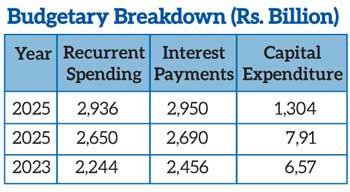
Here are the highlights of the National Budget over the past 3 years
The 2025 Budget navigates a fine line between meeting IMF requirements and addressing domestic economic pressures.
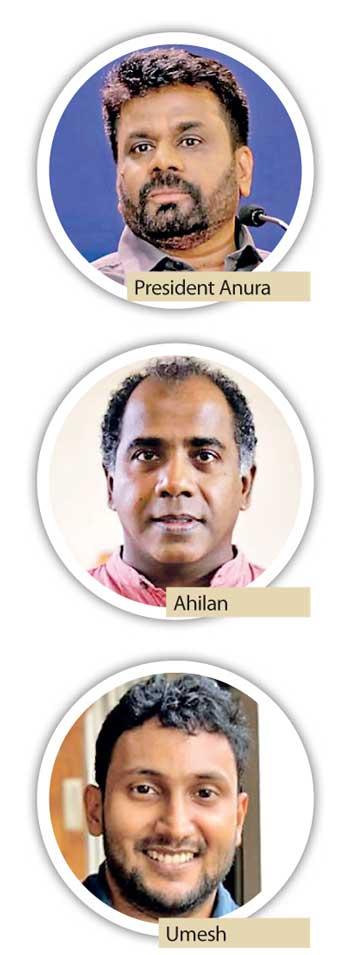
Umesh Moramudali, Lecturer, Department of Economics, University of Colombo, commented that, ‘The budget was largely prepared based on the IMF’s primary surplus targets. It’s not a budget that significantly deviates from the IMF programme.
On the positive side, there are minor investments in public transport and education, but other than that, there is no significant change’.
Despite targeting a primary account surplus, the projected fiscal deficit of 6.7% surpasses the IMF’s 5.2% benchmark. This highlights the delicate task of reconciling fiscal consolidation with growth ambitions. However, the interim government’s plan to raise revenue to 15.1% GDP, by the end of 2025 signals a deliberate approach to improve debt sustainability and foster a more stable economic environment.
Dr. Ahilan Kadirgamar, Political Economist & Senior Lecturer, University of Jaffna, said, “The 2025 budget is the short budget because of the elections since it comprises of a 9 month period. The biggest problem is that we are in an IMF programme that has caused severe limitations particularly due to its austerity measures. Therefore, the government is able to carry out policies and measures within the IMF framework with no major changes. The next few months are a learning and testing period and it is the 2026 budget in November that will dictate whether the government can move out of the IMF programme in the foreseeable future”.
The budget doesn’t simply draw the line with the country’s domestic affairs. Sri Lanka must also take into consideration the stark reality of its geopolitical position. Wedged between the looming colossi of both India and China: two nations vying for hegemonic position of the Indian Ocean. Sri Lanka has quite the task of manoeuvring through the narrow strait of global financial markets and carving out a coherent fiscal path to avoid any potential economic shocks in the future.
The budget does not serve as an outright testament to the NPP’s ability to govern. Rather, it signals the evolution of a movement once marked by a turbulent history, now seeking to reinvent itself into a disciplined political entity. This is a promethean responsibility for a party that holds a 2/3 majority within parliament and is a responsibility that should not be dealt with lightly.
However, whether the government can successfully steer the country through economic turmoil, geopolitical tensions, and structural inefficiencies remains to be seen. One might be tempted to fall back on the old adage, “only time will tell.” Yet, time is a luxury that Sri Lanka can scarcely afford just about now.
11 Jun 2026 3 minute ago
11 Jun 2026 6 minute ago
11 Jun 2026 8 minute ago
11 Jun 2026 11 minute ago
11 Jun 2026 16 minute ago