12 Feb 2025 - {{hitsCtrl.values.hits}}
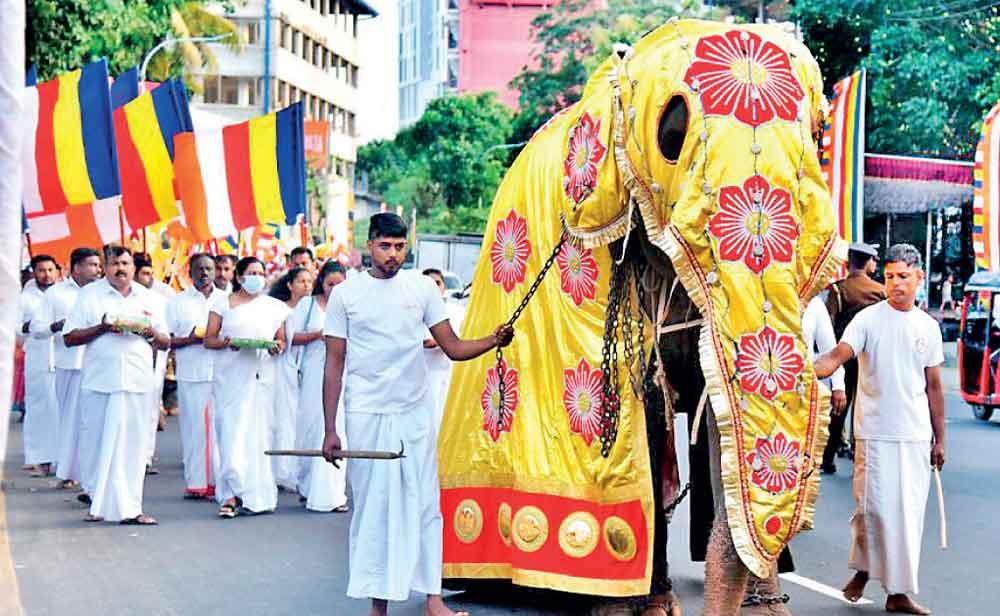
The Beautifully adorned elephants including tuskers provide majesty and elegance to the procession.
Pix by Pradeep Pathirana
 When I think of ‘Gangaramaya Navam Perahera’ the name of the then chief incumbent thera, Venerable Galaboda Gnanissara Thero (Podihamuduruwo), comes to my mind. He passed away on 2nd August last year but it was under his capable direction that the organisation of Hunupitiya Gangaramaya Navam Perahera was handled so far by the young people associated with the temple. This responsibility is now entrusted to the present chief incumbent of Gangaramaya Viharaya, Venerable Dr. Assaji Thero.
Navam Perahera which was originally called ‘Kolamba Perahera’ was conducted in August immediately after Sri Dalada Maligawa Esala Perahera in Kandy. The occasion for conducting Navam Perahera was to commemorate the first sermon of Gautama Buddha - ‘Dhamma Cakka Pavattana Sutta’ at Isipatana.
GANGARAMAYA RAJA Maha Viharaya
Gangaramaya was originally a small hermitage in a piece of marshy land at Hunupitiya within the municipal limits of Colombo. It was transformed into a nationally and internationally famous Viharaya by Venerable Devundera Sri Jinaratana Nayake Thera. Sri Jinaratana Nayake Thera was liked and honoured by Buddhists as well as by non-- Buddhists. With the cooperation of the people in the area, the Thera transformed the small Avasaya –(residence of Bhikkhus) into a fully fledged temple complex within a short period of time. Today, Gangaramaya carries three main features, Sharirika Dhatu (physical remains of Buddha), Maha Bodhi (Sacred Bo tree) and Buddharupa (Buddha Images). The main features of the temple include Viharaya (the main temple), Chetiya (pagoda), Bo tree, Vihara Mandiraya, Seema Malakaya and the relic chamber. In addition, a museum, a library, a residential hall, a three-storeyed Pirivena, an educational hall and an alms hall are also on the premises.
ORIGIN OF NAVAM PERAHERA
In place of the former ‘Kolamba Perahera’ an annual pageant is conducted during the month of Navam (February) beginning in 1979 with the state patronage of the then Prime minister, R. Premadasa. The objectives of this pageant are varied. In addition to the commemoration of the Dhamma Cakka Pavattana Sutta, it is primarily to venerate the Triple Gem, Buddha, His doctrine, Dhamma, and His disciples, Sangha. Another objective is to commemorate the appointment of Arahant Sariputta and Moggallana by the Enlightened One as His chief disciples (Agra Shravaka). The two most important positions in the Order of Maha Sangha were conferred on Arahant Sariputta (Dakunath sau) and Arahant Moggallana (Wamath Sau) by the Enlightened One at the first congregation on Navam Full Moon Poya day after the Enlightenment.
APPROPRIATION OF TRADITIONAL DANCING AND OTHER FORMS OF SINHALA CULTURE
Navam Perahera is also for the appropriation and sustenance of traditional dancing and other forms as well as Sinhala culture. It is also to encourage talented artists and to keep their art alive and known. Thus Gangaramaya Navam Perahera emerged during a time when no Buddhist pageant was conducted within the municipality area of Colombo. Gangaramaya Perahera comprises of a multitude of participants who in unison make the pageant magnificent.
PERFORMERS
Various kinds of performers make the pageant colourful. In addition to electric lamps in the streets and special illuminations on the festive days, there are torch bearers who provide not only light but also colour to the pageant. Copra or dried kernel of coconut is put into flambeaus and lit to emerge flames to illuminate the surroundings.
WHIP CRACKERS
Whip crackers serve many purposes. Firstly it is a means of clearing the way for the main Perahera. Spectators confine themselves to the pavement and leave the road entirely for the procession to pass without any disturbances. Secondly, it is a signal that the procession is approaching. It is also an offering made by sound indicating the majesty of the procession. It is said that even the celestial beings hear the sound which they think is an invitation to watch the procession. Devotees young and old including school children walk behind the whip crackers some of them carrying flags and banners in addition to trays of flowers.
ELEPHANTS
Beautifully adorned elephants including tuskers provide majesty and elegance to the procession. The tusker of the temple carries the relic casket on its back. As in the case of Sri Dalada Perahera and Bellanwila Raja Maha Viharaya Perahera elephants walk in Gangaramaya Navam Perahera majestically. They are adorned in costumes consisting of three parts, the body part, the forehead garland called Nettimalaya and the ear ornament called ‘Kan Joduwa’. A large quantity of puffing, rich cloth, velvet etc. are required to make these costumes. These ornaments add to the elegance of the elephants which in turn provide elegance to the procession.
DRAMA PERFORMERS–DANCERS
Drama performers of Gangaramaya Navam Perahera can be categorised into four groups. There are ordinary dancing teams representing Kandyan dancers, low country dancers and Sabaragamuwa dancers.
DRUMMERS
The world’s oldest and most ubiquitous Musical instrument, the drum is used in all the dancing performances. Various kinds of drums such as “Gatabera”, “Magul Bera”, “Yak Bera”, “Udakki”, “Panteru” and “Rabana” are used in dancing performances. Talampota, also known as Taitalama, the Tamil cymbal is used with the tambourine to provide timing. Tambourines are beaten to produce rich and melodious sounds in harmony with dances and “Vannams,” the songs of the performers.
Talampta is used in all the dancing performances to keep the rhythm through the loud ringing sound made when the two cymbals are hit together.
HEWISI DRUMMERS
The most important group is the Hewisi drum players. They produce a drumming roar with the large drum, “Daula” the double drum “Thammattama” and the trumpet or the bugle horn “Horanewa”. Meanwhile, conch shell blowers produce gentle and prolonged sounds increasing the serenity of the atmosphere.
VANNAM OR METRICAL VERSES
Dancers in their costumes look elegant when they move in the procession. They sing vannam while dancing. Vannams are metrical verses sung by the dancers to produce lyrical music in their performances. There are eighteen Vannams such as the Turanga (Horse) Vannama, Vairody (cat’s eye gem) Vannama, Savula (cock) Vannama and the most important Gajaga (elephant) Vannama. When the performers dance to the tune of Gajaga Vannama they move just like elephants.
VES NATUMA
A special kind of Kandyan dancing is known as Ves Natuma. Dancers of this category have to undergo training for a long period before they are fully fledged ves dancers. The performer will be entitled for the ves costume with a beautiful headdress only after being well-trained.
PANTHERU DANCE
Pantheru dancers form another group. Each dancer has a circular instrument called “Pantheru” which produces a clinging sound. When the members of the “Pantheru” dancing group dance to the tune of the drum beat and the clinging sound of “Pantheru” it creates a melodious atmosphere. This form of dancing is only second to ves dancing.
BORU KAKUL KARAYO—SILT WALKERS
“Boru Kakul Karayo” or silt walkers provide special colour to Gangaramaya Navam Perahera. The performers walk high above the ground on long poles with pads to rest their feet on. They sneer at the spectators from above and provide them entertainment.
THE ORGANISATION
A significant feature of this pageant is that it is planned and organised excellently. The Perahera parades several streets and the main road in front of Gangaramaya Viharaya and along the Beira Lake, Navam Mawatha. Seating accommodation is provided for the spectators. The Perahera route is determined well in advance and the places where the elephants, dancers, drummers and torchbearers should stand to start the procession are marked on the road. This enables the Perahera performers to come to the places assigned to them well in time to commence the parade in an orderly manner without making last-minute rush and confusion to find their proper places at the eleventh hour. Seating arrangements are made for spectators so they to watch the procession properly. Nothing is left for the pageant to get disorganised.
As mentioned earlier the Perahera arrangements are made by Gangaramaya temple and the entire organisation is handled by the young people associated with the temple under the direction of the chief incumbent of the temple.
11 Jun 2026 16 minute ago
11 Jun 2026 20 minute ago
11 Jun 2026 25 minute ago
11 Jun 2026 27 minute ago
11 Jun 2026 31 minute ago