13 Aug 2025 - {{hitsCtrl.values.hits}}
 The sugar industry in Sri Lanka has been facing an unprecedented crisis. The Pelwatta and Sevenagala sugar factories managed by Lanka Sugar Company PVT Ltd and the Ethimale Sugar factory in Siyambalanduwa, which is fully operated by a private company, are facing a threat of closure due to the poor sale of sugar and ethanol. The Hingurana sugar factory which is run as a semi-government enterprise is facing a similar predicament.
Financial mismanagement
|
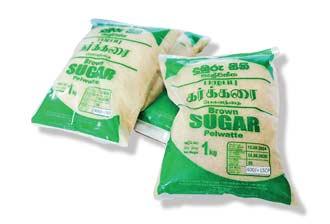
Brown sugar produced by |
Trade union leaders of Pelwatta Sugar Company have pointed out that the company is engulfed in the most serious crisis it has ever experienced in its history.
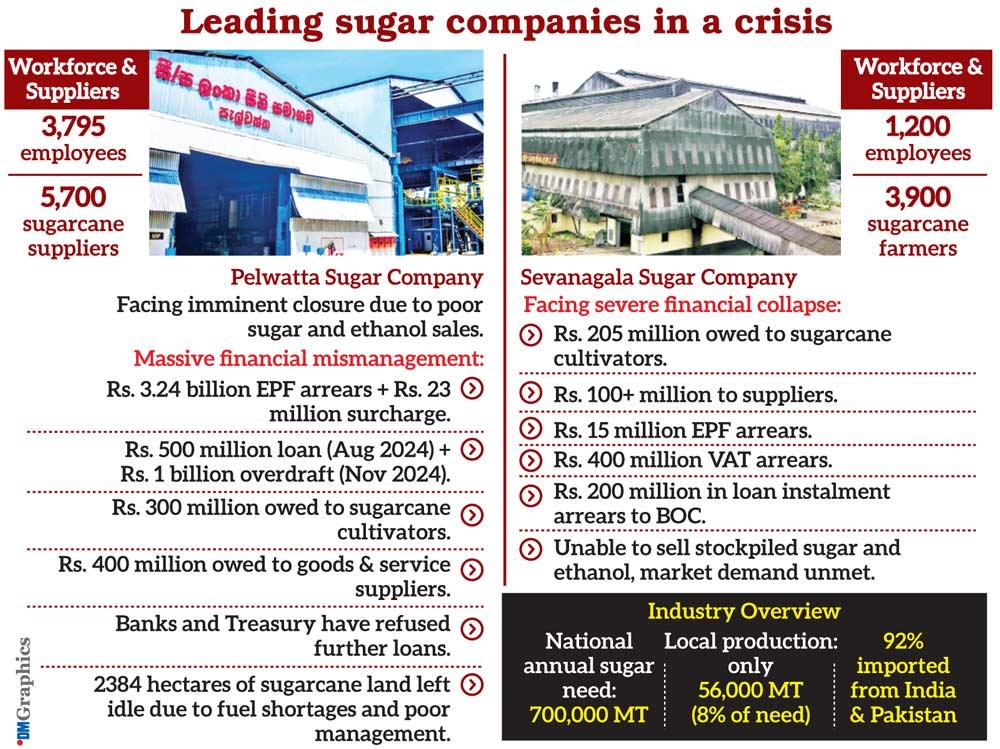
They said that the company has run into arrears regarding EPF contributions amounting to Rs 3240 million for the last nine months and added to it is a surcharge of Rs. 23 million. Meanwhile the company had raised a loan of Rs.500 million in August 2024 to meet the expenditure in maintaining the company despite incurring heavy losses.
“This was followed by a bank overdraft of Rs.1 billion in November 2024 and several other loans to pay salaries and wages of employees. By now the banks hesitate to grant further loans to the Company which is considered a bad debtor. The treasury and the Ministry of Finance has refused to grant further loans to the company. Meanwhile the company has run into arrears of payments amounting to Rs.300 million and sugarcane cultivators have already taken to streets demanding the settlement of arrears. The company owes another Rs. 400 million to the goods and service suppliers,” the trade union employees said.
They further said that the Sevanagala Sugar Factory is in a similar predicament. The company owes Rs. 205 million to the sugarcane cultivators and more than Rs.100 million to the sugarcane suppliers. The arrears of EPF contributions amounts to Rs. 15 million and VAT amounts to Rs.400 million. The company is in arrears of loan instalments amounting to Rs. 200 million payable to the Bank of Ceylon. Under the circumstances, it is a clear indication, that the two companies would not last long, but it is sad that the relevant authorities have failed to work out an effective plan to overcome this situation,” the trade union leaders further said.

 “Pelwatta and Sevenagala sugar factories play a major role in the economy of Uva with thousands of families depending on direct and indirect employment. Ethimale Sugar factory makes a similar contribution to the socio-economic conditions of Uva and Galoya. Meanwhile Galoya Sugar Company is responsible for a fair share of the people’s economy in Digamadulla,”
- Jeewan Pradeep, Representative Samagi Employees’ Union of Pelwatta
Sugar Factory
Union leaders pointed out that President Anura Kumara Dissanayake should intervene to resolve this crisis.
Pelwatta Sugar Company has a strength of 3795 employees and 5700 sugarcane suppliers while Sevanagala Sugar Company has a strength of 1200 employees. More than 3900 farmers supply sugarcane to the companies.
However the two companies have been crippled as they haven’t been able to meet the market demands for their produce including sugar and ethanol. Large consignments of sugar and ethanol have been stagnating in stores for a long time. The employees who accused the management of its lethargic attitude during this crisis pointed out that the Chairperson of Pelwatta Sugar Company, the Chief Executive Officer and the Chief Operational Officer have been in Colombo showing the least concern regarding the prevailing situation.
No preparation for cultivation
“More than 2384 hectares of land belonging to the company has been allocated for sugar cane cultivation. Usually work in the field is in full swing during June-August every year. However, no arrangement has been made yet to prepare land for cultivation. The employees of the Land Preparation Section report to duty and leave sharp on time while idling the whole day. Such actions would lead to a crisis in future. The company maintains sugarcane nurseries in about 327 hectares of land on the banks of Yalabowa, Menikganga and Kudaoya rivers. But the supply of water to the nurseries has come to a standstill since last June due to the lack of diesel to operate the water pump,” claimed President of the Pelwatta Sugar Company Inter Employees’ Union Roshan Dileep.
History of sugarcane cultivation
Sugar cane cultivation in the country dates back to the ancient times, but it had developed as an industry during the Dutch period. The Dutch rulers had cultivated sugarcane in the Southern Province in the South Western wet zone and on the banks of Kelani Ganga, Deduru Oya, Gin Ganga and several other areas. They commenced sugar and jaggery industries as cottage industries. During British rule, the sugar cultivations spread all over the island.
Sugar industry as a state enterprise dates back to 1956 when large scale sugarcane cultivation was inaugurated in the Galoya Valley. Establishing the Sri Lanka State Sugar Corporation in 1957 was a landmark event in the sugar industry in the country. The Kantale and Hingurana sugar factories were established in 1960 and 1961 which gave a new impetus to the sugar industry in the country. A quantity of more than 3200 metric tons of sugarcane had been ground at the two factories per day.
Under the liberal economy, introduced by the government of President J.R. Jayewardene, the private sector was allowed to share opportunities in the sugar industry. The sugar factories in Pelwatte and Sevanagala were inaugurated in 1986.
Pelwatta Sugar Factory was transformed into a joint venture-49 percent of shares owned by the government and 51 percent by the private sector- aimed at increasing the production. By 1992 the capacity of grinding had increased to 3300 metric tons of sugarcane per day. Ethanol was being manufactured with a production capacity of 30000 litres per day. This facility was inaugurated in 1996.
However under the restructuring of state owned enterprises, Sri Lanka Sugar Corporation was privatised in 1989. Subsequently, Kantale and Hingurana sugar factories were privatised in 1993. In 2002 Pelwatta and Sevanagala sugar factories were privatised amid strong protests from employees.
The Hingurana sugar factory, which was closed due to losses, reopened in 2005 with 51 percent of the shares owned by the state, and 49 percent being vested with the Galoya Plantation Company. In 2015 the factory was further developed with modern machinery with the capacity of an increased production of 20000 litres of ethanol per day.
Meanwhile Sevanagala and Pelwatta sugar factories were taken over by the government in 2011.
Questions are raised whether the sugar companies are in a position to meet the country’s requirement of 700,000 metric tons of sugar per annum.

 Usually work in the field is in full swing during June-August every year. However, no arrangement has been made yet to prepare land for cultivation. The employees of the Land Preparation Section report to duty and leave sharp on time while idling the whole day. Such actions would lead to a crisis in future”
- Roshan Dileep, President Pelwatta Sugar Company Inter Employees’ Union
Depending on Indian and Pakistan Imports
The total output of sugar factories in the country is 56000 metric tons per annum which is eight percent of the country’s requirement. The country has to depend on imports to meet 92 percent of the requirement of sugar from India and Pakistan.
The per capita consumption of sugar in Sri Lanka exceeds in a large proportion when compared to the main production of sugar.
Future of local sugar companies
The two companies have been running at a loss for about two years as they haven’t been able to cater to market demand. The managements have failed to pay the salaries and emoluments of employees and to meet the expenditure for the supply of goods and services.
An employee of the company said that when Gotabaya Rajapaksa was president he had banned the import of sugar and Ethanol during the Covid 19 pandemic. That resulted in the increase of income of the companies.
“Chairman Janaka Nimalachanda and the Chief Executive Officer Gamini Rasaputra rendered a dedicated service. They never run into arrears in salaries or payment of dues to the sugarcane suppliers. They increased the price per ton of sugarcane from R.S. 5000 to Rs.10000 despite the economic crisis prevailed during the Covid 19 pandemic,” a source said on conditions of anonymity.
The majority of employees and the trade union leaders were of the opinion that the mismanagement of profits of the company between 2020 and 2023 had resulted in the present crisis. They said that the management had failed in maintaining co-relations with the trade unions.
Dileep said that the prevailing crisis should not be attributed to the present government or the management.
“The heavy profits generated from the sugar industry had not been used gainfully and purposefully for a long time. Machinery and equipment at the Hingurana factory had been installed in the early 1960s and those at Pelwatta and Sevanagala in 1980s. However, the governments and other relevant authorities have failed to replace them with new machinery and equipment. Questions are raised as to whether they had used the profits for the development of the industry. They had invested the profits on wasteful projects to enhance their image. A former minister provided employment to more than 1200 from his district and placed them on high salary scales to muster their support,” he further said.
“The downfall of the Pelwatta and Sevanagala sugar factories was mainly due to the restructuring of the two companies by the Government of President Ranil Wickremesinghe. The two companies had earned massive profits for 2020-23 period, but the present crisis was due to the short sighted decision to import sugar and Ethanol. The government imposed 18 percent VAT on Ethanol and brown sugar and withdrew the custom duties on imported sugar at the instigation of the IMF.
“In fact the downfall of all sugar companies started in 2024 owing to this short-sighted decision. The losses incurred to the company amounted to 1893 million rupees in 2024. The present government hasn’t been able to reverse this decision yet and to streamline the affairs of the company. The sugar industry would be a profit-making venture if the import of sugar is reduced to the barest minimum and the import of Ethanol is totally banned,” said Secretary of the Independent Trade Union Circle Premasiri Dissanayake.
He further said the present government has permitted several private companies to manufacture Ethanol with rice and maize instead of molasses, a by-product of sugarcane. He said that it resulted in the decline of demand for Ethanol manufactured with molasses by the sugar companies.
Minister and Company management subject to criticism
Trade Unions, the employees and the sugarcane farmers accuse Minister Sunil Handunnetti and the management of the company of inefficiency.
“Our continual representations to Minister of Industries Sunil Handunnetti regarding the government’s taxation policy and its adverse impact on the sugar industry fell on deaf ears. He told parliament recently that he had a thorough understanding of the issue in the sugar industry. He knows only A and Z of the issue and nothing else. He is ill advised by officials and does not know even the strength of the cadre of the company. Although nearly one year has elapsed since the government assumed power, the minister, who visited Pelwatta and Sevenagala sugar factories only once, returned in a couple of hours without any response to our representations regarding the issues affecting the company and the employees. He only promised to resolve whatever issue facing us within three months, but we have not heard anything from him so far.
“Pelwatta and Sevenagala sugar factories play a major role in the economy of Uva with thousands of families depending on direct and indirect employment. Ethimale Sugar factory makes a similar contribution to the socio-economic conditions of Uva and Galoya. Meanwhile Galoya Sugar Company is responsible for a fair share of the people’s economy in Digamadulla. It would be worthwhile to take a realistic and a dispassionate view of the issue in the context of the local background and the country’s economy,” a representative of Samagi Employees’ Union of Pelwatta Sugar Factory Jeewan Pradeep said.
However, the trade unions affiliated to Peratugami Socialist Party, giving leadership to the ongoing agitations were of a different opinion. They said it is ridiculous that the creators of the prevailing crisis in Pelwatta and Sevenagala sugar companies are appearing as saviours of the farmers and the employees and shedding crocodile tears.
“The VAT Amendment Act was tabled in parliament by Minister Susil Premajayantha on December 13, 2023. The import duty on sugar was withdrawn and 18 percent VAT imposed on local sugar under the act. Parliamentarian Namal Rajapaksa and others were responsible for the VAT Amendment Act being presented in parliament. Now they compel the government to withdraw the VAT and resolve the issue. The Chairperson, the Chief Executive, and all those holding senior positions in Pelwatta and Sevenagala Sugar Companies are close confidantes of Ranil Wickremesinghe and Sajith Premadasa,” said the Convenor of the Farmer Campaign Vimal Wattuhewa.
Authorities not responsive to media
Chairperson of Pelwatta Sugar Company Sandamali Chandrasekara or the Chief Executive Officer Deepika Gunaratne the Chief Operations Officer of Pelwatta and Sevenagala Sugar Companies Ishan Dharmaratne, Minister Sunil Handunetti and Deputy Minister Chaturanga Abesinghe were not available to comment on the issue. Our continual attempts to contact them over the phone were futile.
However, Deputy Minister of Trade and Commerce, Food Security, R.M. Jayawardena said that steps were being taken to streamline the affairs of the Sugar Companies.
“Pelwatta, Sevenagala, Hingurana and Ethimale sugar companies have taken a concerted decision not to sell brown sugar for a price less than Rs. 200 per kilo and Ethanol for less than Rs.800. The government has taken steps to suspend the import of brown sugar. I am hopeful that the prevailing crisis could be resolved and the two companies would be stabilised soon. A long-term plan would be implemented to modernise the sugar factories, replace the old machinery and equipment to boost production and to make them profitable ventures,” The Deputy Minister said.
11 Jun 2026 7 hours ago
11 Jun 2026 7 hours ago
11 Jun 2026 7 hours ago
11 Jun 2026 7 hours ago
11 Jun 2026 8 hours ago