14 Mar 2026 - {{hitsCtrl.values.hits}}
 “When you play, you don’t try to impose an emotion; you hope instead that an exchange is created — that mysterious flow that arises only when many people share the same space.”
“Jazz teaches us freedom. And music, in general, teaches us to listen to one another — to respect timing, not to overlap, to leave space, to harmonize our contribution.”
“Do not renounce your origins or roots in the attempt to appear more ‘international.’ You can communicate your cultural heritage with pride without sacrificing the quality or strength of the project.”

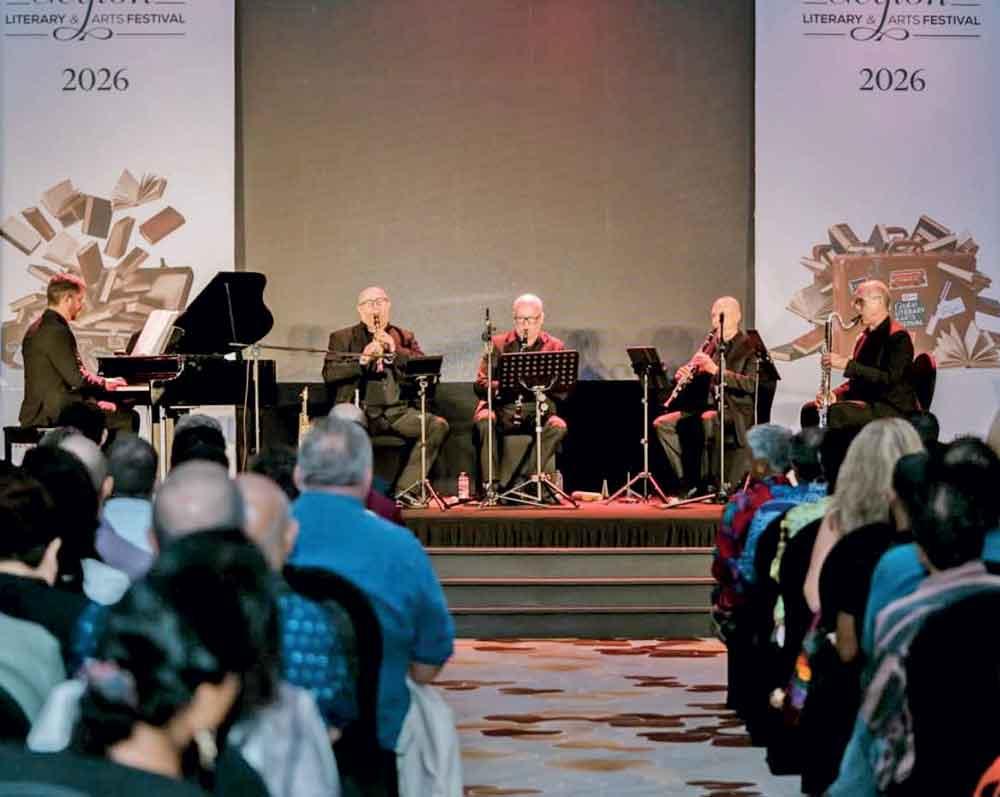
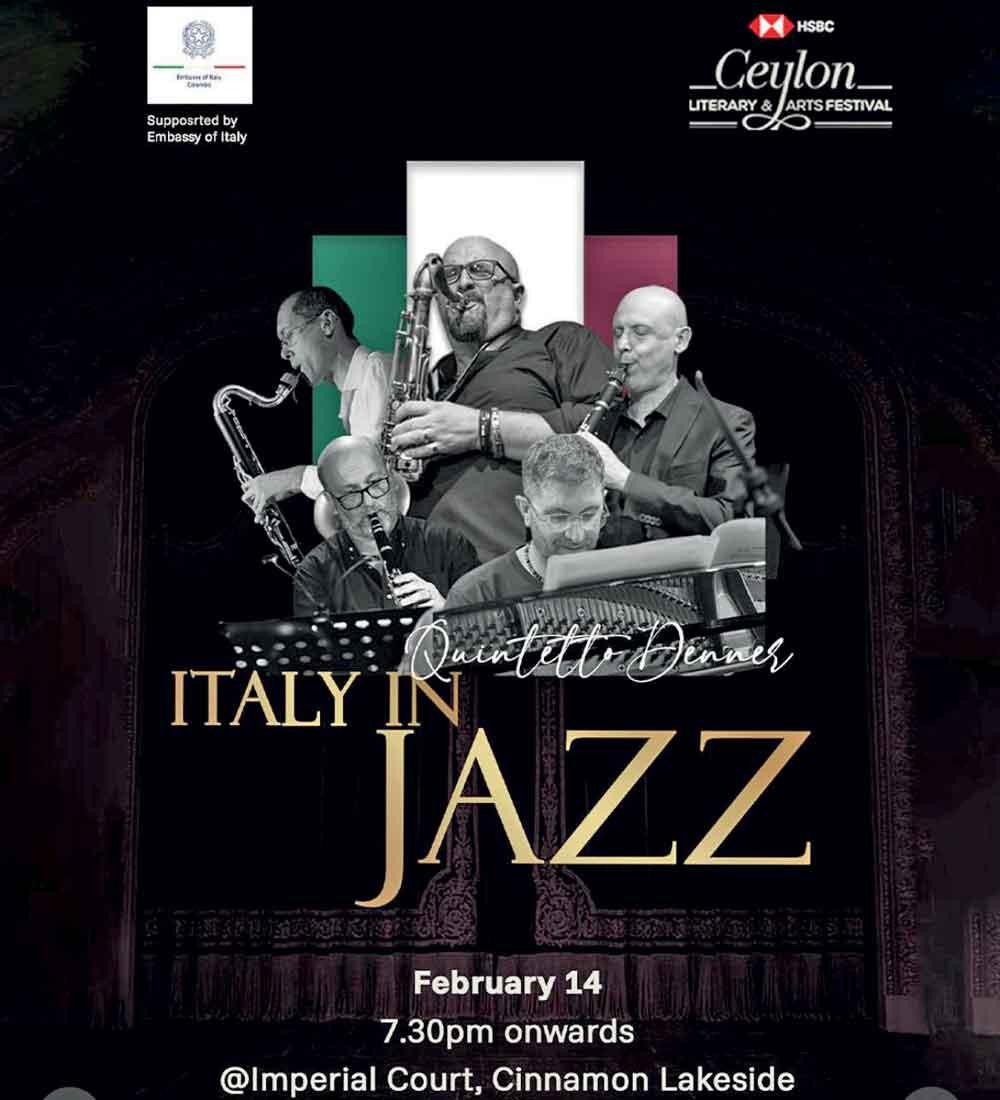
On the evening of February 14, 2026, beneath the warm glow of Colombo’s cultural calendar at the Ceylon Literary Festival, Quintetto Denner did something that went far beyond performance.
They built a bridge.
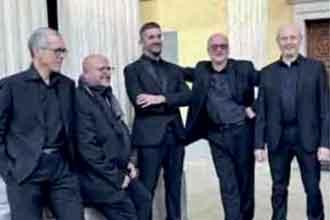 “Italy in Jazz” was not conceived as a Valentine’s Day concert. And yet, the coincidence of the date lent the evening a quiet intimacy. What unfolded was not a recital designed around romance, but something far more profound — a dialogue between classical discipline and jazz improvisation, between Italian heritage and Sri Lankan warmth, between five musicians and a listening audience that quickly became part of the performance itself.
The story of Quintetto Denner began many years ago, long before their arrival in Colombo. Originally formed as a trio dedicated to classical and contemporary repertoire, the ensemble’s artistic trajectory shifted dramatically following an encounter with two towering figures of Italian jazz: Guerrino Allifranchini and Filippo Rodolfi.
“The project was born many years ago,” they explain. “In the beginning, we were a trio dedicated to classical and contemporary repertoire. A turning point came when we met two extraordinary figures of Italian jazz: Guerrino Allifranchini, a vocalist, saxophonist and clarinetist of international renown, and Filippo Rodolfi, a pianist, composer, and arranger with an equally prestigious career.”
That meeting reshaped everything. The trio expanded into a quintet, and with it emerged what they describe as a “natural integration between the jazz dimension and the more structured world of classical and contemporary music.”
Their formation — three clarinets, bass clarinet, and piano — is unconventional. Literature written specifically for such an ensemble was virtually nonexistent. Filippo Rodolfi became central to solving that challenge. Through original compositions and carefully crafted arrangements, he defined the architecture of their sound and helped overcome what they describe as one of the main obstacles of a “non-standard” ensemble: the absence of repertoire.
If Rodolfi gave them structure, Guerrino Allifranchini gave them something equally enduring — humanity.
“We learned an enormous amount from Guerrino—musically and, above all, humanly. For us, who were little more than kids, working side by side with him was an immense privilege.”
Despite an international career of remarkable scale, Allifranchini remained humble, generous, and deeply collaborative. From that collaboration grew something that still defines the group today: a sense of family.
“I have always considered him, and still consider him, not as a father figure but as a brother: someone who illuminated our path and left an indelible mark on our history.”
That familial dynamic is visible on stage. Decisions about which instrument carries a melody are not dictated rigidly. Though the arranger may suggest a direction, choices often emerge organically during rehearsal.
“We discuss a lot, listen carefully to one another, and let the music guide us. In the end, we decide together which voice truly resonates with the emotional core of the piece.”
It is an instinctive process — and perhaps one of the most beautiful aspects of their identity.
A Valentine’s Evening , By Chance
Despite the symbolism of February 14, the ensemble did not prepare a romantic setlist.
“Not particularly,” they admit. “We didn’t prepare a Valentine’s Day–specific repertoire. We simply added My Funny Valentine because it was February 14th, but it was a spontaneous decision, made ten minutes before going on stage.”
That spontaneity is central to jazz itself.
“When you play, you don’t try to impose an emotion; you hope instead that an exchange is created — that mysterious flow that arises only when many people share the same space, the same breath, and music becomes the connecting medium.”
When that flow appears, they describe it simply as magic — a rare alchemy in which stage and audience cease to exist as separate entities.
The evening’s repertoire was a carefully curated portrait of Italian musical identity.
They performed exclusively Italian music, with one exception: Spain by Chick Corea, included because of a “wonderful arrangement”
by Filippo Rodolfi.
The rest of the programme spanned centuries and genres. Classical and operatic giants such as Giuseppe Verdi and Giacomo Puccini stood alongside Italian cinema, represented through an “Ennio’s Medley” dedicated to Ennio Morricone.
The journey continued into Italy’s singer-songwriter tradition — Lucio Battisti, Sergio Endrigo, Paolo Conte, and Gino Paoli — artists whose music shaped generations.
Every piece, they emphasise, was arranged or composed expressly for their ensemble by some of the most compelling voices in contemporary Italian music. The result was not a random selection of beloved works, but a cohesive narrative of Italian artistry — interpreted through clarinets and jazz sensibility.
Yet one of the most moving moments of the night did not originate in Italy.
In a gesture of cultural respect, Quintetto Denner performed Hanthana Sihine, a beloved Sinhala song. It was a piece they had never encountered before their visit.
“We always try to do this: whenever we have the privilege of meeting a culture different from our own, we explore its music. We ask our hosts to suggest meaningful songs and then reinterpret them ‘in our own way,’ respecting our language and identity as musicians.”
Sometimes, they say, jazz functions as a bridge from their culture to another. Other times, they take a local melody and build the bridge in reverse.
“This time it happened with Hanthana Sihine — a piece we didn’t know, but which touched us deeply from the first listen.”
The arrangement, crafted by pianist Alessandro Manni Villa, was met with an emotional response that confirmed the risk had been worthwhile.
“We immediately felt from the audience’s reaction that the same emotion reached them too.”
They identify that moment as one of the most powerful of the evening — a gift exchanged between cultures.
Sri Lanka: Love at First Sight
Having performed in major international venues — from opera houses in China to jazz festivals in Canada — comparisons are inevitable. Yet Colombo left a particular imprint.
“Our encounter with Sri Lanka was love at first sight,” they say.
They speak of smiles — constant, sincere, welcoming. “If I had to capture our relationship with the audience in one image, I would choose a smile.”
Three words define Sri Lanka’s audience for them: enthusiastic, smiling, and respectful.
When they stepped off stage that night, they felt something unexpected.
“We felt deeply welcomed. I know it may sound strange, but it truly felt a bit like coming home.”
It did not feel like a first visit, they explain, but rather like reconnecting with old friends.
“Illogical as it may seem, that is exactly how we felt.”
In a time when global headlines often highlight division, jazz offers a quiet counterpoint.
“Jazz teaches us freedom. And music, in general, teaches us to listen to one another — to respect timing, not to overlap, to leave space, to harmonize our contribution with that of the group.”
It becomes, in their view, a living metaphor for coexistence — dialogue without domination, expression without erasure.
The Message
As the conversation turned toward the next generation, their advice was clear and deeply sincere.
“Do not renounce your origins or roots in the attempt to appear more ‘international.’ You can communicate your cultural heritage with pride without sacrificing the quality or the strength of the artistic project you bring into the world. Often, it is precisely that authenticity that makes it unique.”
In other words, international recognition does not require imitation. It requires identity.
More than two decades into their journey, Quintetto Denner continues to evolve. Collaborations persist. Arrangements are refined. New audiences are discovered.
But what happened on February 14 in Colombo was not just another concert date on a touring calendar.
It was a reminder that music, when played with sincerity and openness, collapses distance.
Italy arrived in Sri Lanka through Verdi, Puccini, Morricone, Battisti, and jazz improvisation. Sri Lanka answered back through Hanthana Sihine and smiles.
And for one evening, two cultures — separated by geography but united in sound — recognised each other completely.
Not as strangers.
But as something far more familiar.
08 Jun 2026 8 minute ago
08 Jun 2026 43 minute ago
08 Jun 2026 1 hours ago
08 Jun 2026 1 hours ago
08 Jun 2026 2 hours ago