06 Feb 2025 - {{hitsCtrl.values.hits}}
 The special commemorative supplement published with the Daily Mirror and the Daily FT on 4th February 2025 to mark the 77th anniversary of Independence, and especially its lead article, contains several inaccurate statements.
|
Pic by Pradeep Pathirana
|
The Ceylon (Constitution) Order in Council 1946 came into force in 1947. Commonly described as the “Soulbury Constitution”, it was in fact drafted in Ceylon, on the instructions of Mr. D.S. Senanayake, Vice-Chairman of the Board of Ministers, and Mr. J.H.B. Nihill, the Legal Secretary, by a young Assistant Legal Draftsman, Bernard Percival Peries, on the basis of the report of the Royal Commission headed by Lord Soulbury, the Ministers’ Draft prepared by Sir Ivor Jennings, and the WhitePaper embodying the decisions of the British Government. Thereafter, in accordance with the Parliamentary Elections Order in Council, also drafted by Peries, a General Election was conducted between 20th August and 20th September 1947, at the culmination of which, Mr. D.S. Senanayake, was sworn-in as Ceylon’s first Prime Minister. The first meeting of the House of Representatives was on 14th October 1947, and Ceylon’s first Parliament was ceremonially opened by the Governor of Ceylon, Sir Henry Moore, on 25th November 1947.
Following further negotiations conducted by Mr. Senanayake and Sir Oliver Goonetilleke, and the signing of an External Affairs Agreement, a Defence Agreement, and a Public Officers Agreement, the Ceylon Independence Act was enacted by the United Kingdom Parliament on 10th December 1947. Acting under that Act, King George VI issued an Order-in-Council designating 4th February 1948 as the “appointed day” for “the attainment by Ceylon of fully responsible status within the British Commonwealth of Nations”.
At 7.30 am on the morning of 4th February 1948, Sir Henry Monck-Mason Moore was sworn in as the Governor-General of the Dominion of Ceylon by the Chief Justice Sir John Howard. Thereafter, the Prime Minister and the members of the Cabinet were sworn in. Apart from religious ceremonies and a broadcast to the Nation by Mr. Senanayake, there does not appear to have been anyother significant official event in Colombo on that day, whether at the Town Hall or elsewhere.
It was on 10th February 1948 that the “first” session of the First Parliament of the Dominion of Ceylon was inaugurated by the Duke of Gloucester representing King George VI
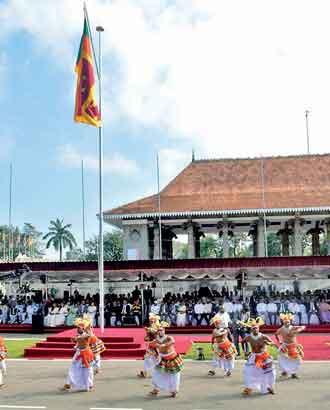
It was on 10th February 1948 that the “first” session of the First Parliament of the Dominion of Ceylon was inaugurated by the Duke of Gloucester representing King George VI. The ceremony took place in the specially constructed Assembly Hall in Torrington Square which, in conception and execution, was an amazing historical flashback. The large gathering included envoys from foreign countries, religious and civic dignitaries, and judges in their scarlet and ermine robes. The Address of Thanks was presented by Sir Oliver Goonetilleke on behalf of the Senate, and Mr. S.W.R.D. Bandaranaike on behalf of the House of Representatives. Thereafter, to the accompaniment of magul-bera and the blowing of conches, the Prime Minister unfurled the Lion Flag, and broadcast to the Nation. There is no record of any other event at the Town Hall or elsewhere.
The Duke and Duchess of Gloucester spent another week in Ceylon, during which they visited Kandy where they witnessed Mr. Senanayake unfurl the Lion Flag over the pattirippuwa of the Dalada Maligawa, and Peradeniya where the Duke laid the foundation stone of the Convocation Hall of the University of Ceylon, and where he, Lord Soulbury, Mr. Senanayake, and Dr Andreas Nell were each conferred the honourary degree of Doctor of Laws. There is no record of the Duke having visited the Parliament building.
It was in the following year, 4th February 1949, that, following a morning parade and march-past of the armed forces on the Galle Face Green, the scene shifted in the afternoon toTorrington Square where a drill display by a thousand schoolgirls took place in the presence of the Governor-General, the Chief Justice and the Prime Minister who were accommodated on a specially constructed dais. The highlight of the day was the arrival of four young runners representing the four major communities who brought with them messages of goodwill and co-operation from the four corners of the Island. The relay, which had commenced from Devundera, Point Pedro, Batticaloa, and Colombo, ended when the four runners handed over their scrolls to four young women who were accommodated on the dais. Each, in turn, read the message. If I recall correctly, three of the four runners were Oscar Wijesinghe, Lakshman Kadirgamar, and Duncan White. The four young women were Swarnamali Amarasuriya, Sirimani Ramachandran, Ayesha Zally, and Phyllis de Kretser.
Another significant event that afternoon was the laying of the foundation stone for the Independence Memorial Hall in Torrington Square by the Prime Minister at the spot where the Assembly Hall had stood in the previous year. Three years later, Mr. Senanayake passed away, and his cremation took place at the same spot in whatwas then known as Independence Square.
Two more years passed by, and the new Independence Hall was the magnificent venue for the State Opening of the Third Session of the Second Parliament of Ceylon by Queen Elizabeth II in April 1954.
What I have described above are drawn from memory but confirmed from newspaper clippings and other material I have maintained of significant events since from October 1947. When I entered Royal College in January 1948, having been a wolf-cub at Royal Primary School, I was immediately inducted into the scout troop. That had its privileges. On 4th February of that year, I was among the scouts “on duty” at the specially constructed Assembly Hall when the Duke of Gloucester opened Parliament. When I returned home, I made a replica of the Assembly Hall using cardboard strips and colourful chocolate paper as a substitute for the ralipalan.
In the following year, I was “on duty” at Torrington Square when the four runners brought their messages of goodwill and then heard them being read by the four young women, one of whom was to become my sister-in-law many years later. Thereafter, on every Independence Day I was “on duty” at Galle Face Green.At every opening of a new session of Parliament, I stood on the steps of the Parliament building in the blazing sun, compensated only by the fact that on the opposite site of the steps were the girl guides. These opportunities ended when I could no longer wear blue shorts and stockings and had to graduate into longs.
11 Jun 2026 15 minute ago
11 Jun 2026 19 minute ago
11 Jun 2026 24 minute ago
11 Jun 2026 26 minute ago
11 Jun 2026 30 minute ago