27 Feb 2025 - {{hitsCtrl.values.hits}}
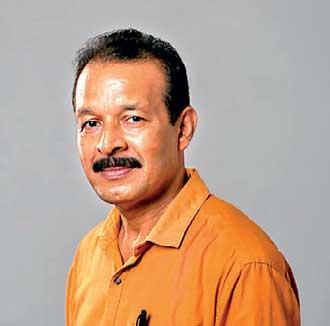
 Dr. Ranjith Dharmathilaka is a senior lecturer at the Faculty of Visual Arts, University of the Visual & Performing Arts. With a rich oeuvre of paintings spanning over 3 decades, along with being an accomplished author, Dr. Ranjith is a maestro in all things art.
Since the 9th edition of his solo art exhibition is just around the corner, Daily Mirror sat down in conversation with him to get a deep dive into his work and upcoming exhibition.

 Can you give us a small introduction to your work?
I held my first solo art exhibition in 1989. The paintings displayed at the exhibition were crafted incorporating watercolours. From my second exhibition onwards, I decided to incorporate watercolours and continued to do so, up until my 8th exhibition, where I transitioned to acrylic paint. This transition was a result of my well-wishers commenting that I have a natural affinity for abstract art. My 9th solo art exhibition, titled the ‘rhythm of power’, is scheduled to take place during the first week of March, and all the paintings that are to be showcased have been created incorporating abstract art.
|
Dr Ranjith Dharmathilaka brings 30 years of artistic experience to his 9th solo exhibition |
Are there any thematic areas you’ve touched upon through your paintings?
I’m from Badulla, and I was raised in an environment lush in greenery. This gave me a stepping stone to base my art upon. I have given a good amount of focus to the environment through my acrylic paintings. This time, however, I have taken a detour from my general method and granted more of a focus on the cultural aspects of society. Tangential to this, my artistic lens has been directed towards a cityscape theme, which will be displayed at my 9th exhibition.
The reason for this is that there is a common conundrum despite us living in the present, we tend to cling on to remnants of the past. This is a yearning that can only be experienced through the wonders of art, hence my foray into it. I have included themes of war, grandeur, and horse riding, which I have showcased as powerful symbols that bear significance to our country’s proud heritage. What I am to achieve through my paintings is to provoke people to engage with incidents from Sri Lanka’s past and interpret them in the present.
What inspired you to come up with the name ‘The Rhythm of Power’?
Each one of my exhibitions has a name that befits the paintings being showcased, and ‘the rhythm of power’ should tell you all there is to know about the upcoming exhibition. As poetic as it sounds, power does have its own rhythm, and it can be applied to any facet of life.
Society is fractured into varying strata, and this has been evident since times past. From ancient kings to the general population, each had their assigned place within society, along with their inherent experiences. I have managed to capture this feature through my abstract painting
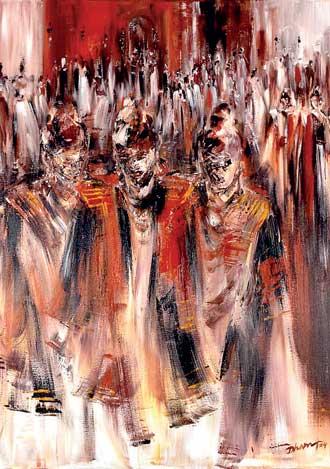
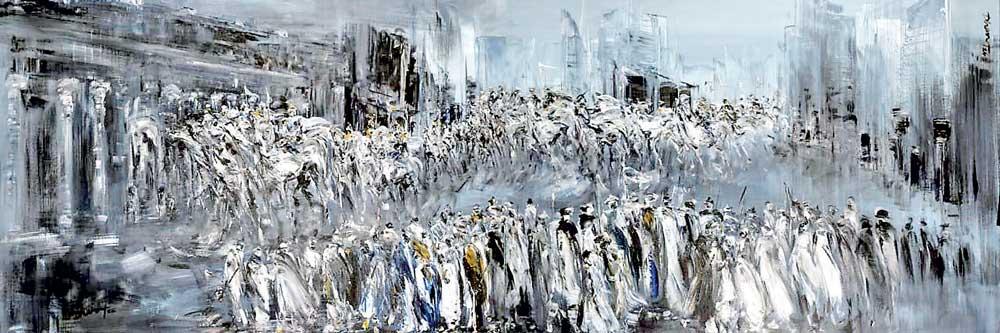
Abstract art has a rawness to it, an almost modern touch to a centuries-old form of expression: painting. I have incorporated a form of art known as abstract expressionism into my work. This helps me focus on using broad brushwork and preserving my emotional state of the perceived image I am currently working on.
|
Selections from Dr. Ranjith Dharmathilaka’s abstract expressionist works
|
Abstract art has been used in myriad methods: spraying, splashing, using a wide arsenal of materials, and walking on a painting from all four directions, thereby preserving and uplifting the emotion of the painting.
H.A. Karunaratne, also known as the father of abstract art in Sri Lanka, was inspired by Pablo Picasso when he initially began his journey. In the last picture, H.A Karunaratne worked on a painting done with two colours. What I mean to say is that art doesn’t take a lot of effort, but patience and a creative mind.
What makes your 9th art exhibition unique?
When I first started off painting natural elements, I incorporated a multitude of colours into my paintings, but this time, I’ve done something different. The paintings have been brought to life with simple tones such as white and brown, along with using a few splashes of blue, black and yellow. The purpose of such a method is to depict the raw images in my mind. In short, simplicity is the bedrock of my work.
You mentioned that you made the switch from watercolours to acrylic paintings before; did this change your perception of painting?
When I begin working on a painting, I never use a pencil to even sketch. I simply begin putting paint to paper, and this is done with the intent of preserving something I’ve previously experienced in all its rawness. My workflow involves a good amount of speed and precision, which makes up for an enjoyable process overall. Using cardboard instead of canvas enables me to maintain a high level of efficiency in my work, up until the completion of the project. As I mentioned before, the name of the exhibition is synonymous with my work. Thus, I’m able to maintain a steady rhythm when I’m both working on and presenting my paintings.
You mentioned that you have a keen eye for detail. How deeply have you considered the details that go into your work?
I’m both an artist as well as a graphic artist. This multi-disciplinary approach has given me the ability to study the workflow and methodology of artists from across the globe. For the ‘rhythm of power’, my art has undergone a massive shift from natural elements to figures. What I aim to show people through my work on cityscapes is how we navigate our lives through this complex maze called a city. For example, I have incorporated white, black and red into one of my paintings, which is also reflective of the behaviour in people. People embody each of these shades within themselves. Tangential to this, I have also crafted portraits of kings and other ancient symbols of prestige and grandeur that nudge people to embrace our proud heritage.
Although each painting took me close to 2 hours to complete, every time I walked by it, I tended to see its details in varying lights. Since our eyes can adapt to light, you tend to see pictures in varying angles in different lights. My motive through this exhibition is to enable someone to experience what I have experienced through my work.
Now that we’ve gotten some insights into the technical aspects of your work, could you please tell us more about your upcoming exhibition?
As I mentioned previously, this is my 9th solo art exhibition titled, ‘The Rhythm of Power’. Each one of my exhibitions has been named according to the paintings displayed at the exhibition, thereby giving it an allegorical touch to it. There will be 33 paintings exhibited this time, and the dimensions of each painting are quite large; each frame is around 8ft 6in in length. If I were to talk about the process of working on these exhibits, all I can say is that it was a carefully measured approach.
Are there any words of wisdom you wish to impart to upcoming artists in the country?
Craft your own style of art. As someone who has been steeped in the arts in general, be it painting, poetry or performing arts, I’ve always been thrilled to hear of anyone developing an interest towards it. This is one of the only fields that has the capacity to expound and amplify their creative license publicly.
As a lover of the arts in general, I’ve always been thrilled to hear anyone developing an interest towards it because this is a genre/one of the few fields that expounds human emotion at its core. Embracing the arts gives birth to a very sensitive human being, and that sensitised human being is able to feel and understand. If someone is able to translate their raw and unfiltered emotions into art, be it painting or writing, therein lies the beginning of a wonderful journey.
As an artist, the best advice I can give someone is to take inspiration from artists like Van Gogh, Gauguin, Picasso and DaVinci. It’s always good to take inspiration from these artists and create your own style of art, because your art tells your story.
The ‘Rhythm of Power’ will be held at the J.D.A. Perera Gallery, Colombo-07, from the 06th to the 09th of March, from 10:00 am to 10:00 pm. Entry for the exhibition is free of charge.
11 Jun 2026 16 minute ago
11 Jun 2026 20 minute ago
11 Jun 2026 25 minute ago
11 Jun 2026 27 minute ago
11 Jun 2026 31 minute ago