04 Sep 2025 - {{hitsCtrl.values.hits}}
Ahead of the Shanghai Cooperation Organization (SCO) summit held in north China’s port city of Tianjin, the leaders of the most populous and powerful countries in the Global South met.
A photo which shows Chinese President Xi Jinping, Indian Prime Minister Narendra Modi and Russian Vladimir Putin together went viral because of its symbolic weight. It sends a powerful message about the alignment of powers in the south when their interests merge against the west. They stood like old friends in a jovial mood.
The three most powerful non-western leaders stood shoulder to shoulder in this fashion sending a powerful message to the entire world; that they won’t bow down to the western pressure.
International relations take shape under the circumstances which are evolving by the day. The SCO summit and the leaders’ meeting that preceded it took place in the wake of reciprocal tariffs imposed by U.S. President Donald Trump.
India, a key contributor to the global economy, was hit with an oppressive tariff rate of 50 percent. It was a punitive rate imposed because it refused to stop purchasing Russian oil.
India and China sought to ease tension and improve relations at this meeting. Thawing of relations between India and China was unimaginable before because of border tension and standoffs since 2020.
For Sri Lankans, what they have mostly seen over the years is the tension between China and India playing out in the region. New Delhi continues to view with unease any deepening Chinese footprint here, citing national security concerns. The latest example is its strong opposition to Chinese maritime research vessels entering Sri Lanka’s exclusive economic zone — a development India perceives as having clear security implications.
In the aftermath of the hostile military standoff in 2020, anti-China sentiment ran rampant in India, with hundreds of Chinese apps – including TikTok – banned and Chinese companies were prevented from investing in India.
Now, the U.S. tariffs have prevailed upon the two countries to explore close collaboration in trade while easing off border tension. Xi told Modi that China and India are each other’s development opportunities rather than threats, according to a news report by Xinhua.
As long as the two countries keep to this overarching direction, specific matters in the bilateral relations will fall into place and there will be steady and sustained progress in bilateral ties, Xi said as reported by Xinhua.
He said China and India are important members of the Global South, and shoulder the crucial responsibility of improving the well-being of the two peoples, promoting the solidarity and rejuvenation of developing countries, and advancing the progress of human society, Xinhua reported.
Modi told Xi that his country was committed to improving ties with China and discussed reducing India’s burgeoning bilateral trade deficit of nearly $ 99.2 billion, while emphasising the need to maintain peace and stability at their disputed border after a clash in 2020 triggered a five-year military standoff, as reported widely in the international media.
There are immediate takeaways from the meeting – agreement to resume direct flights and to simplify visa processing. India and China are now set to normalize border tension and improve trade relations.
Ahead of the SCO summit, the Indian leader met with the Russian President. India and China are the largest importers of Russian oil. These two countries serve as the lifeline of Russia after the western world slapped sanctions on Moscow following the war with Ukraine. The two countries defied the U.S. call to stop oil purchases from Russia.
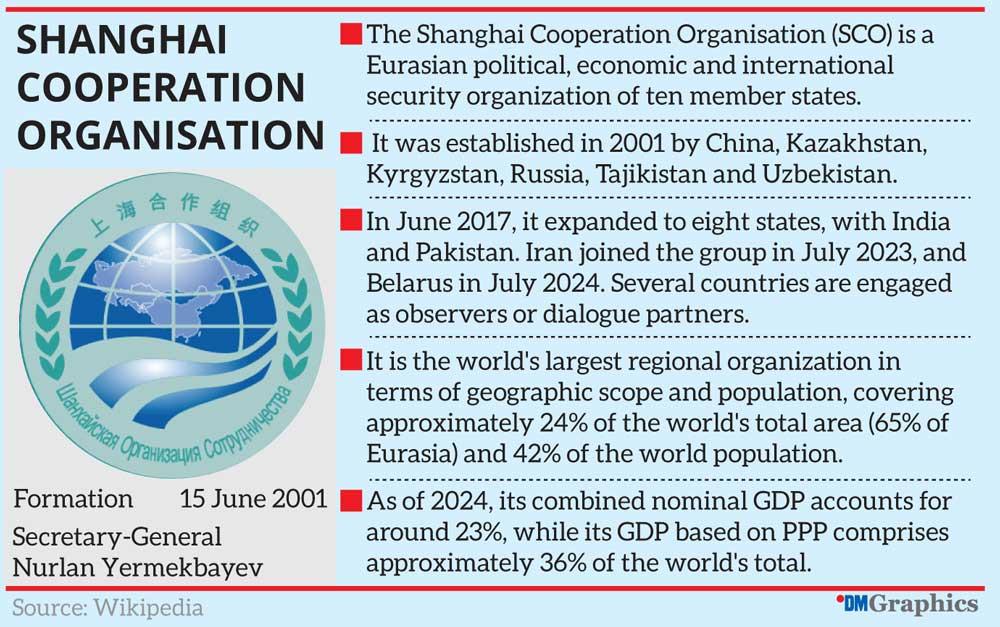
The three leaders were at the SCO summit. The SCO is an international security bloc that was established in 2001 by China, Russia, Tajikistan, Kyrgyzstan, Kazakhstan and Uzbekistan. India and Pakistan became full members in July 2023.
The grouping now has 10 members, including Iran and Belarus. Today, it is a defining organization in a multi-polar world rejecting the western model of globalization.
The summit carried symbolic weight this year with the presence of these leaders showing camaraderie and charting a new course for cooperation. Sri Lanka, a SCO dialogue partner, was not invited for the summit this time.
Sri Lanka has been an active member of the Global South right throughout. In fact, it has also sought membership of BRICS, another key bloc.
Many eyebrows have been raised locally as to why Sri Lanka was not invited for the summit. It is natural for Sri Lanka to enhance ties with countries such as India, China and Russia and seek further economic integration with them for long term prosperity.
Yet, its hands are tightened today in choosing partners and seeking geopolitical alignments.
As a country located in the heart of the Indian Ocean with a geostrategic posture, it is caught in the midst of an aggressive competition among major powers for hegemony. In India’s security radar, Sri Lanka is featured prominently as its closest maritime neighour in the south. In striking fresh deals with China, Sri Lanka is compelled to bear in mind that none of them has any sort of bearing on India’s national security interests.
Sri Lankan even had to abandon some investment projects over protest from India.
Now, India and China are warming up to each other in the new global landscape. Their relationship is complex and complicated. Any current easing off of tension does not mean that India will lose its concerns over Chinese involvement in Sri Lanka in case of a threat to its national security, real or perceived. Sri Lanka’s equation with India remains the same.
Also, choices remain limited for Sri Lanka because of the economic crisis. The U.S. remains its largest export destination. Currently, President Trump has slapped 20 percent tariffs on Sri Lankan goods entering the U.S. market. Any further hike of such tariffs will be disastrous for the Sri Lankan economy which is now trying to recover from its worst ever crisis.
It is sensible if the current government makes a cautious approach under the evolving circumstances in the word. Sri Lanka will not seek to identify with any camp at this time. At the same time, it should not miss opportunities available at the moment. India and China are critical partners and the U.S. remains the island’s largest export market.
It is the tightrope Sri Lanka must walk. Its instinct to engage with the Global South is natural and necessary. Greater integration with blocs like the SCO or BRICS could open new trade, investment, and strategic opportunities.
The lesson from the SCO summit is clear. The world’s great powers are not bound by permanent enmities. They adapt and come together when interests demand it. For Sri Lanka, the prudent path forward is one of caution at the moment. It should develop its strengths somehow and leverage its strategic positioning.
08 Jun 2026 35 minute ago
08 Jun 2026 51 minute ago
08 Jun 2026 56 minute ago
08 Jun 2026 58 minute ago
08 Jun 2026 1 hours ago