12 Mar 2026 - {{hitsCtrl.values.hits}}
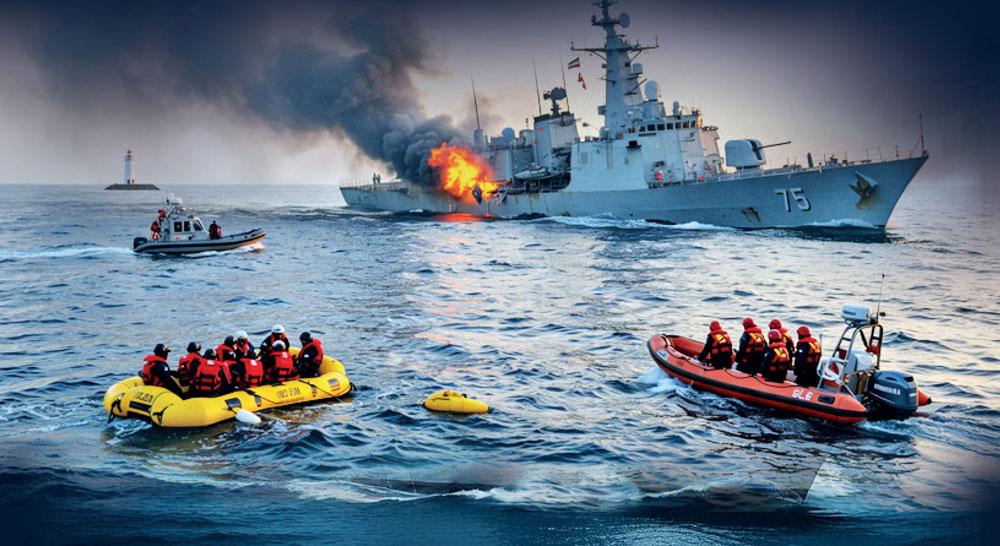
 Attorney-at-Law Dr. Dan Malika Gunasekera, an expert in international law, the law of the sea and maritime law, shared his legal insights with the Daily Mirror regarding the reported attack on an Iranian warship in waters close to Sri Lanka and the series of developments that followed. Speaking on the legal implications of the incident, Dr. Gunasekera explained that under existing international legal regimes, there is generally no prohibition on military engagement taking place outside a state’s national territorial sea. However, he stressed that the situation requires careful diplomatic and legal consideration, particularly in light of Sri Lanka’s longstanding position as a neutral State. Commenting on the Iranian seamen and crew members who were rescued from two vessels following the incident, Dr. Gunasekera also noted that Sri Lanka must act with caution. In his view, seeking the assistance of international bodies such as the United Nations or the International Committee of the Red Cross could have strengthened Sri Lanka’s position while ensuring neutrality. Excerpts from the interview:
- In the area of commercial shipping, there are civil liability conventions like the CLC Convention, or convention for Civil Liability for Oil Pollution Damage for damage occurring from tanker vessels. There is a legal instrument convened by the IMO. Then with regard to bunker oil pollution also in commercial shipping, there is an instrument called the bunker oil convention of 2001.
- “Seeking the assistance of international bodies such as the United Nations or the International Committee of the Red Cross could have strengthened Sri Lanka’s position while ensuring its longstanding status of neutrality.”
 QWhat are the key principles of international laws that apply when a military attack takes place in waters close to a coastal state like Sri Lanka?
The United Nations Convention on the Law of the Sea (UNCLOS), often called the Law of the Sea Convention, is one of the most extensively negotiated international agreements and is widely regarded as the “Constitution of the Oceans.” Its development began with the first UNCLOS conference in the late 1950s, but both the first and second conferences failed to produce a comprehensive legal framework due to difficulties in reaching consensus among states. A breakthrough came during the third conference in the 1970s, leading to the signing of the Convention in 1982 in Montego Bay, Jamaica. Although many countries participated in the negotiations, the United States has not ratified the Convention. UNCLOS is a key instrument of international law because it regulates maritime relations among coastal and landlocked states and governs the use of the world’s oceans. Despite being signed in 1982, the Convention only entered into force in 1994 after sufficient ratifications were obtained. Issues relating to warships and military vessels received limited attention during negotiations, as states were reluctant to restrict their naval capabilities. Consequently, among the Convention’s roughly 320 articles, only a few deal directly with military activities at sea.
 QUnder the United Nations Convention on the Law of the Sea (UNCLOS), what jurisdiction does Sri Lanka have over incidents occurring in its territorial sea, contiguous zone, and Exclusive Economic Zone (EEZ)?
Territorial Sea
The United Nations Convention on the Law of the Sea (UNCLOS) allows every coastal State to claim a territorial sea extending up to 12 nauticalmiles from its baseline. This maritime zone is considered an extension of a State’s Sovereignty over its land territory, meaning that the domestic laws of the coastal state apply within this area.
However, geographical limitations sometimes prevent states from claiming the full 12 nautical miles. For example, the distance between Sri Lanka and India in the northern waters is about 18 nautical miles, which has been equally divided, giving each country approximately 9 nautical miles of territorial sea in that area. In most other coastal regions, Sri Lanka enjoys the full 12-nautical-mile territorial sea. Within this zone, foreign vessels are allowed passage only under the right of innocent passage, meaning their movement must not threaten the peace, security, or order of the coastal state. Foreign warships generally require prior permission, while commercial ships may pass as long as their passage remains innocent.
Contiguous Zone
Beyond the 12-nautical-mile territorial sea lies the contiguous zone, an additional maritime area where a coastal state has limited enforcement powers but not full sovereignty. In this zone, which extends up to another 12 nautical miles, the coastal state may enforce specific laws relating to customs, fiscal (taxation), immigration, and sanitary regulations. These powers allow authorities to prevent or punish violations that may affect the state’s security or regulatory system. Therefore, vessels that leave the territorial sea and enter the contiguous zone may still be subject to these controls, particularly if they are suspected of breaching customs, immigration, taxation, or public health regulations.
Exclusive Economic Zone
Thecontiguous zone is included within a coastal state’s Exclusive Economic Zone (EEZ), which extends up to 200 nautical miles from the baseline. Beyond the 12-nautical-mile territorial sea, the remaining 188 nautical miles from the EEZ, including the contiguous zone. Unlike the territorial sea, the EEZ does not grant full sovereignty to the coastal state. Instead, the state has limited sovereign rights, primarily over the exploration, exploitation, conservation, and management of natural resources in the waters, seabed, and subsoil. These rights enable the state to regulate activities related to both living and non-living resources, while general navigation remains open to other states.
High sea
Beyond the exclusive economic zone is the high seas and high seas is free for all. So, in the exclusive economic zone, the ships have the right to navigate. It’s a right to navigate as long as it adheres to the sovereign rights with regard to the exploration and exploitation of natural resources of the coastal state. The foreign vessels have the right to navigate. Any country can fish in the high seas and so forth, but also there are now regional organisations that maintain certain conservation arrangements in the high sea areas of various oceans.
QIf a foreign naval force, such as the United States, conducts a submarine attack in the Indian Ocean close to Sri Lanka, does it violate Sri Lanka’s sovereignty or international maritime law?
Now, as I told you before, there is no prohibition as such for ships to get engaged in such activities outside the national territorial sea. The submarines in particular, can operate under the water in the exclusive economic zone. But when, if they come to the territorial sea, then even the submarines have to navigate on the surface of the water. It is not a prohibition because the law of the sea does not prohibit such acts.
There is no need to get consent from the nearby coastal State when such activities take place in the international waters. So, still exclusive economic zone is called international waters because it only has sovereignty with regard to the natural resources.
What role does the United Nations or the International Maritime Organization play when a naval conflict affects maritime safety or shipping routes in the Indian Ocean region or Strait of Hormuz?
The International Maritime Organisation (IMO) is the international regulator for maritime affairs. It is called the watchdog for shipping. It mainly regulates commercial shipping and it does not do anything with regard to naval conflict. But when there is kind of naval conflict that affects commercial shipping, of course, then the IMO can intervene. The IMO can intervene with the respective governments.
Now even during the Red Sea conflict, which was a proxy war where Houthis attacked commercial vessels, we saw that the IMO issuing various kinds of resolutions and guidelines for its commercial fleets in avoiding the attacks of the Houthis. But other than that, the IMO cannot intervene in the naval conflicts. But however, the United Nations, being the main international organisation for peace, can interfere and then they can take certain decisions through its executive council.
The Security Council takes decisions, inform the countries that are involved in the war-like situation, or if it extends to a war, even in the war, the countries that are involved in such war, the United Nations can intervene and try to safeguard the region’s sea areas.
QIf an Iranian vessel was sunk as a result of the attack, who would bear responsibility under international law for environmental damage caused by fuel spills or hazardous cargo?
We have to really distinguish between the civil liability situation in commercial shipping and the sort of a liability that erupts in a situation of a naval conflict. In the situation of a naval conflict, the blame should go to the attacking state and whatever damage has to be paid by the attacking state. Actually there is no strict law with regard to this. It is basically the laws of war and laws on armed conflicts that provide some sort of relief to the situation. But there are no applicable strict laws pertaining to this sort of an event or situation.
QCould the sunken vessel near Sri Lankan waters pose a risk to marine ecosystems, fisheries, or coastal communities, and what international mechanisms exist to address such damage?
It can happen because of the chemical deposits in the ship and the other types of toxic material that may be present in such ships. Then it’s a risk for marine ecosystems, fisheries, coastal communities because we also eat fish and if the fish are contaminated with lead or cadmium or mercury or likewise. Humans are vulnerable to cancerous substances. There is no such instruments addressing the compensation aspect with regard to loss or damage in such a situation. However, control of such things, there are international instruments such as the anti-fouling convention with regard to the paints and other things. With regard to biodiversity, also there are conventions.
QIf pollution or environmental harm occurs in Sri Lanka’s maritime zones, is there a legal pathway for Sri Lanka to seek compensation from the responsible state or parties involved?
In the area of commercial shipping, there are civil liability conventions like the CLC Convention, or convention for Civil Liability for Oil Pollution Damage for damage occurring from tanker vessels. There is a legal instrument convened by the IMO. Then with regard to bunker oil pollution also in commercial shipping, there is an instrument called the bunker oil convention of 2001. There are additional fund conventions that provide the funding for such damage or loss. With regard to the damage caused by warships, naval auxiliaries, then like I said earlier, it is matter that has to be handled between diplomatic channels of the states in obtaining the rightful compensation for the damage or loss occurred to coastal states.
QWhat obligations does Sri Lanka have under international maritime treaties to ensure the safety of navigation and protection of marine resources in its surrounding waters?
Yes, the particular domain is very, very legislated and a highly legislated area, especially by the IMO (International Maritime Organization) in its legislations that apply to commercial shipping. And those only apply to commercial shipping. So, whatever the damages that occur as a result of shipping activities can be obtained through such regimes. In particular, there are five main areas of marine pollution: shipping, land-based pollution, dumping by ships, atmosphere pollution and deep sea mining.
QWhat legal frameworks govern humanitarian obligations at sea if sailors or crew members from a damaged vessel require rescue or assistance?
I would like to reiterate that international humanitarian law applies to Sri Lanka because we are a state party to international humanitarian laws most of the humanitarian laws. We are supposed to give assistance to sailors and crew members at times of distress.
We have to be very careful in this situation and, in my opinion, what Sri Lanka could have politically done at that moment is to get the assistance of the UN or the ICRC (International Committee of the Red Cross), so that their intervention in that process would have given us a much greater opportunity or a much greater involvement by protecting our status as a neutral state.
My opinion is that politically we could have obtained the assistance of UN or ICRC in that situation, although we could intervene within the realm of international humanitarian law. But the present situation is quite risky for us to unilaterally decide something and take action, even in the guise of humanitarian law, because within the realm of international law you have to see how we could maintain our status of neutrality.
08 Jun 2026 42 minute ago
08 Jun 2026 53 minute ago
08 Jun 2026 1 hours ago
08 Jun 2026 2 hours ago
08 Jun 2026 2 hours ago