21 Jul 2025 - {{hitsCtrl.values.hits}}
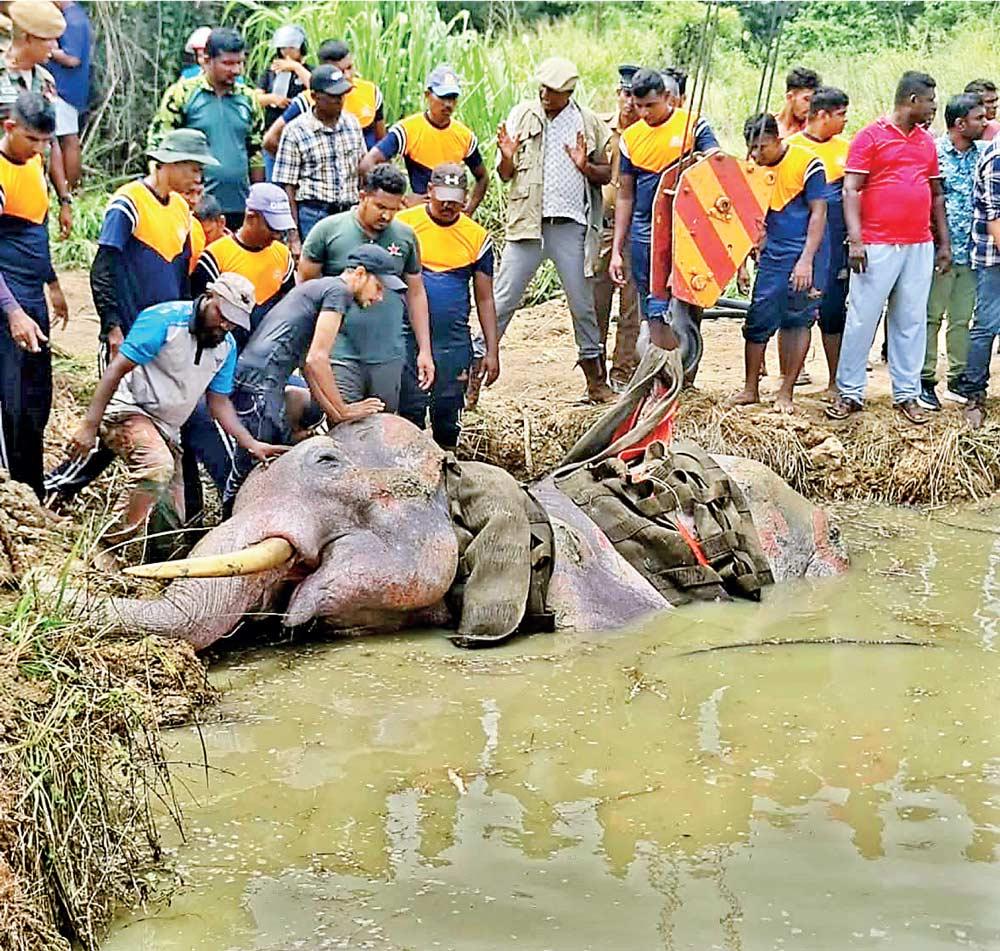
Tusker Bhathiya, moments before he breathed his last. (Image courtesy social media)
The fall of another majestic tusker underscores the need to bring about urgent reforms in Sri Lanka’s wildlife conservation strategies. Elephants walking around with gunshot injuries has become a common sight. But these sightings were noted by wildlife enthusiasts even during the 1980s as recorded by veteran wildlife enthusiast Srilal Miththapala in his book titled ‘Elephantine Tales’. With over 13,000 firearms being provided to farmers to protect their crops against crop damage, wildlife enthusiasts and conservationists have started to question the priorities of the incumbent government.
Attempts to aggravate HEC rather than solve it?
 Miththapala’s book sheds light on the science behind elephant behaviour and situations that would stress elephants when in their natural habitats. Being the gentle beings elephants are, Miththapala’s experiences in Sri Lanka’s national parks from over 30 years indicate that unless elephants receive positive reinforcement for their behaviours, such as giving food in a particular location or carrying snacks in safari jeeps, these animals would often maintain their distance with people.
According to Asian Elephant Expert Dr. Sumith Pilapitiya, elephants are being shot at for two main reasons: (i) some farmers shoot elephants when they raid their crops; and (ii) elephants get shot in the foot from trap guns poachers set up in the jungles with the intention to shoot species such as deer and wild boar, which can be sold as bush meat.
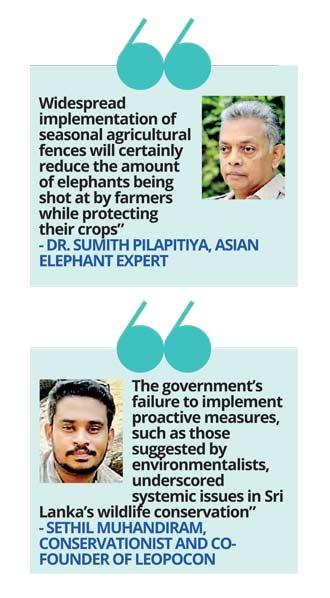
Speaking about The National Action Plan for Human Elephant Conflict Mitigation (NAP) Dr. Pilapitiya said that it recommends setting up seasonal agricultural electric fences to protect seasonal crops, particularly paddy. “These fences are erected by farmer organizations supported by the Government agency that works with the respective farmers and are for crop protection. Widespread implementation of seasonal agricultural fences will certainly reduce the amount of elephants being shot at by farmers while protecting their crops,” he explained.
The use of trap guns and other lethal weapons is fuelled by the demand for the bush meat trade. He said that in order to reduce the probability of elephants getting shot in the foot through illegal trap guns, people as a society has to make a serious attempt to reduce the market for bush meat. “If there is no demand for bush meat, the driving force for the use of trap guns in the forests will be eliminated. However, this is easier said than done. The authorities should be much more vigilant in conducting anti-poaching operations,” he further said.
But Dr. Pilapitiya underscored that this situation is not helped in any way, when the Government proposes distributing guns among farmers, as has been reported in the media. “If recent media reports are accurate, we have the Ministry of Environment issuing a statement stating that stringent regulations will be introduced to prevent elephants from being shot at, while the Agriculture Ministry issued a statement regarding the distribution of guns for farmers to protect their crops. This is completely contradictory,” he added.
He further said that having studied elephant behaviour for many years, it is well-known that if human are aggressive with elephants, such as by shooting at them, the elephants become much more aggressive towards humans. “So basically we are trying aggravate the conflict rather than solve it,” he explained.
Efficient response mechanisms needed
Further responding to a query on efficient response mechanisms to treat critically injured elephants, Dr. Pilapitiya said that while response mechanisms to deal with injured elephants can be improved, the Department of Wildlife Conservation (DWC) is short-staffed and lacks required resources like vehicles etc., for a quick response. “The main state intervention needed, even more than treating injured elephants is to address the causes of people shooting elephants. If we can reduce the shootings, the response mechanisms of the DWC may be adequate to deal with the problem. We seem to focus on treating the symptom of the problem rather than the problem itself. A strategic, comprehensive systematic approach is needed to address HEC. Unfortunately, successive Governments are looking for quick fixes, like elephant drives, which have been proven scientifically to have no long-term impact other than making elephants more aggressive and increasing the conflict,” he added.
Status of the National Action Plan HEC Mitigation
The National Action Plan for Human Elephant Conflict Mitigation (NAP) was prepared by a multi-stakeholder Presidential Committee in 2020. But according to Dr. Pilapitiya, unfortunately, the implementation of the NAP commenced only in October 2022 through facilitation and oversight of a Presidential Committee. “The NAP calls for HEC mitigation actions from several different agencies from various ministries. Coordination and collaboration among different government agencies under different ministries is a real challenge in Sri Lanka. That is why an apex body appointed by the Presidential Secretariat is needed to facilitate and oversee the implementation of the NAP,” he added.
“In my opinion, implementation of the NAP in 2023/2024 which included vigilant monitoring of the electric fences by DWC and the construction of approximately 285 seasonal paddy field fences in 2024 by the Department of Agrarian Development have been main contributory factors for the number of elephant deaths in 2024 (388 elephant deaths) being less than in 2023 (488 elephant deaths). While direct cause and effect are difficult to draw, the only new activity in HEC mitigation was the implementation of the NAP, so it could be concluded that the NAP had a positive effect,” Dr. Pilapitiya said.
His appeal to the present government is to take a systematic approach to HEC mitigation by implementing the NAP, without trying ad hoc measures. “It is obvious that all plans can be improved, so if improvements are needed, we should do it while implementing some of the key activities of the existing NAP, because the NAP is not based on politics but grounded in science,” he emphasised.
Urgent need for enhanced conservation strategies
Bhathiya, the recent tusker that succumbed to gunshot injuries was a much- loved animal in its home range spanning from Nikaweratiya to Deduru Oya and its surrounds. Footage of villagers chanting pirith to save the majestic being spoke volumes about their sentiment towards the animal. Public sentiment on social media and other media platforms amplified calls for better inter-agency coordination and adoption of international expertise from countries like Thailand. “The government’s failure to implement proactive measures, such as those suggested by environmentalists, underscored systemic issues in Sri Lanka’s wildlife conservation, with Bhathiya’s case becoming a focal point for demands for urgent reform,” said Sethil Muhandiram, conservationist and co-founder of Leopocon, a non-profit organization dedicated to the conservation of leopards. “By July 8, 2025, slight improvements were noted, with Bhathiya showing increased responsiveness and limb movement, though his prognosis remained uncertain. However, the response faced criticism for alleged negligence, where calls for adopting methods like India’s makeshift platforms or obtaining expertise from Thailand falling on deaf ears of DWC officials. Bhathiya’s case therefore underscores the urgent need for enhanced conservation strategies to protect Sri Lanka’s rare tuskers amidst ongoing challenges like human-elephant conflict and resource limitations, again and again, in a much-needed context,” he reiterated.
According to the DWC, 13 more elephants who had sustained gunshot injuries are being treated by veterinary officers. Footage of another majestic tusker with gunshot injuries, currently remaining submerged in the Kandalama Lake is now viral on social media. Certainly the time is ticking and wildlife enthusiasts hope and pray that they wouldn’t be unfortunate to witness the passing away of Sri Lanka’s last elephant or tusker as a result of anthropogenic activities and short-sighted decision making in the near future.
 Speaking at a press conference following Bhathiya’s death DWC’s Acting Director General Ranjan Marasinghe explained the timeline of events after the DWC was alerted about the tusker’s health. “We got to know about Bhathiya’s injury on May 18. By May 19 we started giving treatments with the help of our veterinary officers. Annually, 20% of elephants succumb to gunshot injuries. Another 14% of elephants die due to illegal electrocution and 10% die due to hakka patas (elephant crackers). According to DWC records, the highest number of elephant deaths (488) was recorded in 2023,” he said.
In a startling revelation, Marasinghe said that postmortem reports of most gunshot injuries reveal that most injuries have been caused due to domestically manufactured weapons than commercial ones. “Here we have an issue in enforcing the law because we don’t have an opportunity to determine the origins of a bullet made domestically. Such a conclusion could be drawn only for commercially manufactured weapons. But all law enforcement authorities are working together in this matter. Due to the dearth in human resources, the DWC cannot patrol throughout the entirety of forest areas from a practical point of view. But we are planning to launch a new mission to seize trap guns and snares. We provided all facilities to rescue Bhathiya. When an elephant suffers an injury to his nervous system or when it is unable to walk about there are less chances of saving the elephant. It’s health deteriorates when its unable to move around and feed on its own. This is quite an unfortunate situation and we are taking all measures to minimise risks as much as possible,” he added.
11 Jun 2026 8 hours ago
11 Jun 2026 8 hours ago
11 Jun 2026 8 hours ago
11 Jun 2026 8 hours ago
11 Jun 2026 8 hours ago