11 Mar 2026 - {{hitsCtrl.values.hits}}
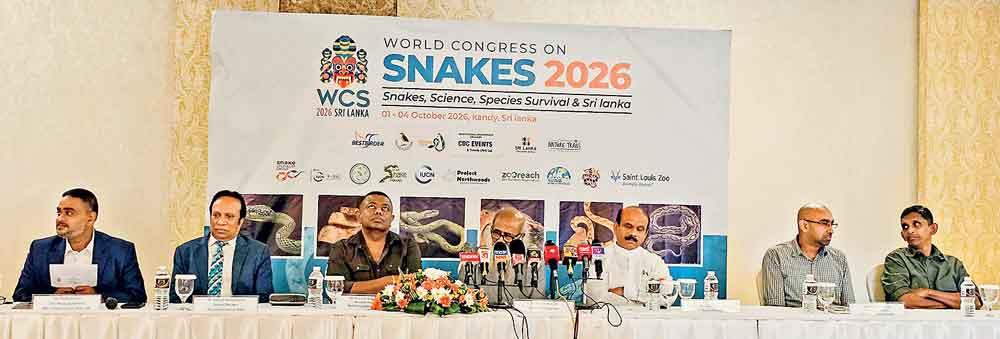
(Left to Right) Mr. Imran Hassan, CEO/Managing Director, CDC Events & Travels (Pvt) LTD, Mr. Thusitha Samaraweera, General Manager, The Grand Kandyan Hotel. Dr. Nimal D. Rathnayake, Secretary General, WCS. Dr. Anslem De Silva, Congress Chairperson. Hon. Chandrasiri Wijenayake, Mayor of Kandy. Dr. Kanishka Ukuwela, Committee Member, WCS and Mr. Suranjan Karunarathna, Scientific Committee Member

Dr. Nimal D. Rathnayake, Secretary General of the WCS
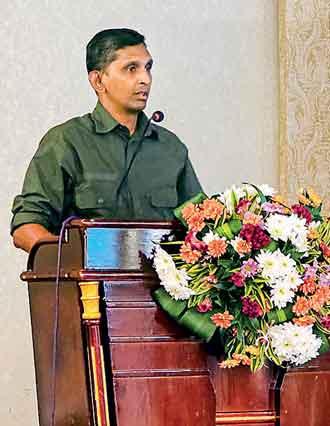
Mr. Suranjan Karunarathna, Scientific Committee Member of WCS
 The scientific sessions (from Oct. 1 to Oct.4) will explore a wide range of topics, including snake evolution, taxonomy and classification, natural history, ecological behaviour, anatomical and physiological adaptations and advanced genetic and genomic research
According to Karunarathna, A major focus of the congress will be addressing the neglected public health crisis of snakebite. Researchers and clinicians will discuss snakebite epidemiology, clinical management, and prevention strategies. The programme covers twelve major thematic areas, encompassing every dimension of snake biology and human–snake interactions, including cultural relationships, veterinary care, and captive management
 Snakes are often feared, yet they are among the most vital and misunderstood creatures in the natural world. The World Congress on Snakes (WCS) 2026, to be held from Oct. 1 to Oct. 4 at the Grand Kandyan Hotel in Kandy, will bring global experts together to discuss conservation, research and snakebite management. The event will feature scientific sessions during the first four days, followed by a field trip beginning on October 5.
“In 2001, the World Congress of Hepatology was conducted, considering all reptiles,” explained Dr. Nimal D. Rathnayake, Secretary General of the World Congress. The process of conserving has been initiated by Dr. Anslem De Sliva, a veteran organiser of the 4th World Congress of Herpetology (2001) and congress chairperson. He delivered a broad aspect of the conservation story on different types of reptiles. The Founding Partners of the WCS are Dr. Anslem de Silva (Sri Lanka), Dr. Julie Ray (India) and Dr. Dan Natusch (Australia).
“About 33% of Sri Lanka’s snake species are threatened with extinction, including 12 critically endangered species and 9 vulnerable species,” said Dr. Rathnayake.
According to Dr. Rathnayake, there are over 4,100 described snake species globally, of which approximately 600 are venomous. Sri Lanka is home to 247 reptile species, including 112 species of snakes. Among these reptiles, 165 species are endemic and 122 are considered threatened. The country also records a high number of snakebite incidents while possessing remarkable faunal diversity with more than 7,500 indigenous species.
Moreover, he stated that Sri Lanka accounts for 111 snake species (2.72% of global diversity). Of these, 34 species (30%) are medically important, while 19 species (17%) can cause significant medical complications. Around 33% of Sri Lankan snakes are threatened with extinction, including 12 critically endangered species and nine vulnerable species.
The scientific sessions (from Oct. 1 to Oct.4) will explore a wide range of topics, including snake evolution, taxonomy and classification, natural history, ecological behaviour, anatomical and physiological adaptations and advanced genetic and genomic research. The congress will also examine venom biochemistry and its growing role in medical research and pharmaceutical development.
Mr. Suranjan Karunarathna, Scientific Committee Member, reasoned that Sri Lanka was selected as the host country due to its rich snake biodiversity and ecological significance. Moreover, the congress will feature plenary sessions, symposiums, poster presentations, auctions, and different group activities. It is expected to generate economic benefits for the country while strengthening international research networks and professional collaboration. Special training opportunities for early-career researchers will also be included.
Focus on public health crisis
According to Karunarathna, A major focus of the congress will be addressing the neglected public health crisis of snakebite. Researchers and clinicians will discuss snakebite epidemiology, clinical management, and prevention strategies. The programme covers twelve major thematic areas, encompassing every dimension of snake biology and human–snake interactions, including cultural relationships, veterinary care, and captive management.
The organising committee has also announced the launch of a new book during the congress, documenting different snake species in Sri Lanka with contributions from nine countries. The publication aims to serve as an important resource for scientists studying global snake diversity.
The committee said that nine internationally renowned experts will deliver plenary lectures representing conservation science, clinical medicine, and wildlife management. Dr. Vivek Menon will discuss global biodiversity priorities and the role of snake conservation in international environmental policy. Renowned conservationist Romulus Whitaker will present community-based approaches that reduce snakebite risk while protecting wildlife.
Dr. Julie Ray and Professor Indraneil Das will highlight conservation experiences from the Americas and the ecological importance of rare rainforest snake species. Professor Aaron Bauer and Dr. Jia Tang Li will examine taxonomy and genomic research as tools for understanding environmental changes. Finally, Dr. Bartosz Borczyk, Professor Anjana Silva, and Dr. Taksa Vasaruchapong will address snake evolution, clinical toxicology (the medical focus on diagnosing, treating, and preventing illnesses caused by drugs, chemicals, and environmental agents) and the sustainability of venom production and antivenom research.
Further information can be obtained or emailed to www.worldsnakes26.com and [email protected]
04 Jun 2026 5 minute ago
04 Jun 2026 29 minute ago
04 Jun 2026 40 minute ago
04 Jun 2026 2 hours ago
04 Jun 2026 2 hours ago