18 Jul 2025 - {{hitsCtrl.values.hits}}
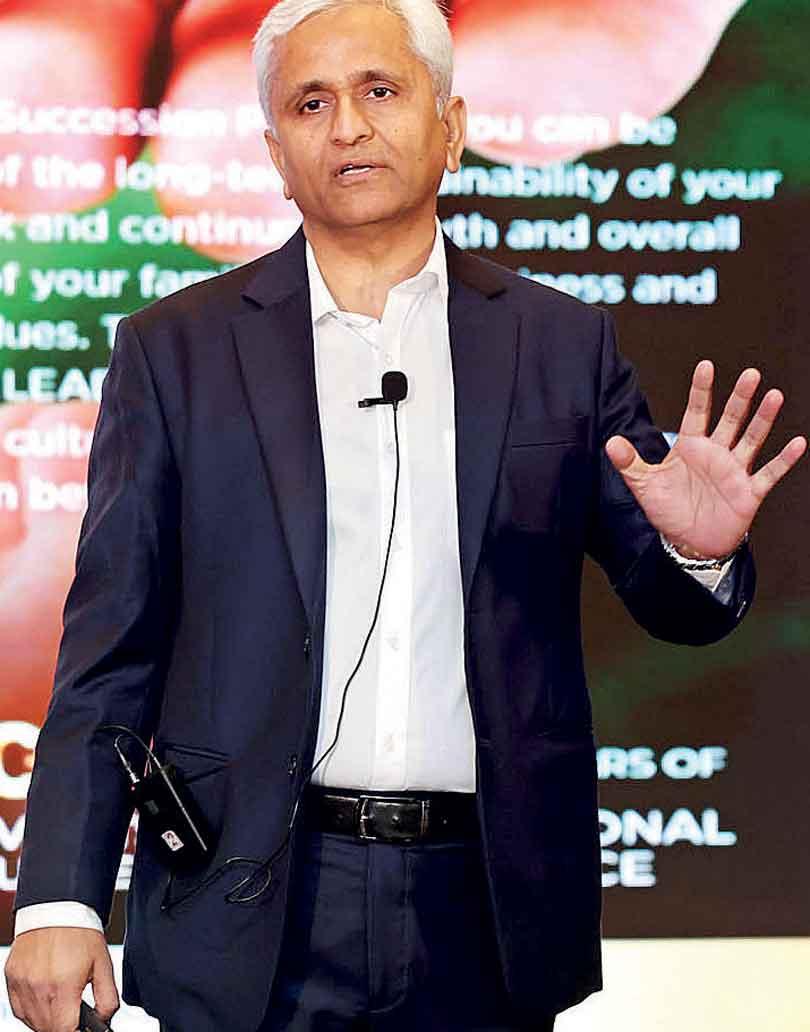
Rakesh Sharma
Pic by Pradeep Dilruckshana
A consultant’s perspective
Neglecting clear succession plans, governance, and communication
dooms most family businesses to conflict and collapse
By Nishel Fernando
At a recent Colombo conference, renowned financial consultant Rakesh Sharma delivered a stark warning to family business owners: without a deliberate and structured approach to succession, 95% of businesses are destined for conflict and collapse. Sharma, highlighted how many founders, focused solely on immediate growth, fail to build enduring institutions. This oversight creates a perilous environment, leading to disillusioned heirs, communication breakdowns, and legal landmines, ultimately jeopardising the family’s legacy for generations.
Last week, at the 8th Round Table Conference held in Colombo, renowned speaker, writer, and financial consultant Rakesh Sharma delivered a powerful and sobering address, pulling back the curtain on the often-ignored issue of succession planning in drawing examples from his experience with interactions with some of wealthiest and successful Indian family-owned businesses.
He articulated that without a deliberate and structured approach to passing the baton, the vast majority of family businesses are destined for conflict, deterioration, and eventual collapse.
Sharma, who has guided over 22,000 business owners and is affectionately known as India’s “Succession Guru,” painted a vivid picture of the typical family business owner, a figure many in the Sri Lankan context would recognise.
This is the patriarch working from dawn till dusk, a veritable “labourer” in their own enterprise, making every single decision. They are laser-focused on business growth, which they narrowly define as increasing sales and profits.
However, in this relentless pursuit, they neglect the crucial aspect of “business success,” which Sharma argues is about creating an enduring legacy, a business that can thrive without them at the helm.
This singular focus on immediate growth creates a perilous environment.
“Ninety-five percent of the businesses will not achieve true success,” Sharma warned, precisely because the owner is fixated only on the business’s expansion.
The consequences of this oversight are devastating, not just for the business, but for the family unit. The next generation, observing a parent who lives a life consumed by work with no time for family or celebration, becomes disillusioned.
“The way you are living your life, I am not going to live that life,” is the silent or sometimes spoken sentiment of the children who see no joy in the enterprise.
Even the owner’s spouse often feels the strain of this all-consuming lifestyle.
The Peril of the ‘Self-Employed’ Mindset
A fundamental problem, as Sharma identifies, is that most business owners operate with a “self-employed” mentality rather than as institution-builders. They are the central hub around which everything revolves; all decisions, big and small, are made by them alone. While this may lead to financial success and wealth creation in the short term, it creates a fragile structure entirely dependent on one individual.
The journey, according to Sharma, should be from a self-employed operation to a business, then an organisation, and finally, an institution.
“Why only the 5% business owner can create the institution? Because they are well aware about the journey,” he stated. An institution is a business that runs on systems, processes, and a strong governance structure-not on the whims of a single person. It is built for longevity, capable of outliving its founder.
The failure to evolve beyond the “self-employed” stage leads to a tragic and predictable outcome. When the founder is no longer in the picture, the wealth and the business often deteriorate.
The next generation, who may have felt entitled but were never properly trained or integrated, are unprepared to lead.
Without proper governance or a professional structure, the business falters.
Sharma cited the cautionary tale of Atlas Cycle Limited, once a hugely profitable company that crumbled because the succeeding generation was not prepared and no institutional framework was in place.
Communication Breakdown and the Family Complexity Crisis
Parallel to the challenges in the business structure are the growing complexities within the family itself. As a business grows, so does the family. Spouses, children, and in-laws enter the picture, each with their own expectations and aspirations.
Sharma illustrated this with a poignant image of a family at the dining table, physically present but emotionally disconnected, not making eye contact or talking to one another.
This breakdown in communication is the fertile ground for conflict. The son waits impatiently for his father to retire and hand over the reins, while the father clings to control, believing his son isn’t capable.
Daughters and daughters-in-law may work hard in the business but are given no clarity about their future, their roles, or their potential for leadership and ownership.
“No clarity, no discussion, no legal documentation. People avoid such talks. And they say we are doing business. This is not the business,” Sharma asserted.
He argues that for a family business to truly succeed, it requires “honesty in the communication, openness in the communication, and the transparency in the communication.”
The family must be able to discuss difficult questions about the future, about roles, and about the vision for the business for the next 5, 10, or even 50 years.
The Legal Landmine: Dying Without a Will
While Sharma’s legal examples were rooted in Indian law, the principles he espoused hold profound relevance for Sri Lanka. He highlighted a critical, often overlooked, legal vulnerability: the failure of business owners to create a will.
The founder may have a 20-year vision for importing machinery but fails to write a simple will on a plain piece of paper.
In India, if a Hindu, Jain, Sikh, or Buddhist dies intestate (without a will), their assets are divided equally among their mother, wife, son, and daughter. This can lead to immense complications. The family is forced to go to court to obtain a succession certificate, a process that can take anywhere from six months to five years. The business is left in limbo, and the family endures immense hardship.
In Sri Lanka, the laws of inheritance, while different, present similar complexities. Depending on the decedent’s marital status, community, and the nature of the property, the laws of intestate succession can lead to outcomes the business founder never intended.
Assets, including crucial business shares, can become fragmented among multiple heirs, some of whom may have no interest or capability in running the business. A married daughter, with whom the son has a strained relationship, could suddenly become a significant shareholder, creating a “hell” for the operational family members.
Sharma’s message could serve as a stark warning to Sri Lankan entrepreneurs: emotions are not a substitute for legal documents.
A will is the first, most fundamental step in succession planning. He clarified common misconceptions: writing a will does not mean transferring assets immediately; it only takes effect upon death. It can be written on plain paper, requires no specific legal format, and can be changed at any time.
The only requirements are the signature of the person making the will and the signatures of two witnesses who are not beneficiaries.
Building a Legacy Without Conflict: The Path Forward
Sharma proposes a multi-faceted approach centered on creating governance structures for both the family and the business. This is the action that legendary family businesses like the Dalmia Group took to transition into enduring institutions.
Family Succession Planning
The first step is to create a comprehensive estate plan. This involves creating a will, and potentially exploring instruments like family trusts or gift deeds to ensure that assets are passed on smoothly and according to the founder’s wishes. This plan should be reviewed every two to three years to adapt to changes in the family and the business.
The Family Constitution
To manage the “family complexity,” Sharma champions the creation of a “Family Constitution” or a “Family Charter.” This is a written document, created with the consensus of all family members that lays down the rules of engagement. It addresses critical questions:
Questions like-
What are the minimum educational qualifications required for a family member to join the business?
What will their roles and responsibilities be?
How will salaries and perks be determined?
What financial support will be available to family members who do not join the business?
Can spouses or in-laws join the business, and in what capacity?
Business Governance and Professionalisation:
The business itself must be professionalised. This means establishing clear structures, roles, and Key Performance Indicators (KPIs) for everyone, including the founder.
In the boardroom, family relationships take a backseat to professional responsibilities. A daughter on the board should have the full right to question her father about his performance, and vice versa.
This requires creating a board structure that may even include external, non-family professionals to bring objectivity and strategic guidance.
Sharma also advocated for the Limited Liability Partnership (LLP) structure, which he described as a “beautiful business entity” gifted by the Indian government that offers protection, low taxation, and easy succession.
Sri Lankan businesses have similar modern corporate structures available that can offer advantages over traditional sole proprietorships or partnerships, which often “die” with their owners.
“Think about your family. Think about yourself. Think about your loved ones,” he urged the audience. The work of building a legacy is not easy. It involves having hard conversations that many families avoid. But the alternative is far worse.
“If you don’t do it, nobody will do it, and the family will suffer in the next 100 years. It means at least three generations will suffer,” he concluded.
11 Jun 2026 5 hours ago
11 Jun 2026 5 hours ago
11 Jun 2026 5 hours ago
11 Jun 2026 6 hours ago
11 Jun 2026 6 hours ago