01 Apr 2025 - {{hitsCtrl.values.hits}}
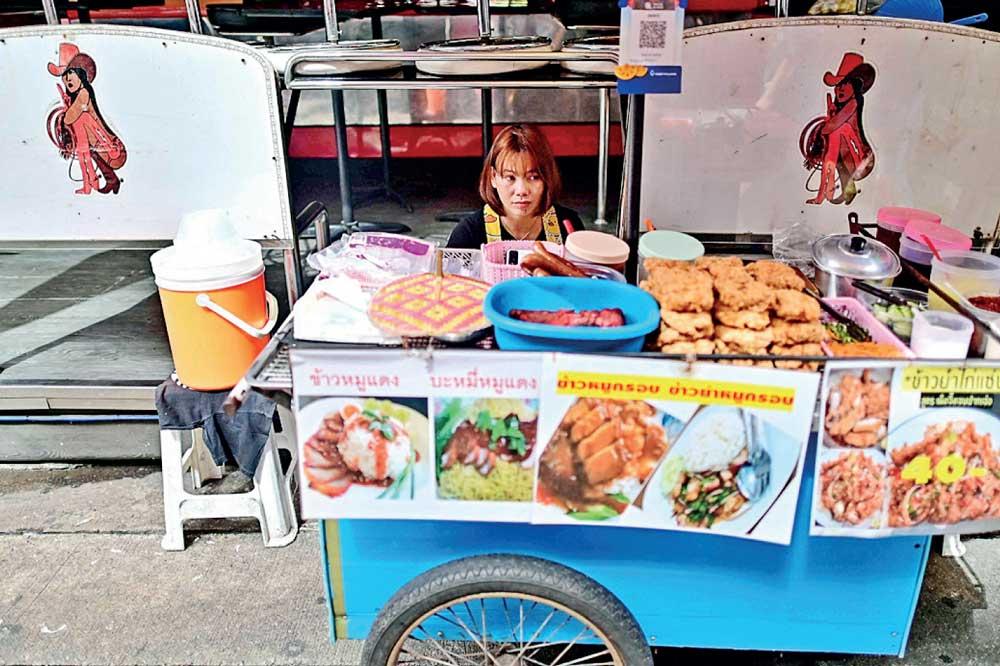
Despite their transformative potential, women in Asia continue to face systemic barriers to education, employment, and leadership roles. Here a food vendor waits for customers along the popular night entertainment street “Soi Cowboy” in Bangkok
 Government programmes such as ‘Digital India’, ‘Start-up Bangladesh,’ ‘InnovaBiz Interest Relief Program’ in Sri Lanka and ‘Pakistan Vision 2025’ aim to create an inclusive entrepreneurial ecosystem by offering financial support, skill development and digital infrastructure that benefit female entrepreneurs. Women-led businesses are thriving on platforms like Meesho (India), Pickaboo (Bangladesh) and Daraz (Pakistan), which enable entrepreneurs to start online stores with minimal investment. Then why are female entrepreneurs being comparatively less in South Asia, according to World Bank reports in 2015?
Beyond government support, social norms and cultural attitudes, women’s participation significantly impacts female entrepreneurs in South Asia. Recent research highlights the evolving role of Asian female entrepreneurs and women in business, revealing both advancements and persistent challenges. In the existing research, lack of education or technical expertise, gender discrimination, and the attitude of not respecting oneself has been found as major parameters which demotivates the female entrepreneurs. However, after examining a series of studies, we were able to identify that there are more prominent factors that discourage the female entrepreneurship.
Cultural influence
Research highlights several challenges faced by female entrepreneurs in women-led social enterprises. These include cultural influences, lack of support, limited access to finance, and gender discrimination. We need to support these amazing women as they work to overcome these issues. By encouraging flexible work arrangements, helping them seize new opportunities, and providing vital financial resources, we can help them grow into successful business leaders. Combining social entrepreneurship with women’s empowerment can address important social issues while boosting economic growth, especially in developing Asian countries. Seeing many social enterprises emerging in areas like education, healthcare, and agriculture is encouraging, as these initiatives seem to focus more on community welfare and drive sustainable development. Research also indicates that women-led social enterprises create solutions that are needs-driven by the community, solving such critical problems as poverty and the environment. A few of them are the Anita Dongre Foundation in India, Green Ladies in Hong Kong, and Wonder Woman in Pakistan. These social enterprises are considered to lead to increased household incomes, better social cohesion, greater roles for women, and long-term improvements in education and health for future generations. Together, we can strengthen these initiatives and build a brighter, fairer future!
Influence of economic factors
Social entrepreneurship and women’s empowerment are transforming Asia’s economic and social landscape, offering a blueprint for sustainable development. Across the region, women-led enterprises are driving inclusive growth by addressing critical challenges such as poverty, education gaps, healthcare access, and environmental sustainability. By merging purpose with profit, these entrepreneurs are creating innovative, community-driven solutions that foster long-term resilience. Despite their transformative potential, women in Asia continue to face systemic barriers to education, employment, and leadership roles. Empowering them through access to education, financial resources, and entrepreneurial opportunities not only enhances their economic independence, but also generates broader societal benefits. For example, pioneering social enterprises such as India’s Self-Employed Women’s Association (SEWA) are a beacon of how women’s empowerment can uplift entire communities. By uniting governments, business, and civil society, Asia can harness the double engines of social entrepreneurship and women’s empowerment to build inclusive and resilient economies. Empowering women in social entrepreneurship is not just about fairness—it is an economic necessity. By unlocking their full potential, Asia can create more inclusive, resilient, and sustainable economies. This Women’s Day, let us recognise the achievements of women entrepreneurs and commit to dismantling barriers that hinder their progress—ensuring a future of shared prosperity for all.
The influence of social factors on women-led social enterprise
A World Bank study highlights that women in South Asia are 15% less likely than men to have a bank account, with only 25% of women in the region possessing formal accounts compared to 41% of men. Fresh data reveal that Nepal has made significant strides in financial inclusion, particularly closing the gender gap. According to the Nepal Financial Inclusion Report 2023 in 2022, women’s access to formal financial services was at 89% while men’s stood at 90%, reducing the gender gap by just 1%.
However, there are disparities in the use of bank services as the same report also shows that 79% of women utilize bank services compared to 83% of men. This would mean that even with greater access, more needs to be done to enhance active use of financial services by women in Nepal. Most women entrepreneurs in South Asia are in the informal sector such as street vending, agriculture, petty retail, and home-based industries. These sectors and enterprises often remain unregistered and are not captured in official economic data. Lack of education and technical skills training restricts females’ ability to develop skills and entrepreneurial skills, but also exposes them to exploitation by officials who exploit their lack of knowledge of rules and regulations, leading to increased bureaucratic hurdles and corruption. The lack of education and technical skills training often restricts women’s ability to develop skills and entrepreneurial skills, but also expose them to exploitation by officials who exploit their lack of knowledge on laws, leading to increased bureaucratic hurdles and corruption.
Challenges
The lack of education and technical skills training often restricts women’s ability to develop skills and entrepreneurial skills, but also exposes them to exploitation by officials who exploit their lack of knowledge on laws, leading to increased bureaucratic hurdles and corruption. Some cultures also believe that women shouldn’t hold seniority or authority over men. Some government policies and programs have been established with a direct focus on male entrepreneurs, inadvertently leaving out the unique needs that women possess within the business arena.
These needs include significant factors such as childcare responsibilities or mobility issues that are particularly relevant to women. Women’s empowerment and social entrepreneurship are transformative forces driving sustainable economic development in Asia. As women increasingly step into entrepreneurial roles, they not only uplift themselves, but also create ripple effects that benefit entire communities. Social enterprises, which prioritise impact alongside profit, provide women with opportunities to address pressing social issues, ranging from education and healthcare to environmental sustainability. Empowered women reinvest in their families and societies, fostering better health, education, and economic stability. In countries like Bangladesh and India, microfinance and women-led cooperatives have demonstrated how financial inclusion can break cycles of poverty. Additionally, digital platforms now enable women entrepreneurs to access markets, resources, and networks beyond geographical limitations. However, systemic barriers such as gender bias, limited access to funding, and policy constraints persist. Governments, businesses, and civil society must collaborate to create an enabling ecosystem, offering mentorship, financial support, and policy reforms that promote gender equity. By harnessing the potential of social entrepreneurship, Asia can achieve not just economic growth, but a profound societal transformation where women are key architects of a more inclusive, resilient, and prosperous future. Women’s empowerment is not just a moral imperative; it is an economic necessity for sustainable development.
Then why do we need to consider them as silent contributors?
“You educate a man; you educate a man. You educate a woman; you educate a generation (Brigham Young).”
Social entrepreneurship and women’s empowerment are pivotal forces for societal transformation in the contemporary era. Historically, Asian women have faced numerous cultural, economic, and structural barriers that have hindered their participation in mainstream national development and transformation. Factors such as a predominantly male-dominated workforce, limited access to education, and financial exclusion have marginalised the role of women in fostering national prosperity. However, global stakeholders and the academic community have redirected global attention to these social impediments and compelled action. The United Nations Sustainable Development Goals (UNSDG) 4 and 5 underscore the imperative for quality education and gender equality worldwide. Currently, women’s empowerment and social entrepreneurship in Asia have experienced significant growth, enabling women to establish robust positions in various sectors, including education, technology, microfinance, and policy reforms. Several notable examples have contributed to elevating the critical role of Asian women. In Pakistan, the Kashf Foundation, Inesvt2innovate, and the National Commission on the Status of Women are exemplary organisations that have provided exceptional micro-financing and legal services to women in the country. These social enterprises require sustained support to reinforce women’s status within our societies and continue their impactful work towards creating a more inclusive and equitable society for Asian women.
South Asian women entrepreneurs are called silent contributors because their contribution to the economy and society is under-recognised. All these three pillars are inter-connected. Despite contributing significantly to entrepreneurship and economic growth, women’s contributions go unnoticed due to societal, cultural, and institutional barriers. The economic role of women gets underestimated when they don’t get formal recognition (like the fact that most women work in agriculture, which is invisible in economic data, disparities they face with banks and access to education and technical skills that make them vulnerable to exploitation).
Note: Contributions to this article were made by Dr. Nuttawuth Muenjohn- Associate Professor Management at University of Bradford, UK, Dr. Akiko Ueno- Associate Professor Marketing at University of Bradford, UK, Dr. Nirma Sadamali Jayawardena- Assistant Professor Marketing at University of Bradford, UK and Dr. Mahnaz Mansoor - Assistant Professor Marketing at University of Bradford, UK, Dr. Obaidullah Amin – Lecturer Marketing at University of Bradford, UK

Research also indicates that women-led social enterprises create solutions that are needs-driven by the community
11 Jun 2026 3 minute ago
11 Jun 2026 6 minute ago
11 Jun 2026 8 minute ago
11 Jun 2026 11 minute ago
11 Jun 2026 16 minute ago