16 Aug 2025 - {{hitsCtrl.values.hits}}
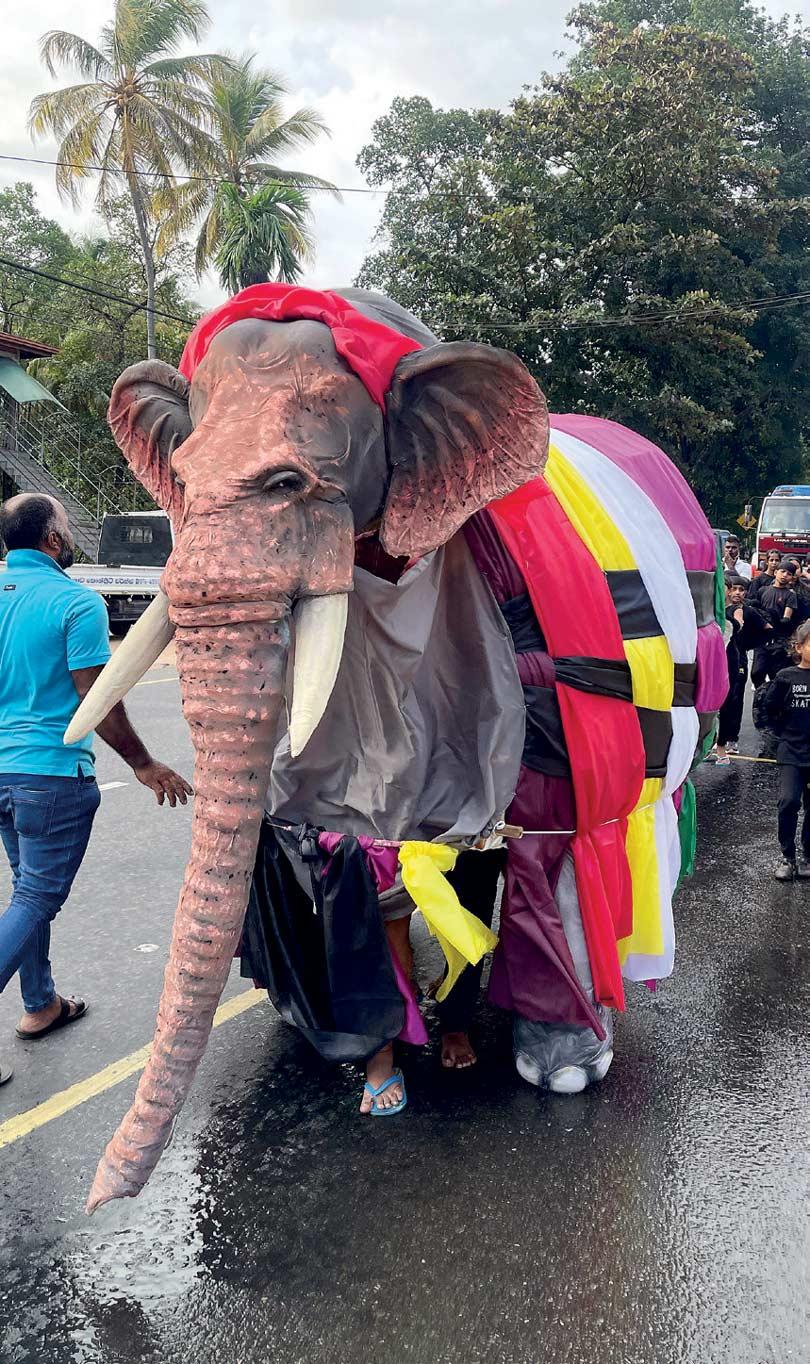
'Human elephants' on the march
 On a quiet Sunday afternoon in Ibbagamuwa, something extraordinary happened. It was a perahara like no other. Instead of majestic elephants adorned with glittering decorations, giant puppets crafted from discarded plastic bottles glided down the streets. School children marched proudly, their faces painted with elephant masks, their voices raised in songs and chants not just celebratory but also hopeful. This was the ‘Elephant Free Elephant Walk’, a powerful blend of tradition and transformation, where culture met an urgent call to protect our planet.
The children of the Athwela Creative Group (ACG) came together with school children to lead the ‘Elephant Perahara without Elephants’ at Ibbagamuwa Central College. The ‘Elephant-Free Elephant Walk’ brought together people from many ethnic and religious communities, including Sinhalese, Tamil, Muslim, Christian, Buddhist, Hindu and other faiths.
The ‘Elephant Free Elephant Walk’ served as a call to action to address the climate emergency, plastic pollution and the Human-Elephant Conflict (HEC) in Sri Lanka. The Elephant Free Elephant Walk was run with the aim of creating a way to respect culture without causing harm to the environment.
The event brought together partners including The Grassroots Trust, Devasaran Development Centre, Women’s Development Foundation, and the Nigel Billimoria Elephant Conservation Foundation.
Elephant-free, yet meaningful Elephant Walk
Peraheras are a much-loved tradition in Sri Lanka. They are spectacular, symbolic and often centre around elephants. Elephants are decorated, paraded and celebrated. But for many years, there had been little conversation about the stress on elephants and their shrinking habitats. For this, the elephant free perahera was created as a project by a group of environmental activists to using elephants made out of plastic bottles and other polythene waste instead of real elephants.
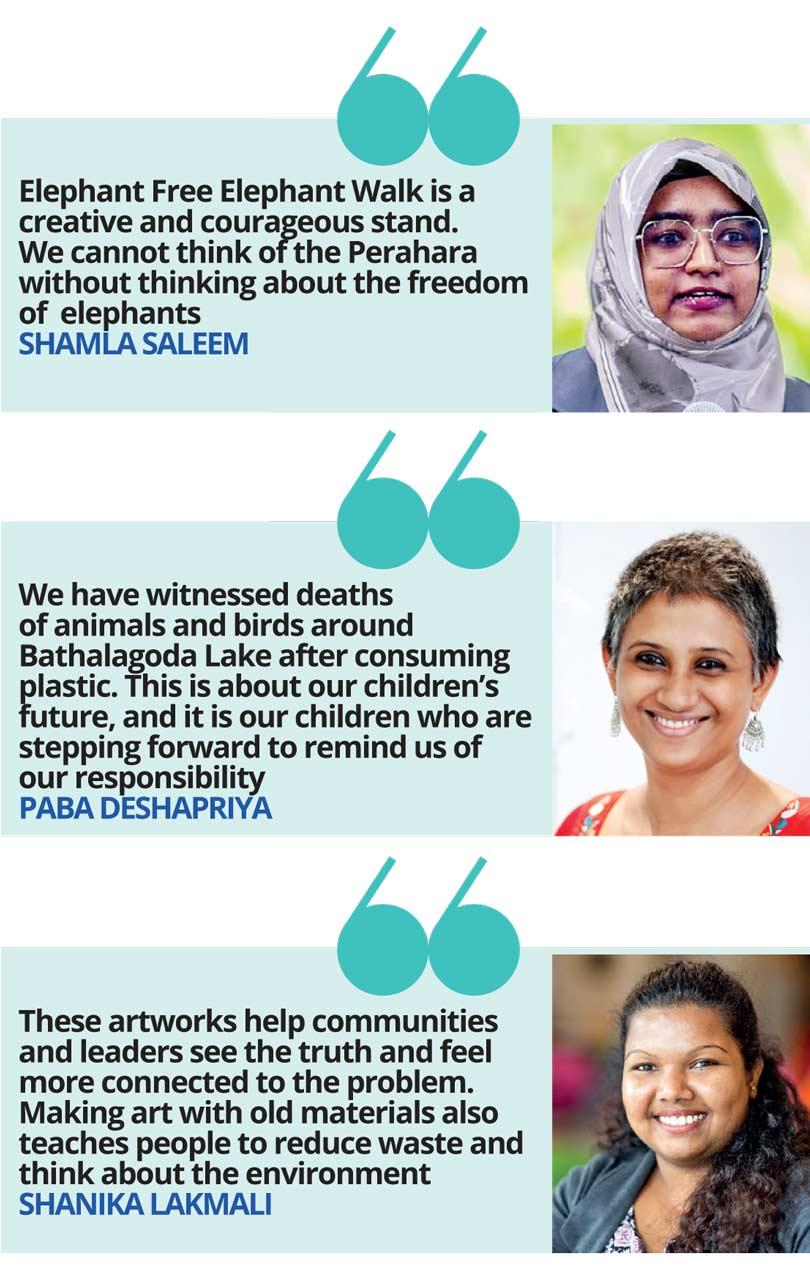
Commenting on this, environment researcher and former management assistant at Sri Lanka Tourism Promotion Bureau Shanika Lakmali said: “Elephant Free Elephant Walk is a creative and courageous stand. We cannot think of the Perahara without thinking about the freedom of elephants. The development of the tourism sector cannot be accepted for various reasons, including cultural importance. Natural resources can be increased to develop the tourism sector in Sri Lanka. Through this, eco-tourism can be improved,” she said.
Shanika pointed out the situation where elephants have become a spectacle not only in the Perahara but also in elephant sanctuaries like Yala National Park. “How uncomfortable we feel when elephants come to our habitats, they feel the same way when we go to theirs,” she added.
The puppets, masks and perahera elements were made from waste materials and biodegradable materials. The giant elephant puppet was made by senior audio-visual artist Amaradasa Heenukeva. His works often combined social engagement with large-scale sculpture and performance. Created with materials such as cement bags, cardboard, PVC pipes and mattresses, these elephant puppets added strength to the Perahara.
Amaradasa, who expressed concern about the environment and the plight of elephants, also commented on the growing interest in storytelling through puppets. “It is very important to pass on this art to the next generation. This Elephant Free Elephant Walk has given us an opportunity to do so. It can really create a powerful awareness among students,” he said.
Between 2015 and 2024, 3,477 wild elephants were killed due to various causes. These numbers revealed a deeply concerning trend, with the highest annual death toll recorded in 2023, when 488 elephants perished. Even during the global pandemic in 2020, a staggering 328 elephants died, followed by 275 in 2021, 439 in 2022, and 388 in 2024.
Awareness for school children
In the weeks leading up to the Elephant Free Elephant Walk, a quiet but powerful transformation unfolded behind the scenes. Artists, educators, and students came together in community spaces, collecting materials like cardboard, cloth, and piping to build life-sized elephant figures. These teams also prepared performances, choreographing dances, scripting plays, and designing visuals.
“This is not just about elephants, it’s about the bigger picture. Climate change, plastic pollution and loss of biodiversity are all connected. Microplastics have been found in our human placentas, ovarian fluid and breast milk. We have witnessed deaths of animals and birds around Bathalagoda Lake after consuming plastic. This is about our children’s future, and it is our children who are stepping forward to remind us of our responsibility,” said Paba Deshapriya, Director, The Grass rooted Trust.
Environment activist and COP delegate Shamla Saleem believed that art could be a powerful way for children and youth to speak up about climate problems. “Children and youth can help people understand climate problems through art. By drawing pictures or creating things from waste, they show how animals like elephants suffer, or how rivers are full of plastic. These artworks help communities and leaders see the truth and feel more connected to the problem. Making art with old materials also teaches people to reduce waste and think about the environment,” she explained.
Having represented Sri Lanka at global climate conferences like COP28, Shamla had seen the country make strong promises about clean energy and protecting nature. But she felt that more needs to be done. “Sri Lanka has made good promises about clean energy and climate action. But doing the work is slow. Government departments don’t work together well. Local areas don’t get enough support. Young people are not given enough space in decision-making,” she added. For her, the way forward was clear: involve youth meaningfully, support local efforts, and use creative tools like art to inspire change at every level.
The Role of EPR and Clean Sri Lanka
The Elephant Free Elephant Walk concluded at the Devasaran Development Centre (DDC), where a Zero Plastic food fair featured vendors from the Atwela Market, using only sustainable packaging and serving practices. It was a tangible demonstration of how small actions, such as using reusable containers, could contribute to big change. As children turned plastic waste into symbolic elephant puppets, they echoed the principles behind Extended Producer Responsibility (EPR), a policy that urges manufacturers to take full responsibility for their plastic products, even after they are used. Like the Perahara, EPR challenged people to rethink the life cycle of waste and inspired action to reduce pollution at its root.
This grassroots creativity aligned strongly with the goals of the Clean Sri Lanka movement, which advocates for improved waste management, sustainable production, and accountability. Just as children and artists transformed discarded materials into a powerful message of hope, EPR pushed industries to redesign products with the environment in mind, creating less waste and promoting a circular economy that benefits nature and people alike.
Waste as a Learning Tool
The main focus of this event was waste segregation and management which is a serious problem in Sri Lanka. Many families and schools dispose of garbage without separating biodegradable materials from plastics, making recycling and composting almost impossible. The event used the elephant as a symbol of balance in both its presence and absence. It invited communities to examine their habits and make daily changes, starting with something as simple as waste segregation.
Ecological researcher and PhD candidate Gayani S. Dissanayake believed that creative engagement could play a key role in connecting people to environmental issues.
“The idea of school children creating elephants from plastic waste to raise awareness about climate change and human-elephant conflict is both creative and impactful. It brings together education, art, environmental consciousness, and wildlife conservation, a powerful combination for public engagement,” she said.
She explained that elephants are powerful symbols of biodiversity, especially in Sri Lanka, and using them in recycled art helps people understand how pollution and habitat loss are connected. “Engaging children encourages intergenerational learning. When students participate, they influence their families and peers. It empowers them to be change-makers from a young age,” she added.
Having worked in ecological education and research, Gayani believed that projects like these can connect two major challenges. Climate change and wildlife conflict, while promoting sustainable habits. “This project cleverly connects two critical issues. Climate change worsens habitat loss, which increases human-elephant conflict. It teaches us that our daily choices, from plastic use to land development, impact both people and wildlife,” she said.
Digital activism as part of the march
In a nod to today’s digital generation, the event also included a mobile screening of student-created videos, TikToks, and reels highlighting climate issues and local solutions. These short videos, filmed and edited by students, gave the event a sense of urgency and helped spread its message beyond Kurunegala.
Organisers continued using these platforms to keep the conversation alive long after the march ended. They aim to create a digital library of student-led climate content that would be accessible to teachers, parents, and activists across the country.
Environmental researcher Sudarsha de Silva stressed the urgent need for stronger global and national action to restore damaged ecosystems.
“Parts of the world have been turned into dead places by human activity,” he said. “The governments of each country should come up with practical plans and implement solutions with the involvement of proper scientists.”
He emphasised that protecting forests alone is not enough. “Not only should forest conservation plans be ensured, but steps should be taken to completely eliminate the use of plastic,” he added. For him, effective environmental action had to combine scientific expertise, government leadership, and a strong commitment to reducing human impact on nature.
The Elephant Free Elephant Walk was more than just a perahara, it was a heartfelt promise from a community determined to protect its heritage while safeguarding the future. Through the creativity of children, the dedication of artists, and the power of collective action, this event showed that culture and conservation can walk hand in hand.
As the giant elephant puppets marched down the streets of Ibbagamuwa, they carried with them a message of hope, urging us all to rethink our relationship with nature and take bold steps toward a sustainable, harmonious world for the elephants, for the environment, and for generations yet to come.
11 Jun 2026 7 hours ago
11 Jun 2026 7 hours ago
11 Jun 2026 7 hours ago
11 Jun 2026 7 hours ago
11 Jun 2026 8 hours ago