29 May 2025 - {{hitsCtrl.values.hits}}
 |
| Prof, Anupama Daranagama |
 |
| Mrs. Nadeeshani Abeyratne |
The fungus causing the blight called Colletotrichum tropicale in rubber cultivation has been identified for the first time in the world by a team of researchers of the Sri Lanka Rubber Research Institute.
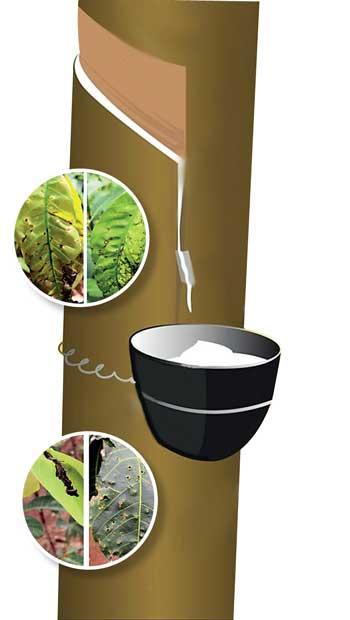
Colletotrichumtropicale is a condition that affects rubber cultivation all over the world. It retards the main function of the leaf which is to produce food for the plant by photosysthesis, thus reducing output of latex.
The causes of this blight have been identified to have changed at various times. In 1905, the fungi that caused this blight had been identified as Colletotrichum Gloeosporioides and in 1997 as Colletortrichumacutatum. Subsequently it had been identified as Colletotrichum simmondsi, Colletotrichum citri, Colletotrichum nymphaeae, Colletrotrichum laticiphilum and Colletotrichum siamense.
However, the researchers of Sri Lanka Rubber Research Institute who conducted the research have identified Colletotrichum tropicale as the main fungus causing the blight.
They are optimistic that their discovery would be instrumental in future reserches to bring under control the Colletotrichum blight. The researchers said they collected samples of affected rubber leaves and examined them based on micro-biological data to identify the fungi causing Colletotrichum blight as Colletortrichum tropicale.
Rubber ( Hevea brasiliensis) is one of the main cash crops in Sri Lanka. More than 13,7000 hectares of rubber cultivation is a main source of foreign exchange earnings of the country. Kalutara, Ratnapura, Kegalle, Monaragala, Colombo, Galle and Matara districts are the main rubber producing areas.
 No remedy found
The rubber cultivation in all these areas are vulnerable to the Colletotrichum blight but an effective remedy has not yet been found.
Latex has been used all over the world as the main raw material in the manufacture of a vast range of products; and in addition rubber cultivation forms a forest cover instrumental in environmental protection.
However the output in rubber cultivation is affected by diverse causes that could result in a serious impact on the economy. With this in view, it is imperative that the causes of diseases affecting rubber cultivation are identified through continuous research.
The research team
The research team of the Sri Lanka Rubber Research Institute that collected the blight affected rubber leaves conducted research through an analytical method using ITS, GAPDH and ACT genes, based on micro- biological Data to identify the Colletotrichumtropicale fungus causing the blight. They carried out laboratory tests by causing the infection artificially to the healthy leaves with the newly discovered fungi.
The research team included Dr. Sarojini Fernando of the Plant Diseases and Micro – Biology Department of the Sri Lanka Rubber Research Institute, Prof.Anupama Daranagama of Kelaniya University and Nadeeshani Abeyratne.
11 Jun 2026 12 minute ago
11 Jun 2026 29 minute ago
11 Jun 2026 54 minute ago
11 Jun 2026 59 minute ago
11 Jun 2026 1 hours ago