09 May 2025 - {{hitsCtrl.values.hits}}
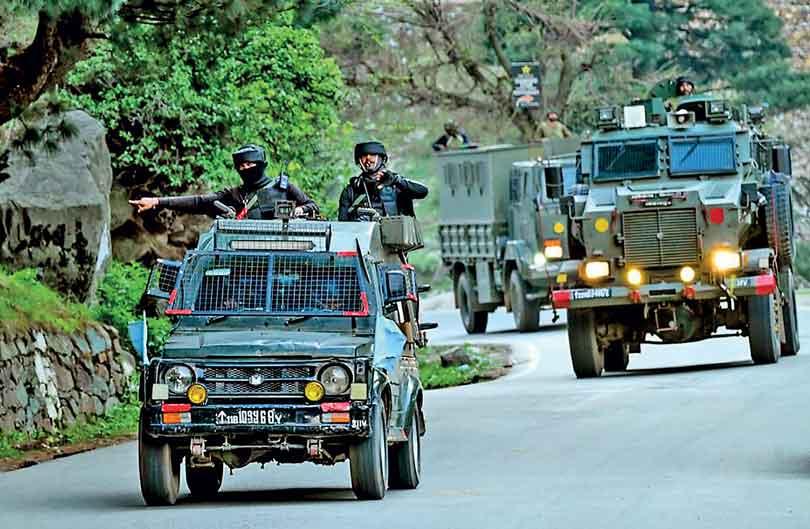
Security personnel rush to the spot after terrorists attacked a group of tourists at Pahalgam, in Anantnag district, Jammu & Kashmir, on April 22, 2025. (Photo Credit: The Hindu)
In Nagasaki, I stood before relics and photographs that bore silent witness to lives lost and dreams shattered
The danger of nuclear weapons lies not only in their potential for catastrophic destruction, but also in their psychological and geopolitical consequences
Although Sri Lanka has ratified key nuclear disarmament treaties, we are located close to two nuclear-armed giants of the South Asian region. India and Pakistan have not ratified the Nuclear Non-Proliferation Treaty
 In August last year, I travelled to Hiroshima and Nagasaki as part of the UNODA Youth Leaders Fund for a World Without Nuclear Weapons inaugural cohort. I received the opportunity as a volunteer youth coordinator for Sri Lanka Campaign to Abolish Nuclear Weapons under the patronage of Forum on Disarmament and Development. Following an intense virtual course, 50 young people were selected for the study tour in Japan. It was a journey that reshaped my understanding of peace, memorialisation, and the enduring human cost of war. Nothing could have prepared me for the emotional gravity of walking through the Hiroshima Peace Memorial Museum and the Nagasaki Atomic Bomb Museum, standing in the Peace Parks, and listening to the voices of ‘hibakusha’, the survivors of the atomic bombings.
What struck me most was the way both cities have chosen to remember. In Hiroshima, I experienced the events of August 6, 1945, through virtual reality, which placed me in the heart of a tragedy too immense to fully comprehend. In Nagasaki, I stood before relics and photographs that bore silent witness to lives lost and dreams shattered. And everywhere, there were names, faces, and stories. They were not mere numbers and statistics. They were children walking to school, mothers preparing breakfast, people living their ordinary lives, until, in an instant, everything left was dust and dirt.
The most moving part of the experience
Listening to the hibakusha share their stories was the most moving part of the experience. Their courage in reliving their pain so that others may understand the horrors of nuclear weapons was deeply humbling and eye-opening. They spoke not just of destruction, but of hope, of their dream for a world where no one else has to endure what they did. Last year, the Nobel Peace Prize was awarded to the Japanese organisation Nihon Hidankyo which is a grassroots movement of hibakusha for their efforts to achieve a world free of nuclear weapons. At the end of the tour, we had the privilege to meet Ishihara Hirotaka, Special Advisor to the Prime Minister on nuclear matters and security. At the end of the meeting, I had the opportunity to personally converse with Hirotaka, where we discussed how, both Sri Lanka and Japan share similar challenges of being in close proximity to nuclear weapon states.
As a young person from Sri Lanka, I carry their stories with a sense of responsibility. Although Sri Lanka has ratified key nuclear disarmament treaties, we are located close to two nuclear-armed giants of the South Asian region. India and Pakistan have not ratified the Nuclear Non-Proliferation Treaty (NPT), the Comprehensive Nuclear-Test-Ban Treaty (CTBT), or the Treaty on the Prohibition of Nuclear Weapons (TPNW). This commitment becomes even more urgent as tensions rise, with the threat of escalation looming dangerously close to home. Just recently, on May 7, India reportedly launched missiles targeting areas in Pakistan, allegedly in retaliation for a prior terrorist attack in Pahalgam, Jammu-Kashmir, raising global concern over the risk of miscalculation between two nuclear-armed states.
The danger of nuclear weapons lies not only in their potential for catastrophic destruction, but also in their psychological and geopolitical consequences. They are weapons of mass destruction, indiscriminate in their impact on civilians, infrastructure, and the environment. The radiation effects of past disasters, such as Hiroshima, Nagasaki, and more recently Chernobyl, remain stark reminders of the long-term suffering caused by nuclear detonations, whether in war or through accidents.
While the peaceful use of nuclear energy is acknowledged, especially in the context of addressing the climate crisis, it must be underpinned by strict safeguards. The CTBT plays a vital role in this regard, ensuring that no nuclear explosion, regardless of purpose, takes place above or below ground. It acts as a firewall between civil use and militarisation, and its enforcement is essential for both safety and disarmament. However, although CTBT has succeeded in significantly discouraging nuclear tests, it is not yet in force until all 44 requisite parties have signed and ratified it.
Globally, there are precedents for hope. Regions like Latin America and the Caribbean, Africa, Central Asia, Southeast Asia, and the South Pacific have all established Nuclear Weapon-Free Zones (NWFZs), reinforcing regional peace and non-proliferation. South Asia, too, has seen proposals for such a zone dating back decades. Unfortunately, these efforts have not yet materialised, largely due to entrenched geopolitical rivalries. But the vision remains relevant. A South Asian NWFZ would not only reduce the risk of conflict but also affirm the region’s commitment to a future without weapons of mass destruction.
The legacy of Hiroshima and Nagasaki teaches us that peace is not passive, it is a choice we must actively make every day, through policy, through remembrance, and through advocacy. As young people, we inherit not just the world as it is, but also the responsibility to shape what it becomes. The stories of hibakusha are not only memories; they are warnings and pleas. Let us honour them by ensuring that no city, no country, no community ever has to suffer the way Hiroshima and Nagasaki did. Let us be the generation that listens and acts.
11 Jun 2026 9 minute ago
11 Jun 2026 13 minute ago
11 Jun 2026 46 minute ago
11 Jun 2026 51 minute ago
11 Jun 2026 2 hours ago