30 Aug 2025 - {{hitsCtrl.values.hits}}
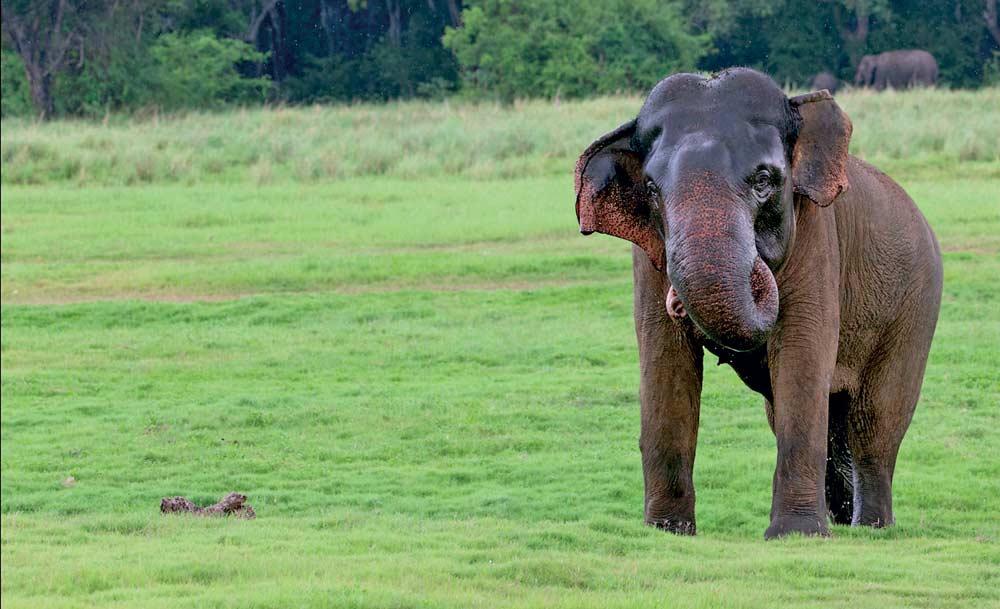
Sri Lanka’s elephants are both a treasure and a challenge
 Amidst debates about electric fences, high-tech warning systems, and costly relocation projects, there exists a much older, humbler practice: the Ali Mantra. Few outside rural communities know of it
Sri Lanka has one of the highest rates of elephant deaths in the world. More than 400 elephants die every year, and many human lives are also lost
 Sadly, this knowledge is fading. Because the Ali Mantra is not written down or formally taught, fewer young people learn it. Many leave villages for cities, and the skill quietly disappears with older generations
The Ali Mantra is not a prayer or temple chant. It is a special shout, performed in a very low and strong voice, used when facing a threatening elephant. It is not done by groups, but by certain individuals who learned it from their parents or grandparents
 Sri Lanka’s elephants are both a treasure and a challenge. They inspire awe, shape our culture, and draw visitors from across the world. But they also walk into farms, destroy crops, and sometimes take human lives. In return, hundreds of elephants are killed every year. This is the reality of what we call “human-elephant conflict.”
Amidst debates about electric fences, high-tech warning systems, and costly relocation projects, there exists a much older, humbler practice: the Ali Mantra. Few outside rural communities know of it. Fewer still understand its value. But in today’s crisis, this ancient knowledge deserves attention.
What is ‘Ali Mantra’?
The Ali Mantra is not a prayer or temple chant. It is a special shout, performed in a very low and strong voice, used when facing a threatening elephant. It is not done by groups, but by certain individuals who learned it from their parents or grandparents. Families pass it down quietly, never putting it into written form or teaching it in public.
Importantly, the Ali Mantra is not meant to scare away whole herds. It is used in very tense, personal moments — when a single elephant steps forward, ears spread wide, ready to charge. At that point, a person raises their voice in this unique way. To many elephants, it signals enough authority and strength to make them stop.
It is not just shouting. The way the sound is produced — low, deep, and drawn-out — matters. Those who don’t know the technique cannot easily copy it.
Why Does It Work?
Modern science helps us understand this. Elephants have extremely sharp hearing. They not only hear the sounds humans hear — they can also sense vibrations at very low levels (called “infrasound,” or sound too deep for us to notice).
When people shout in a low, powerful voice, it overlaps with the range elephants are most sensitive to. Unlike high-pitched noises, which disappear quickly, low sounds travel far and strike harder.
There is also learning involved. Elephants that live near humans gradually understand that this particular sound means danger. They remember it. Over time, the sound becomes a warning signal in their minds.
So the Ali Mantra works on two levels: it uses sound physics (the natural way low sounds travel) and elephant psychology (the way they connect sounds with threats).
The Limits of the Chant
The Ali Mantra is powerful but not perfect.
When a male elephant is in musth (a natural period when males produce more hormones, become aggressive, and sometimes ignore normal signals), the chant usually fails. During musth, elephants are so driven by biology and stress that they don’t respond to sound deterrents.
Those who use the Ali Mantra have always known this. When facing a musth elephant, they understand the danger is far greater, and other methods are needed. This is important: the Ali Mantra is not magic. It is a survival tool. It works in many cases, but not in all.
Ancient Knowledge Meets Modern Ideas
For centuries, rural communities lived with elephants not by dominating them but by adapting.
The Ali Mantra shows how carefully people observed elephant behaviour and shaped responses. They didn’t have machines or research labs. They had patience, memory, and necessity.
Today, scientists study “bioacoustics” (the role of sound in animal life). They use sound to guide whales away from ships, to move birds from airports, or to track frog populations. What researchers now test with equipment, villagers already practiced through the Ali Mantra.
This should remind us: traditional practices are not always superstition. Many come from deep observation and trial over generations. When science looks again at them, the logic becomes clear.
Why This Matters Today
Sri Lanka has one of the highest rates of elephant deaths in the world. More than 400 elephants die every year, and many human lives are also lost. Most deaths come from direct clashes: farmers trying to protect crops, elephants breaking through fences, confrontations on village roads.
Governments often respond with fences, firecrackers, or relocation projects. These methods are costly and not always effective. Worse, they sometimes injure or kill elephants. The Ali Mantra offers something different. It is low-cost. It causes no harm. It allows a farmer or villager to protect themselves without violence. It will not solve the wider conflict, but it offers a window into more humane solutions.
Most importantly, it carries a philosophy: that humans and elephants can still communicate — not as enemies, but as neighbours forced to share land.
A Vanishing Heritage
Sadly, this knowledge is fading. Because the Ali Mantra is not written down or formally taught, fewer young people learn it. Many leave villages for cities, and the skill quietly disappears with older generations.
Losing the Ali Mantra would mean losing not just a chant, but an entire way of thinking — that coexistence with elephants requires respect, understanding, and adaptability.
Preserving such practices matters. They are part of our intangible cultural heritage, just as important as stories, songs, or crafts. They are also practical tools that modern conservation can use.
Beyond the Chant
The Ali Mantra alone will not save Sri Lanka’s elephants. It cannot replace ecological corridors (safe passage routes for elephants), early-warning systems, or better land management. But it reminds us of an important truth: solutions to the conflict must combine modern science with local wisdom.
Too often, conservation debates are framed as battles between technology and tradition. But the future lies in weaving them together. The Ali Mantra is proof that local voices — literally — matter in the global conversation on wildlife survival.
Conclusion: A Human Voice in a Shared Land
When someone shouts the Ali Mantra at a charging elephant, it is more than a sound. It is the echo of ancestors who faced the same danger, the memory of trial and survival, and the possibility of peaceful coexistence. In an age of electric wires and heavy machines, it is easy to forget that the human voice still carries power. The Ali Mantra shows that the media of sound based on knowledge and respect can nullify the aggression of one the largest animals on earth. Sri Lanka’s future with elephants will depend not only on fences and technology, but also on whether we value, protect, and learn from the ancient tools of coexistence already in our hands.
Dilum Alagiyawanna is a telecommunications engineer turned environmental conservationist and documentary filmmaker, focusing on policy-driven wildlife protection in Sri Lanka.
08 Jun 2026 37 minute ago
08 Jun 2026 53 minute ago
08 Jun 2026 58 minute ago
08 Jun 2026 1 hours ago
08 Jun 2026 1 hours ago