13 Sep 2025 - {{hitsCtrl.values.hits}}
 The manner in which cases are pursued today points to politicization, blurring the line between justice and political expediency
Sri Lanka’s Achilles’ heel in its recovery story is precisely this failure of large-scale projects to take off
Sri Lanka has made remarkable strides in stabilizing its economy, undertaking one of the largest fiscal adjustments in its history—equal to nearly 8 percent of GDP over three years. The adjustment was sharper and faster by international standards, when compared with more than 330 similar efforts in 123 countries worldwide since 1980, according to a new World Bank review of Sri Lanka’s public finances released on Tuesday.
Yet, the country is not out of the woods. Bound by the IMF programme, Sri Lanka has little room outside a liberal economic framework.
The World Bank notes that fiscal measures have restored stability, but at a cost: households now face higher indirect taxes, real public-sector wages have fallen, and growth has slowed due to lower public investment.
World Bank suggests the next phase of fiscal calibration should focus on raising revenue in fairer, growth-friendly ways and improving the quality of public spending.
The challenges ahead are daunting
Sri Lanka must service its foreign debt, rebuild reserves, and create jobs.
To improve living standards, growth must remain well above five percent. Current projections fall short of that benchmark. With such modest rates—what some economists call “natural growth” requiring little government effort—the country risks drifting rather than driving toward prosperity, according to former Deputy Governor of the Central Bank, Dr W. A. Wijewardena.
He said earlier that Sri Lanka must shift its focus towards fostering innovation, empowering entrepreneurs, and moving beyond its current economic trajectory to achieve a prosperous future with a sustained growth rate of over eight percent.
Dr Wijewardena cautioned that the nation should not be complacent with the current nominal economic stability, arguing that a growth rate of around five percent is effectively “zero growth” for a country such as Sri Lanka that needs to catch up.
“For a country like Sri Lanka to become a prosperous nation within a single generation, we must have a compound growth rate of about eight percent year after year,” Dr Wijewardena said.
“Anything below 4.5 percent is a negative growth rate for us. What we are planning today is to have either a zero growth rate or a negative growth recovery, which is not helpful for Sri Lanka.”
This is why a serious national debate on the government’s economic direction is essential—whether it is genuinely on track with the reforms and policies needed to meet the targets promised in its election manifesto.
Instead, the public conversation has been consumed by another narrative
In recent weeks, newspapers, prime-time bulletins, and social media feeds have been dominated by arrests of past politicians, or the enactment of legislation to deny benefits to the former Presidents.
The arrest even included former President Ranil Wickremesinghe, as part of the government’s anti-corruption blitz.
Corruption and fraud are despised by all right-thinking people. Before the election, many voters believed that graft was the sole cause of the country’s economic ills and that its eradication would free up vast sums for development.
That belief became a central campaign theme of the National People’s Power (NPP), which is now in office.
But the daily spectacle of legal action against former rulers suggests a different reality. While accountability is necessary, these matters should rightly be left to law enforcement. The manner in which cases are pursued today points to politicization, blurring the line between justice and political expediency.
This inevitably raises the question: Are politically charged actions being used to distract public attention from the government’s economic performance?
Tackling corruption is important, but amid the din of anti-corruption headlines, critical concerns on the economic front must not be pushed aside—or reduced to a publicity stunt for the ruling party. On the ground, progress is worryingly thin.
The government has not been able to launch any major investment project. Even the proposed $3.7 billion Sinopec venture remains stalled, nine months after the signing of an MoU.
Sri Lanka’s Achilles’ heel in its recovery story is precisely this failure of large-scale projects to take off.It is fair to ask: what action has the government taken, and how far has it progressed?
These are not minor bureaucratic hiccups. They reflect structural weaknesses: lack of coordination among agencies, cumbersome approval processes, and policy uncertainty. Unless resolved, these weaknesses will discourage investment at the very moment Sri Lanka needs it more than ever.
Eradicating corruption alone will not generate growth. Of course, rooting out graft is critical for any society, but economic prosperity demands more—long-term reforms for boosting exports, productivity, and improvement of the investment climate.
The government must be result-oriented in creating an enabling environment built on policy consistency, transparent regulations, and efficient institutions.
Foreign policy, too, plays a role in shaping economic opportunity
The government’s absence at the recent Shanghai Cooperation Organization (SCO) summit was a costly mistake.
The SCO is a forum where the Global South pushes for new economic and security arrangements. For Sri Lanka, it would have been an opportunity to expand trade and investment ties with India, China, and Russia.
Given its unique geographic position, Sri Lanka has the chance to pursue a strategically neutral foreign policy—balancing relations with both the Global North and Global South.
People have every right to question when they see the government underperforming in both economic management and foreign policy. Their aspirations are higher. They elected this administration not only to bring past wrongdoers to justice but also to deliver prosperity.
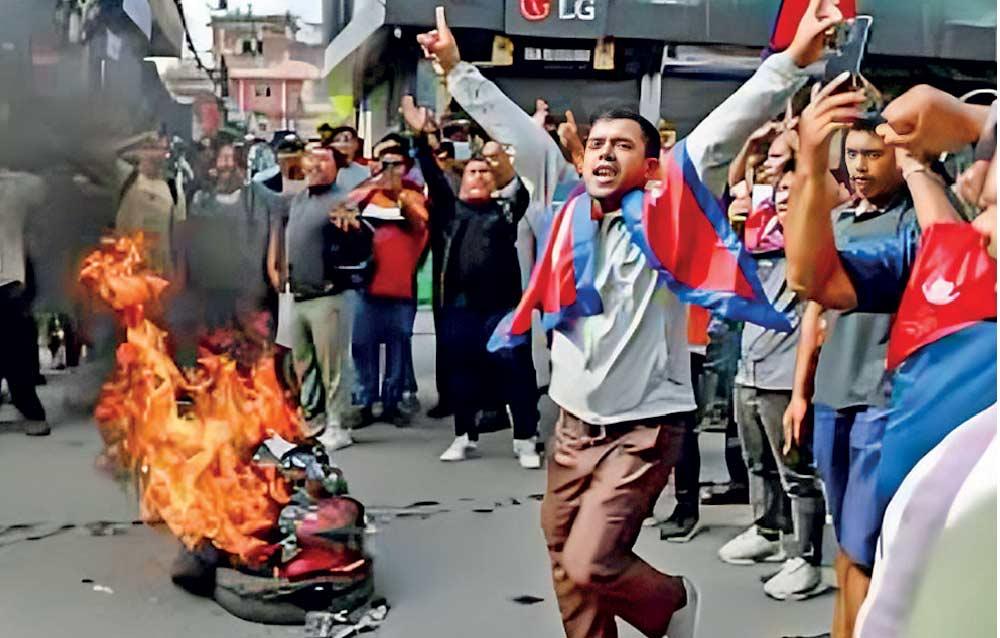
Nepal’s experience offers a warning. The government there sparked youth-led protests by banning social media platforms such as Facebook, WhatsApp, YouTube, and X—an “inflection point” for young people already frustrated by corruption, nepotism, and weak growth.
The demonstrations crippled the country and forced Prime Minister K.P. Sharma Oli to resign. Even after the ban was rolled back, the anger persisted. The government’s ban on social media is unjustifiable. Yet, protestors’ reaction was excessive. There is no relent in their protests across the country.
Sri Lanka, which faced similar unrest in 2022, cannot afford to ignore these lessons.
Young people aspire to a better future. If economic growth stalls and opportunities fail to materialize, frustration will resurface here too—and the political cost for the current rulers will be severe.
08 Jun 2026 10 minute ago
08 Jun 2026 26 minute ago
08 Jun 2026 31 minute ago
08 Jun 2026 33 minute ago
08 Jun 2026 48 minute ago