01 Dec 2025 - {{hitsCtrl.values.hits}}
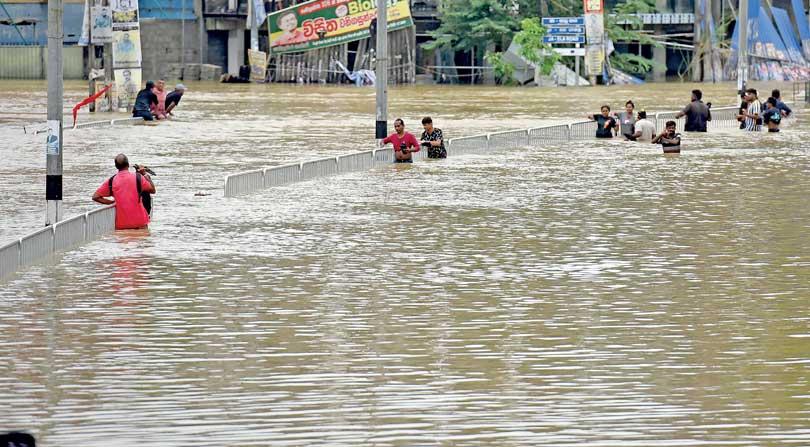
Gampaha became a vulnerable area following rising water levels in Kelani River
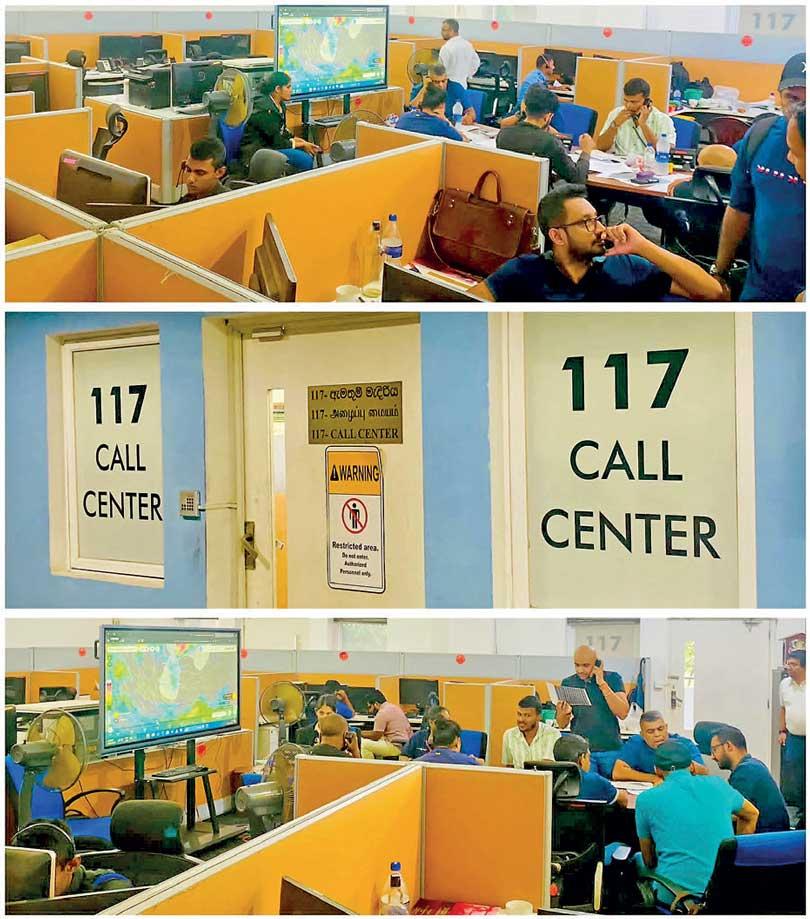
Inside 117 call centre (Courtesy - Thashmila Senewirathna)
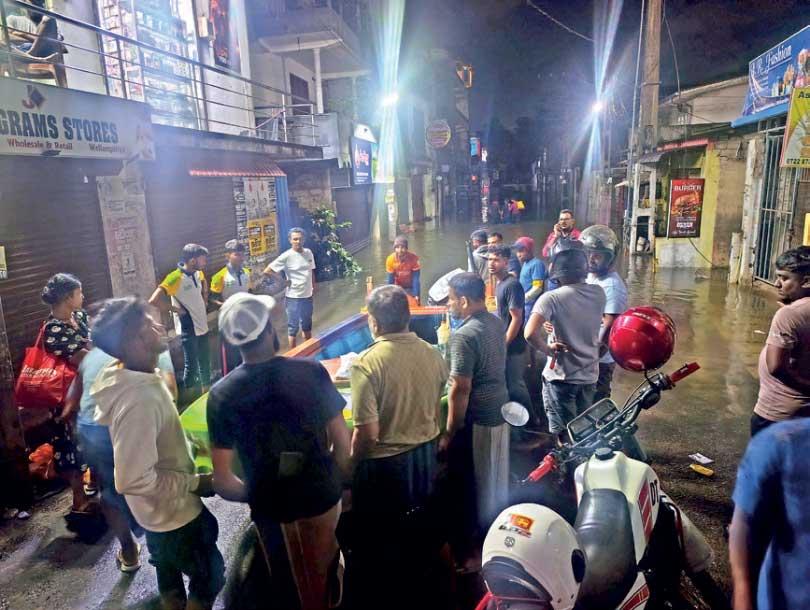
Boat service being deployed in Kolonnawa
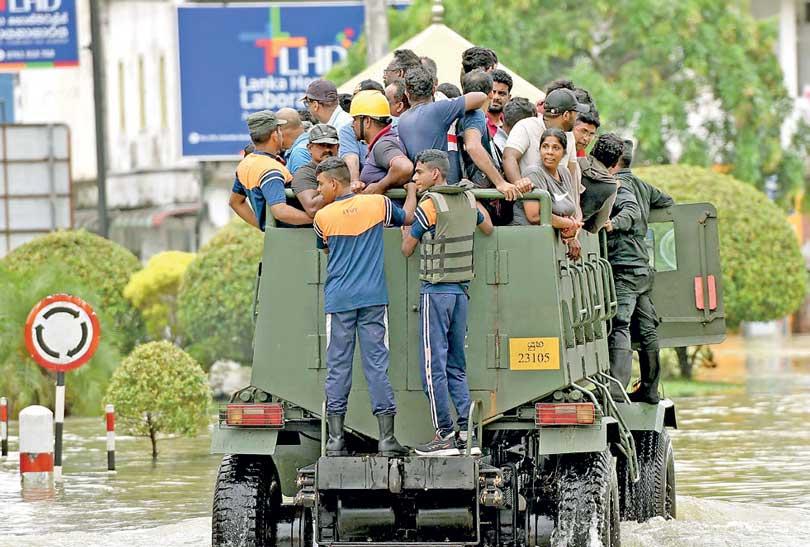
Sri Lanka Army evacuating flood-affected victims
 Sri Lanka is facing one of the worst catastrophes in recent history. Authorities claim that the impact of heavy rainfall, sometimes exceeding 400mm in Central Highlands and other parts of the country, contributed to a devastating flood situation along low-lying areas. With over 150 recorded deaths and over 190 people still missing, demand for relief and rescues amidst ongoing evacuation attempts, the aftermath of Cyclone Ditwah is worrying.
Natural disaster mitigation, a national priority
Following the impact of Cyclone Ditwah, over 203 landslides have been recorded according to latest statistics issued from the National Building Research Organisation (NBRO). According to Ranjith Premasiri, Professor at the Department of Earth Resources Engineering at the University of Moratuwa, the frequency of landslides have increased over the past few years. Speaking to the Daily Mirror, Prof. Premasiri said that landslides and most natural disasters are influenced by anthropogenic activities.
“Due to high population density, there’s a rise in human-affected disasters. This is because people construct buildings, they cut down slopes, construct highways and so on. Apart from that, climate change is another factor that contributes to natural disasters. There’s intense rainfall within a couple of days and then severe drought. We may also see an increase in landslides due to dissemination of information,” he added.
Over the past few years, many lives have been lost as a result of landslides. According to Prof. Premasiri, even though we have the knowledge and expertise to minimise the impact from disasters, proper planning and approach to find solutions remains a question.
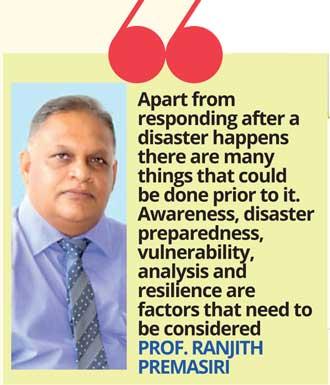
“For example, when there’s a disaster, there are well established principles to apply such as the Sendai Framework and the National Disaster Management Plan. Apart from responding after a disaster happens there are many things that could be done prior to it. Awareness, disaster preparedness, vulnerability, analysis and resilience are factors that need to be considered. But usually after a disaster we will forget it until the next disaster,” he said.
Responding to a query on makeshift establishments in hilly areas, Prof. Premasiri explained about the methods of disaster mitigation.
Disaster mitigation approaches
“There are structural and non-structural approaches to disaster mitigation. Non-structural mitigation is where we develop policies, regulation and tools to protect our environment. We should have a proper land use plan, a building code approved by NBRO when constructing buildings, a proper understanding about the condition of roads and so on. Most sensitive areas such as hilly slopes should be protected. They could be declared as reservation areas so that nobody could encroach those areas. Structural mitigation (engineering measures) such as retaining walls, crop anchoring, soil nailing, geo grids and so on. But we have to understand where we can apply these measures. These cannot be applied everywhere. All major roads in hilly areas from Balangoda-Haputale, Ella-Bandarawela, Kegalle-Kandy, Kandy-Mahiyanganaya, Nuwara Eliya-Kandy have been affected. So, we need to implement these measures on such roads. Geologists can assess the conditions of these slopes and apply the most appropriate measures to protect these roads,” he explained while adding that awareness should be a continuous process.
Prof. Premasiri underscored that the government should prioritise on natural disaster mitigation. “We need to protect people and property, and there needs to be enough allocations and investments. The disaster management plan has been drafted and there’s a Disaster Management Centre. We need to practice basic disaster management mechanisms such as land use, environmental concerns and give more priority to this area,” he said in conclusion.
Damaged road network
One of the main challenges faced by rescue teams at this point is to travel to affected areas. According to Road Development Authority’s Director General Eng. Wimal Kandambi, around 168 major roads have been damaged. In addition, six bridges have collapsed as a result of heavy flooding. “Kandy is one of the most affected areas, but commuting to Kandy has become a challenge,” Kandambi said speaking to the Daily Mirror.
“There were around 10 landslides along the Kurunegala-Kandy road and once they were cleared another two had occurred on Saturday morning. In Kadugannawa alone there were three more landslides. The challenge is that while we continue to clear existing landslides, more landslides may occur along these roads. We are also in the process of constructing daily bridges and would be procuring the shortage from India,” he added.
When asked about constructing roads to withhold natural disasters in future, Kandambi said that during the monsoon season, roads usually get damaged. “But this time the impact is high. In terms of readiness, we have to look at clearing drains on either side of the road and ensure that culverts are functioning properly. What we have observed is that most waterways are clogged near towns and urban settlements. So, we need to expedite these mechanisms and improve readiness in future,” he further said.
Relief distribution and humanitarian operations
The overwhelming demand for relief supplies has become a challenge for most operations centres and community kitchens as people engaged in panic-buying on Friday and Saturday. As most shelves in supermarkets emptied in a jiffy, many community kitchens have now reached out for support. Many individuals have started helping out flood affected victims in numerous ways, providing water bottles, cooked meals, dry rations, sanitary napkins and sometimes even going to the extent of sending reloads to mobile phones of people in desperate situations across the country. In fact, it is a moment of resilience and humanity.
Apart from private donations and supplies, the National Disaster Relief Services Centre has been coordinating and distributing relief services at a national level. Speaking to the Daily Mirror, Jayatissa Munasinghe, Assistant Secretary, National Disaster Relief Services Centre said that disaster management committees have been established at rural level, presided by the Grama Niladhari and economic development officers. “In every divisional secretariat we have deployed a disaster relief development officer. We have a national level committee and a big staff currently engaged in disaster relief operations. We work in sync with DMC, NBRO and weather department,” he added.
Speaking about provisions, Munasinghe said that provisions are being allocated per day.
“This has been identified as a catastrophic disaster and we are conducting an intermediate needs assessment. Through this, we hope to obtain support from donors and provide immediate support to people in highly vulnerable locations. But one of the main challenges we have at the moment is with regards to commuting on roads that have been damaged. On the other hand, due to poor reception we are unable to obtain actual statistics with regards to relief supplies from areas such as Nuwara Eliya. In addition, 219 safety centres are in operation across the island, and people could bring in their contributions to these centres as well,” he added.
Operations at 117 call Centre
One of the most worrying aspects during a natural calamity is people’s reluctance to evacuate despite repeated warnings from authorities. People in areas such as Kolonnawa, Kotikawatta, Kohilawatta and several areas near the Kelani River basin have been affected due to rising water levels flowing inwards. While tri-forces personnel are tirelessly protecting the Kelani River bund, water levels still continue to flow through culverts and drains. According to the Director General of Irrigation Department Ajith Gunasekara, if the Kelani River rises to its critical flood level, the surrounding areas will experience a worse flood than that in 2016.
The 117 emergency hotline call Centre at the Disaster Management Centre has been in full operation to obtain information regarding individuals who require assistance to evacuate, individuals stranded in various places and so on. Their main target is ‘Queue Zero’ which means to have zero calls waiting and to answer every call that they get. The Police and Army have utilised a radio message system to obtain ground level information from areas such as Nuwara Eliya and Gampola as there is no coverage and people cannot be contacted. If mobile hotlines are busy, another 30-40 CDMA ,and mobile phone networks remain active to ensure smooth reception of calls.
But explaining the situation at hand, an individual working at the 117 call Centre, said that the number of calls seeking assistance to evacuate people has exceeded their capacity. Taking to social media, the individual said that most people began calling and seeking assistance once they realised that the water levels are rising. “Some people claim that they are stranded in the third floor of the house, but why did they wait till the last minute to seek help?” he questioned.
“This increases the demand to deploy boats and supplies on time. As a result, it would be a challenge to assist people who are on the verge of death due to a landslide or deluge conditions in other parts of the country. One person’s delay may result in another person’s death. Therefore, we urge everyone to evacuate at your earliest and to oblige with warnings issued by the authorities,” his social media post noted.
Pix by Kushan Pathiraja
07 Jun 2026 6 minute ago
07 Jun 2026 25 minute ago
07 Jun 2026 2 hours ago
07 Jun 2026 2 hours ago
07 Jun 2026 2 hours ago