06 Dec 2025 - {{hitsCtrl.values.hits}}
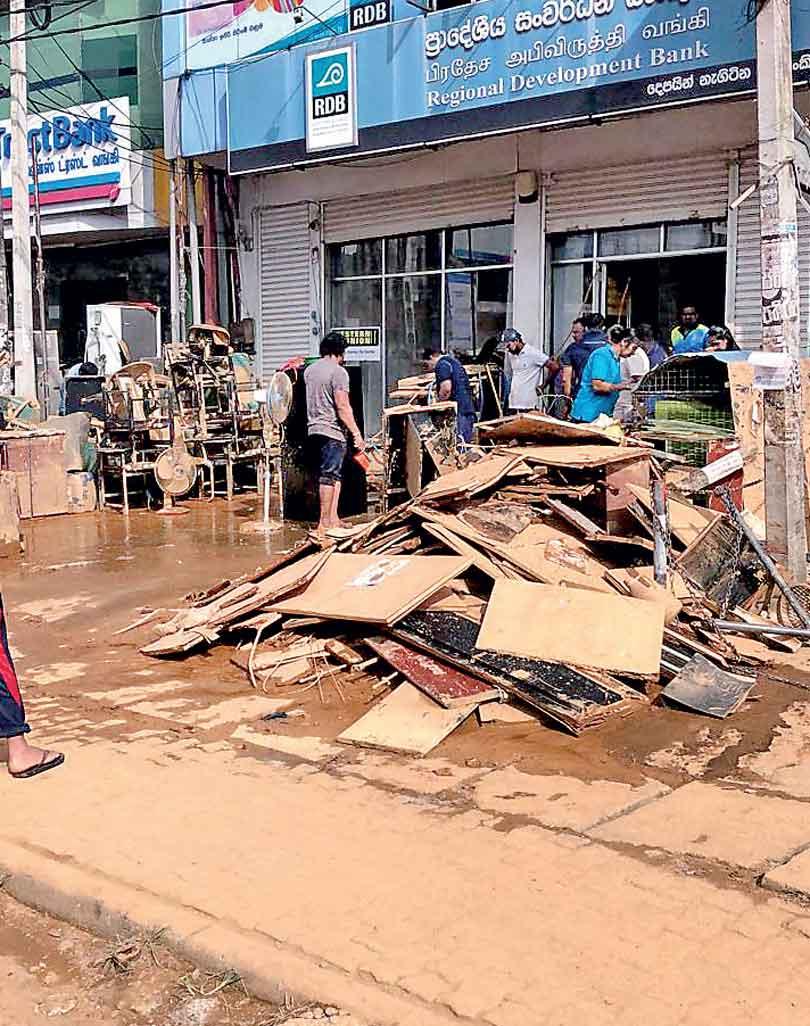
Gampola town was completely devastated by the floods
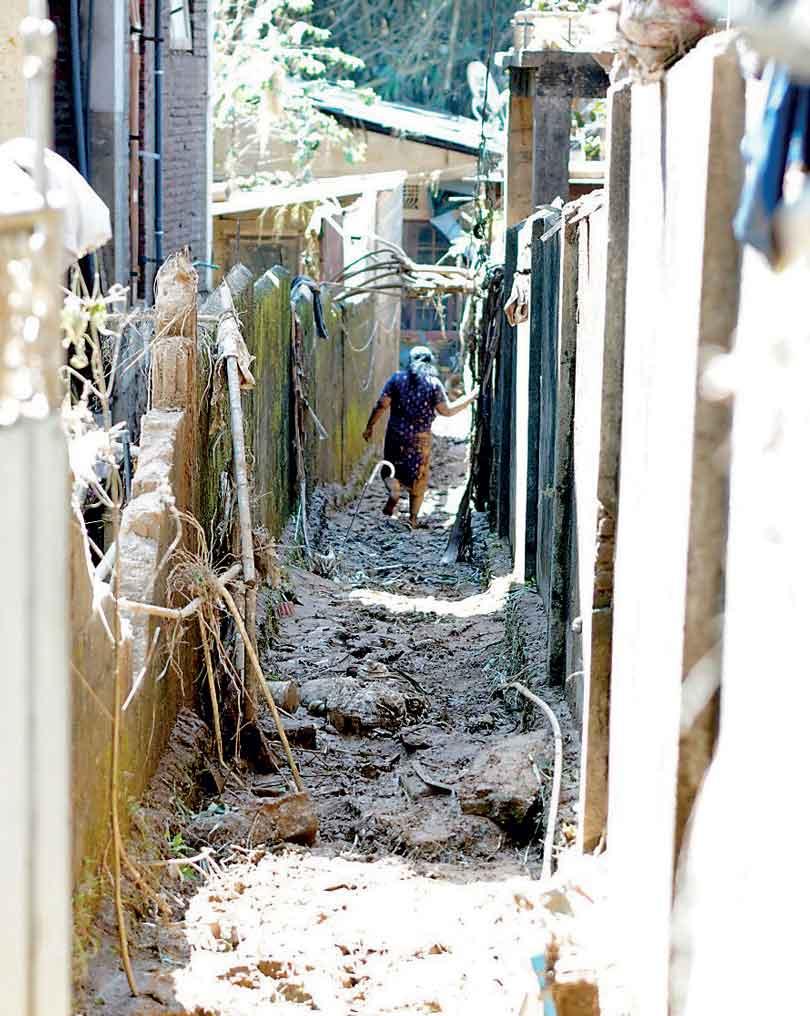
Thushara, a businessman, said that water rose up to 30 feet, destroying his two-story building. “We live on the road beyond the Municipal Council. No early warning was given. If we had been told to move to higher ground, lives could have been saved. Until today, no one has come to listen to our suffering. When I went to the police, the officer on duty even scolded me. Later, a senior officer gave me the disaster hotline number, but we couldn’t use it because there was no communication network,” he said
By Ashanthi Warunasuriya
Cyclone Ditwah that struck Sri Lanka recently left behind a trail of devastation, plunging many regions into severe crisis. We continued to report from places where communication was possible, but there were areas from which no information emerged. One such place was Gampola.
Early reports suggested extensive destruction. We learned that electricity and water supplies were completely cut off, and the roads leading to Gampola had been torn apart by landslides. All communication networks had collapsed. Despite these conditions, We decided to travel there to observe the situation firsthand.
Journey Into Darkness
We left Colombo at midnight on December 1, through landslide debris and fallen earth along the route. After passing Galagedara and Kandy, we reached Gampola at around 4 a.m.
As we entered the town lit only by a few scattered lights, everything suddenly went dark. A distressed shopkeeper approached us, asking for a phone or flashlight. His shop had been filled with mud, and he was trying desperately to clean it. Tearfully, he told us that the entire shop had been submerged.
Walking through the town in the faint morning light, we realised the extent of the disaster. The lower part of the city near the Municipal Council had been completely flooded. Shops and streets were coated in thick mud. Goods damaged beyond recovery were piled outside. Even at dawn, people were trying to clean their homes and businesses, but without electricity or water, their efforts were severely limited.
Most businesses like clothing stores, food outlets, bookshops, electronic goods stores, ferocity’s, etc. and other shops had suffered heavy losses. Spoiled goods lay in heaps along the roadside. The front area of the Gampola Railway Station, and the Railway Station too, was badly affected.
Early that morning, we met Iruk Mihiran Weeraratne, Chairman of the Gampola Urban Council. When asked why no updates had come from Gampola earlier, he explained that communication facilities had collapsed on the 26th, leaving the town completely cut off. “If communication lines had been functioning, many lives and properties could have been saved,” he said. He added that the government would handle burial arrangements for all who lost their lives and that cleanup operations were now underway. Anyone wanting to help was welcome to assist.
We next visited the Gampola Divisional Secretariat, where Divisional Secretary Mrs. Dilushi Jayaratne and her staff were preparing relief supplies. They informed us that 31 emergency shelters were housing over 7,603 displaced individuals. The most urgently needed items included cleaning supplies, clothing, sanitary items, milk powder. Those wishing to help could deliver donations to the Secretariat. Anyone willing to join the cleanup efforts was welcome to participate. However, they are requested to bring their own tools such as buckets, shovels, and brooms.
Several villages including Uduwella, Wetakadeniya, Paragala, Dolosbage, Meethalawa, Rajathalawa, Pupuressa, Ingulagala, Iwalugolla, Raja Ela, Malgolla, Ambalapitiya, Yatapana, and Somerset, had been severely affected by landslides, leaving residents isolated without food and water for days. When we made further inquiries at the Divisional Secretariat, officials confirmed that a system was already in place to reach these families.
Gangarama Viharaya at Risk
In the heart of Gampola, Gangaramaya viharaya is a temple nearly 70 years old. Several sections including the stupa have begun sliding toward the Mahaweli River. Ven. Wilgamuwe Wimalasara Thera, told us: “This temple played a major role in the Buddhist revival of Gampola. Before the disaster, none of these buildings had cracks. But after the floodwaters receded, windows shattered, and parts of the temple began sliding. We received no warning about the risks.” Anyone wishing to help rebuild the temple may contact 077-9982085.
Voices from Gampola
As we moved through the town, many residents shared their stories. Stories filled with fear, loss, and frustration. During this disaster, several shops were looted by thieves.
Sanjeewa, a shop owner, said: “No officer came. There was no warning. Water rose to 25 feet. This area suffered the most and nearly 100 people died here. My shop was flooded and later looted. We were fighting between life and death. Four days passed with no support.”He said that after the floodwaters receded, his shop was looted by thieves.
A businessman said: “We had the largest stock in the Central Province. If the authorities had known that the cyclone would pass over central Sri Lanka, they should have warned us that our location was in a dangerous area. We could then have moved our goods to a safer place and protected them. Now, Gampola as we knew it is gone. The government needs to create a plan to help businesses rebuild. If the dam had been emptied beforehand, the water would not have caused this much damage.
Mohamed Ilfan of Nuwara Road said: “About 420 houses were destroyed. We lost everything. We hope the government will help us rebuild. Thank you for coming to show our suffering.”
Thushara, a businessman, said that water rose up to 30 feet, destroying his two-story building. “We live on the road beyond the Municipal Council. No early warning was given. If we had been told to move to higher ground, lives could have been saved. Until today, no one has come to listen to our suffering. When I went to the police, the officer on duty even scolded me. Later, a senior officer gave me the disaster hotline number, but we couldn’t use it because there was no communication network,” he said
Manjula and Thanuja from Gangawatta Road said: “I built this house with great difficulty. Nothing is left. Building again feels like a dream,” Thanuja said in tears. Her entire home was destroyed by the flood, and many houses along Gangawatta Road had suffered the same fate. They are appealing to the government to provide, without delay, both the financial assistance promised for cleanup and other disaster relief aid.
There was also a deeply sensitive situation in the Ketapetawatta area. Several families in this estate had lost loved ones to the flood. Due to the conditions at the time, we were unable to obtain exact figures that day.
Fayruze, a resident of Ketapetawatta, told the Daily Mirror: “What we need now is help to clean the mud and restore communication. Nine people from our area died. No one came to help. If the authorities had checked on us, many lives could have been saved.
In Gampola town, a few areas such as the streets near the police station and Nuwara Eliya Road were spared from the flood, and on the day we visited, business activities were taking place in the shops along these routes. However, several areas were severely affected by the flood, including Gangawatta Road, Station Road, a section of Nuwara Eliya Road, Mariyawatta, Salma Watta, Mariyawatta again, Nawalapitiya Road, and Kahatapitiya, among others.
We questioned officials about the allegations raised by residents. We contacted Civil Engineer Chathura Arambepola of the Kotmale Dam to inquire about the situation regarding the Mahaweli River. He explained: “We informed the Disaster Management Centre, the media, the District Secretariat, and the relevant police stations about everything. Regarding the opening of the spillway gates and the release of water from the Kotmale Reservoir, we notified everyone by midday on the 26th. We also issued announcements up to Ulapane. Before opening the dam gates, sirens are sounded as well. In addition, we provided hourly updates to the DMC WhatsApp group. We carried out our duties properly.”
We then questioned the responsible authorities regarding the concerns raised by the people of Gampola. Maj. Gen. Sampath Kotuwegoda (Retd), Director General of the Disaster Management Centre (DMC), stated that warnings had been issued through the media, SMS alerts, and WhatsApp channels, urging the public to remain vigilant. He noted that for the first time in recorded history, the center of a cyclone had passed directly over Sri Lanka, and many had underestimated the seriousness of the warnings. He added that if anyone had been unfairly affected or neglected, steps could be taken to address their concerns.
Responding to allegations made against the police, Police Media Spokesman ASP F.U. Wootler said the police had also issued warning messages. Regarding reports of theft in the affected areas, he stated that such incidents should be reported directly to SSP Eric Perera, who would take immediate action.
Restoring Communication
While investigating the breakdown of communication networks, we learned that the power outage had caused the generators supplying electricity to the communication towers to stop functioning. The generators had run out of fuel, which prevented the towers from operating. After this issue was identified, the Sri Lanka Army took action to deliver fuel to the affected towers.
A Town Trying to Stand Again
Amid the devastation, the Army, Navy, and Air Force continued rescue and support operations. With rail lines severely damaged, the Army even prepared a special dakku (trolleys without engines) system to transport goods.
In the end, we saw a town grieving yet helping one another sharing loss, fear, and hope. A natural disaster cannot be stopped, but its impact can be reduced through timely and effective communication. Whether communication failures occurred is something that requires further investigation, and we hope clarity will emerge soon.
Gampola now faces a long road to recovery, but its people continue to clean, rebuild, and hope. As we boarded our bus back to Colombo that evening, we carried with us memories of a resilient town fighting to rise again.
( [email protected] )
07 Jun 2026 58 minute ago
07 Jun 2026 3 hours ago
07 Jun 2026 3 hours ago
07 Jun 2026 3 hours ago
07 Jun 2026 3 hours ago