29 Sep 2025 - {{hitsCtrl.values.hits}}
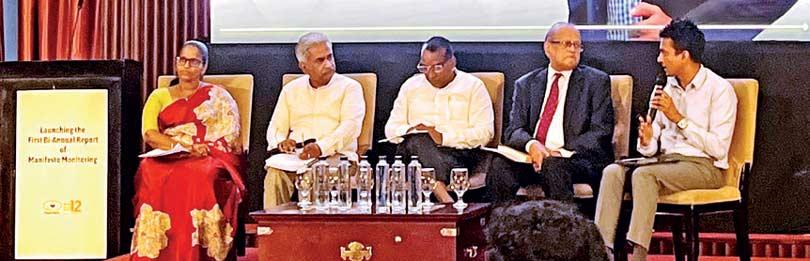
Guest speakers at the launch of ‘The First Bi-Annual Report on the Implementation of the Government’s Policy Statement. The event took place at the BMICH recently
 The event, supported by the Norwegian Ministry of Foreign Affairs, was about more than accountability; it was about trust
The report enables people to predict whether visions of politicians can bring meaningful changes for ordinary citizens
What sets the current report apart is not just its content, but its emphasis on systematic monitoring
 The First Bi-Annual Report on the Implementation of the Government’s Policy Statement was launched with the participation of ministers, civil society leaders, academics, and activists at the Jasmine Hall of the Bandaranaike Memorial International Conference Hall (BMICH) recently.
The Bi-Annual Report on the Implementation of the Government’s Policy Statement was prepared by the ‘March 12 Movement’ and the People’s Action for Free and Fair Elections (PAFFREL) and is titled “A Thriving Nation, A Beautiful Life”. The manifesto under review represents more than a collection of promises, it is the current government’s blueprint for the country’s future.
The event, supported by the Norwegian Ministry of Foreign Affairs, was about more than accountability; it was about trust. In a nation where public confidence in politics has often wavered, monitoring the progress of manifesto commitments is not a bureaucratic exercise—it is an act of civic responsibility. By documenting what has been achieved, what remains in progress, and where gaps persist, the report sets the stage for one of Sri Lanka’s most important conversations: how do we ensure that the lofty visions of political leaders translate into meaningful change for ordinary citizens?
The launch of this report marks a milestone in Sri Lanka’s democratic journey. The event, co-convened by Rohana Hettiarachchi, Executive Director of PAFFREL, was not confined to political elites.
Many who attended the event opined that the wide representation of sections of the society underscored a crucial point: manifestos are not private contracts between politicians and their parties—they are public contracts with the people.
The timing of the report is particularly significant. Barely a year into the new administration, the findings provide a first glimpse of whether the government’s words are being matched by deeds. By placing progress under the limelight just six months into the government’s tenure, the March 12 Movement has introduced an important culture of real-time accountability, a practice long overdue in the country’s political system.
The present government’s manifesto—“A Thriving Nation, A Beautiful Life”—is structured around four National Key Results Areas (NKRAs), encompassing 39 targets and 1,333 activities. It seeks to build a society that balances community well-being, social protection, economic growth, and governance reform.
This structured vision is not new in Sri Lanka’s political tradition. Previous governments too have rolled out ambitious policy statements, promising modern infrastructure, industrial growth, and improved welfare. However, the reality has often been starkly different: unfinished projects, economic mismanagement, and a political culture where short-term gains outweigh long-term national interest.
What sets the current report apart is not just its content, but its emphasis on systematic monitoring. In the past, manifestos largely vanished from public discourse once elections ended. Citizens were left with vague memories of campaign slogans, while accountability mechanisms were weak or absent. This time, the March 12 Movement insists on keeping promises alive in the public imagination.
The theme “A Thriving Nation, A Beautiful Life” resonates with aspirations many Sri Lankans hold dear: a nation that is not merely surviving, but flourishing; a society where comfort, dignity, and opportunity are not privileges, but rights. When framed alongside the idea of a “Clean Sri Lanka”, the manifesto takes on an even broader dimension.
The first six months provide mixed signals. Out of the 1,333 promises, 239 were initiated through Cabinet decisions, 133 through the 2025 Budget, and a handful through executive actions and parliamentary laws. Encouragingly, the government has shown momentum, particularly in the economic sphere. But the shift in weightage—from the manifesto’s balanced distribution to an overwhelming 61% focus on economic decisions—raises questions. Can a nation thrive if its social and community foundations remain under-prioritized? Will prosperity mean anything if it leaves behind the vulnerable?
The launch was not merely a presentation of data. It was a forum for robust dialogue, where distinguished panelists examined the findings through different lenses—economic stability, social protection, governance, and community empowerment.
Dhananath Fernando, CEO of the Advocata Institute, reminded the audience that economic reform is inseparable from institutional credibility. He argued passionately for the independence of the Central Bank, warning that any compromise would undermine public trust and deter investment. His emphasis on consistency—particularly the government’s continued commitment to the IMF programme—highlighted the importance of policy continuity in a country too often disrupted by political cycles.
Dr. Anusha Edirisinghe, from the University of Kelaniya, shifted the spotlight to social realities. She spoke of women and children, particularly their exposure to cyberbullying and online exploitation in an increasingly digital world. Her call for protective mechanisms, such as specialized apps and safety packages, underscored a truth often forgotten in high-level policy debates: modernization without safeguards risks leaving the most vulnerable behind.
President’s Counsel Prasantha Lal de Alwis, Principal of Sri Lanka Law College, offered a constitutional perspective. He cautioned against the hasty abolition of the Executive Presidency, emphasizing its integrative role in Sri Lanka’s complex political framework. While not dismissing reform, he insisted it must be pursued gradually, with stability and consensus at the forefront.
Finally, Dr. Vinya Ariyaratne, President of the Sarvodaya Shramadana Movement, underscored the heart of the matter: monitoring and evaluation. Policies, he argued, are only as strong as their impact on people’s lives. His reminder that “a policy is only as strong as its impact on people’s lives” resonated deeply in a room where both data and human stories converged. As Dr. Ariyaratne reminded, “a policy is only as strong as its impact on people’s lives.” The task before us is to ensure that impact is real, inclusive, and enduring. Only then will the vision of “A Thriving Nation, A Beautiful Life” move from paper to reality—and only then will Sri Lanka truly rise as a clean, thriving democracy.
The significance of the First Bi-Annual Report extends beyond statistics. It represents a shift in political culture, one where citizens, not politicians, set the terms of accountability. Most importantly, for the people of Sri Lanka, the report is a mirror. It shows where the nation is heading and asks whether that direction reflects their aspirations. The theme of “A Thriving Nation, A Beautiful Life” must not be allowed to become another slogan. It must be lived, felt, and realized across every corner of the island.
As the event drew to a close, one thing became clear: the report is not an endpoint but a beginning. It is a call to citizens, leaders, and institutions alike to remain vigilant, engaged, and hopeful. If Sri Lanka is to become a thriving nation, it must also become a clean nation—clean in politics, in governance, in accountability, and in its relationship between the state and its people.
As Dr. Ariyaratne reminded, “a policy is only as strong as its impact on people’s lives.” The task before us is to ensure that impact is real, inclusive, and enduring. Only then will the vision of “A Thriving Nation, A Beautiful Life” move from paper to reality—and only then will Sri Lanka truly rise as a clean, thriving democracy.
08 Jun 2026 8 minute ago
08 Jun 2026 29 minute ago
08 Jun 2026 1 hours ago
08 Jun 2026 1 hours ago
08 Jun 2026 2 hours ago