08 Apr 2025 - {{hitsCtrl.values.hits}}
 Sri Lanka’s population at the end of 2024 is 21,763,170 in comparison to 20,359,439 in 2023
Working population decreases by 3.35 per cent since 2019
Number of births reduced by 30.8 per cent since 2019
Number of marriages reduced by 14.7 per cent since 2019
Number of deaths increased by 17.2 per cent since 2019
Colombo District sees the highest decline in population growth
By Huzefa Aliasger
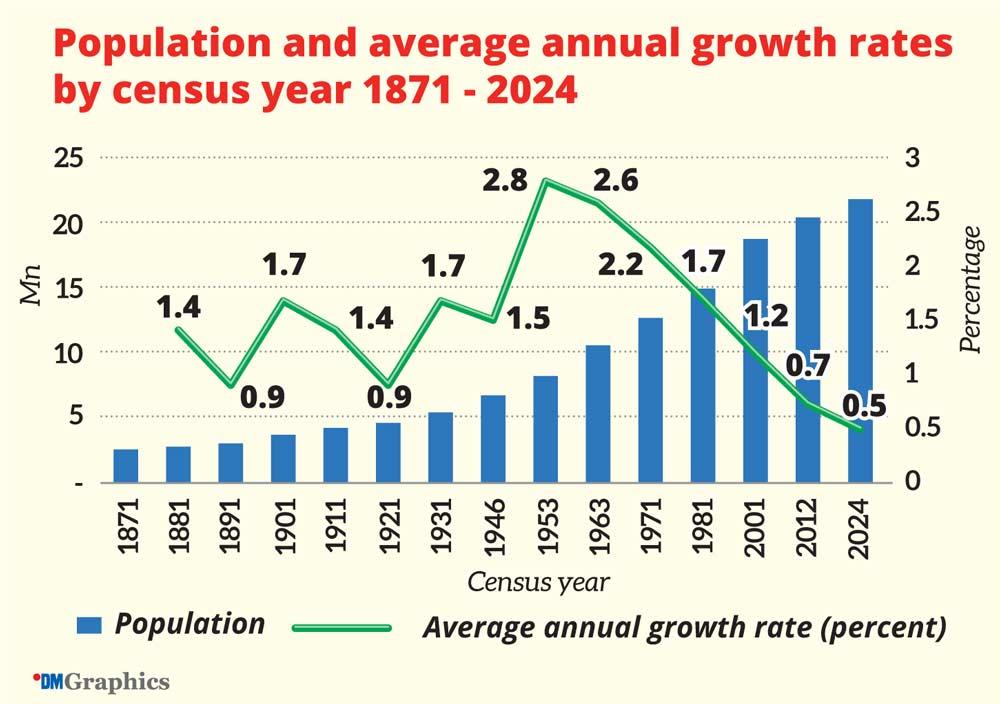
Sri Lanka is facing an astonishing decline in its growth rate with the percentage hitting an all-time low of 0.5 per cent since 1871, leading to social issues such as the shrinkage in the working age group and the increase in the aged population that will trigger challenges for policymakers to spend more on welfare and health.
The recent report released by the Department of Census and Statistics (DCS) on the Census of Population and Housing of 2024, reveals that Sri Lanka’s population at the end of 2024 is 21,763,170 in comparison to 20,359,439 in 2023 which shows an increase of 6.9 per cent since last year (1.4 million) The report states that from 1953 the average annual growth rate has been constantly reducing from 2.8 per cent to 0.5 per cent, while a considerable amount of the growth rate decline is seen in the Colombo District.
It is a decrease in annual growth rate from 1.43 to 0.17 per cent. The population of Sri Lanka in 1871 was recorded at 2,400,380 by the Department of Census and Statistics.
Country Representative of the United Nations Population Fund (UNFPA) Sri Lanka Kunle Adeniyi in an event organised by the Ministry of Finance, Economic Stabilisation, and National Policies in 2024 said that “By 2041, one in four Sri Lankans is projected to be over the age of 60. This transition, while reflective of improved healthcare, presents a challenge that is exacerbated by Sri Lanka’s lower per capita income and less developed social institutions compared to other countries experiencing similar trends.”
The report by the DCS says “When analysing the population by district, Gampaha District has reported the highest population in Sri Lanka, which has a population of 2,433,685. It is followed closely by Colombo District, which has a population of 2,374,461. The population difference between these two districts is 59,224 persons.”
In another statistic released by the DCS the data shows the number of births in Sri Lanka has decreased by 30.8 per cent since before COVID (2019) to 2024, during the same period the number of marriages decreased by 14.7 per cent and the number of deaths increased by 17.2 per cent, in which Colombo District has had the most impact showing, 29.3 per cent decrease in the number of births, 12.1 per cent decrease in marriages and 8.9 per cent increase in deaths.
Lady Ridgeway Hospital (LRH) Consultant Paediatrician Dr. Deepal Perera told Daily Mirror in January 2025, “The paediatric population has decreased primarily because many young people have migrated, and a large proportion of them are either unwilling to marry or choose not to have children due to the ongoing economic crisis, The existing child population must be protected, as they are vulnerable to various communicable and non-communicable diseases (NCDs), as well as psychological issues.”
The report states that Sri Lanka’s population of 21,763,170 is divided by 48.72 per cent of the population being males and 51.28 per cent of the population being females.
The elderly population aged 80 plus have been constant since 2019 with a total of 293,000 persons of which 116,000 are males and 177,000 are females, however the working population aged 20-54 have been seeing a slight decrease of 3.35 per cent from 5,207,000 males and 5,710,000 females to 5,028,000 males and 5,524,000 females in the same time period.
16 Jul 2026 1 hours ago
16 Jul 2026 1 hours ago
16 Jul 2026 2 hours ago
16 Jul 2026 3 hours ago
15 Jul 2026 8 hours ago