22 Apr 2025 - {{hitsCtrl.values.hits}}
 Kollupitiya, Narahenpita and Bambalapitiya identified as areas with cases
Drone technology to be used by CMC to identify abandoned lands
No guidance from Govt. on the control of Chikungunya spreading
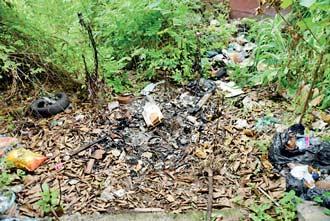
The CMC Pest Control Unit in Colombo 5 is located next to an abandoned UDA property which is a breeding ground for mosquitos rats and snakes
By Huzefa Aliasger and Pranavesh Sivakumar
|
Abandoned land in Colombo |
In the wake of the rise of Chikungunya cases in Sri Lanka, in addition to Dengue, Colombo Municipal Council’s (CMC) Public Health Officers are planning for the use of drone technology to identify empty lands and buildings that serve as possible mosquito-breeding grounds, an official said.
Like Dengue, Chikungunya is a mosquito-borne disease taking its toll on people.
Even the property next to the CMC Pest Control Unit in Colombo 5 belonging to the Urban Development Authority (UDA) is a breeding ground for mosquitos rats and snakes, as reported.
With mosquito-driven Dengue and Chikungunya now raging in Colombo’s city limits, this property has become a major health hazard. The 74-perch block was the site for a proposed housing project, which was stopped abruptly 11 years ago due to faulty pile driving on the marshy land.
Chief Public Health Inspector (PHI) of the CMC Samantha Kumara told the Daily Mirror that drones will be used today to identify such lands and buildings in Kollupitiya, Narahenpita and Bambalapitiya that need attention due to the high density of Chikungunya cases in these areas.
“Narahenpita, Pamankada, Kirulapone have quite a few bare lands which may have mosquito breeding happening. However, we haven’t been notified by the hospitals about Chikungunya cases increasing. Still, we have received a lot of complaints from the public regarding bare lands and buildings that could be possible mosquito breeding places. On every complaint, we have been acting,” Mr. Kumara said. He also said the mosquito density is also high within the municipal area. Actions taken for dengue prevention apply in this case too. Since mosquito density is high, we are carrying out extra fumigations.
Medical professionals stress that with the current increase in mosquito populations, proactive measures are essential to control the spread. They recommend eliminating mosquito breeding grounds as a key step in prevention.
Mr. Kumara mentioned that even though it is a holiday season, they have been receiving a lot of complaints of Chikungunya cases, and they have been working to fumigate areas. House-to-house visits and prevention programmes have also been organised by the CMC.
Speaking to the Daily Mirror, PHI Union Head Upul Rohana said that although measures to prevent Dengue have long been in place, there has been no proper guidance from health officials on how to control the spread of Chikungunya.
“We already have the tools and methods being used for Dengue control, but we are not being directed to apply them to Chikungunya, putting us in a state of confusion,” Rohana said.
Dr B. J. C. Perera Specialist Consultant Paediatrician and Honorary Senior Fellow, Postgraduate Institute of Medicine, University of Colombo, Sri Lanka, said that “Prevention is key to controlling the spread of Chikungunya. Mosquito control is of paramount importance. These include eliminating stagnant water sources where mosquitoes breed, using mosquito repellents, wearing long-sleeved clothing and pants, using mosquito nets, especially for young children and installing protective screens on windows and doors. While a Chikungunya vaccine is available, its current use is mainly for adults, especially those travelling to at-risk areas. More research is being conducted for child vaccinations.”
19 Jun 2026 34 minute ago
19 Jun 2026 3 hours ago
18 Jun 2026 6 hours ago
18 Jun 2026 7 hours ago
18 Jun 2026 8 hours ago