25 Mar 2025 - {{hitsCtrl.values.hits}}
By Kelum Bandara
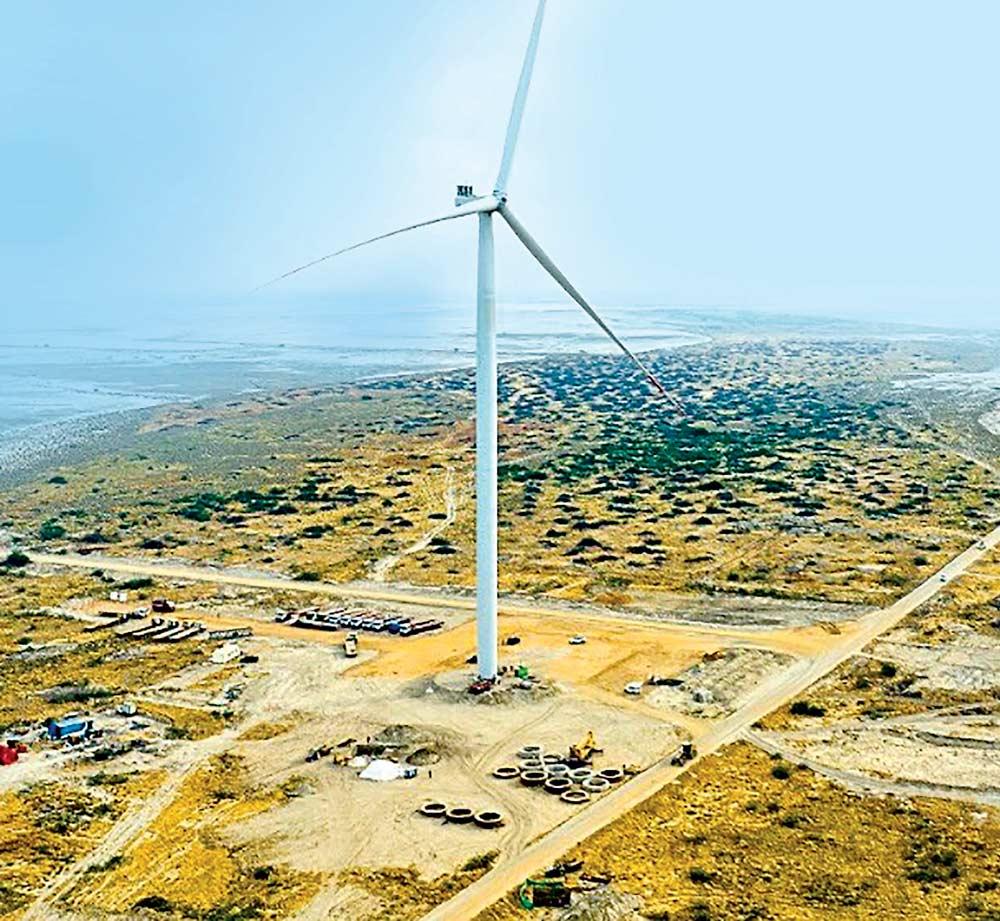
 India’s Adani Group is not ready to compromise on the initially agreed tariff rate and other parameters of the 484 MW wind and transmission project in Mannar, despite its agreement to execute the project if Sri Lanka requests, Daily Mirror learns.
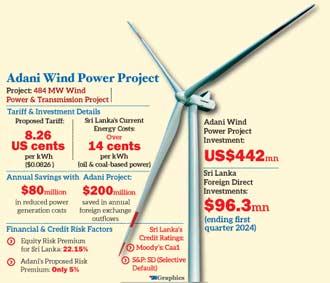
Adani Green Energy SL Ltd informed Sri Lanka’s Energy Ministry its position in this regard after the Sri Lankan authorities including President Anura Kumara Dissanayake said that the price of US $0.0826/kWh (8.26 US cents) quoted and agreed upon earlier is too high.
Subsequently, the company withdrew from the proposed wind project earlier. However, Adani Group reaffirms that it would always be available to undertake any development opportunity if the Sri Lankan government ever considers it to participate.
According to an informed source, due process had been followed and Adani was selected to implement the wind and transmission projects. The Cabinet Appointed Managing Committee on Investment (CAMCI) had approved the project under ‘Fast tracking of Investments’ at that time. After Cabinet approval was given during the time of the last government, the MoUs were entered into between five government entities and Adani Green Energy SL Ltd.
The project also forms part of Sri Lanka’s Long-Term Generation Expansion Plan 2023-2042 approved by the Public Utilities Commission of Sri Lanka.
The tariff quoted has been determined by multiple factors such as the capital cost, cost of raising funds, tenure of the power purchase agreement (PPA), and operational and maintenance costs. The PPA tenure in Sri Lanka is 20 years, whereas in India it is 25 years, allowing for longer asset ownership and operation.
Sri Lanka’s credit rating by Moody’s is “Caa1” and S&P is “SD”. These credit ratings denote a very high risk associated with any lending or investment in a country. The equity risk premium for Sri Lanka is 22.15 per cent, but Adani is seeking only a 5 per cent risk premium.
According to industry experts, the cost of 8.26 US cents per kWh, Adani’s wind energy, if realised, will significantly undercut the country’s current oil and coal-based generation, which averages over 14 cents. The pricing differential will enable Sri Lanka to reduce its annual power generation costs by approximately US $ 80 million.
Sri Lanka spends around US $ 300 million annually on imported oil and coal for electricity. Incorporating Adani’s wind project will save over $200 million in annual foreign exchange outflows, greatly enhancing energy security and economic stability.
04 Jun 2026 5 hours ago
04 Jun 2026 5 hours ago
04 Jun 2026 6 hours ago
04 Jun 2026 6 hours ago
04 Jun 2026 6 hours ago