18 Feb 2025 - {{hitsCtrl.values.hits}}
By Shabiya Ali Ahlam
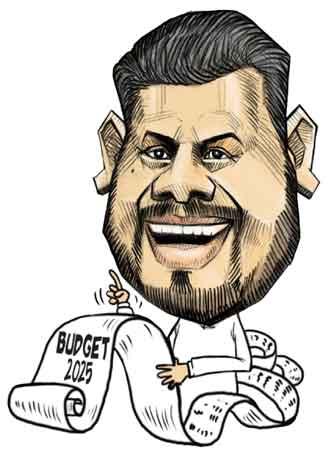 President Anura Kumara Dissanayake delivered his first budget speech in Parliament yesterday,outlining a financial roadmap that doubles as a manifesto for change.
Delivering the speech in Sinhala with quiet confidence, he set the tone for an administration determined to reshape the island nation’s economic trajectory, while staying true to its reformist ideals.
The proposals were largely unsurprising but focused on growth, offering something for everyone while emphasising improved livelihoods.
Many had expected changes and hoped for them to be not painful. But the budget sought to balance continuity with reform.
At the outset, Dissanayake noted that this budget differs from the traditional ones. Funds have been allocated to sustain the ongoing initiatives while making adjustments to align with the government’s mandate.
At the core of the plan were boosting production in industry, services and agriculture, encouraging public participation in economic activities and ensuring equitable distribution of benefits. On the demand side, the promise was to maintain an uninterrupted supply of essential goods and services, fair pricing and acceptable quality standards.
To achieve these objectives, Dissanayake outlined a hybrid economic approach that blends market competition, government regulation and state intervention, where necessary. He emphasised that the government’s role is to facilitate and remove the barriers preventing people from reaching their economic potential.
“We intend to set a foundation to create an economy where all citizens are active participants, active stakeholders and active beneficiaries,” Dissanayake said.
He stressed that it is an injustice when individuals cannot fulfil their economic potential due to geographical limitations, disability, lack of education or inadequate infrastructure. The change, he admitted, would take time and would require sustained efforts to empower people and integrate them into economic progress.
As with the past budgets, this one included salary increases for the public sector. However, it was the proposed increase in the private sector minimum wages that drew the loudest cheer.
The private sector, often seen as the engine of growth, is rarely considered in salary revisions. The upward adjustments will be phased out to ensure smooth implementation.
Public reaction has been largely positive, particularly regarding the emphasis on education, healthcare and infrastructure, the key areas essential for equipping Sri Lankans for modern economic opportunities, both locally and abroad.
Beyond the immediate relief measures, the budget also set the stage for long-term economic reform. It highlighted priorities such as sound financial and debt management, human capital investment, export promotion, public-private partnerships, digitalisation, innovation and anti- corruption measures.
These policies, Dissanayake said, would help Sri Lanka capitalise on post-crisis opportunities and drive a transformative shift in its economic trajectory.
Reflecting on his administration’s composition, Dissanayake noted that it includes “some of the most passionate and disciplined politicians” alongside accomplished academics and professionals who have made personal sacrifices for national progress. “Together, we have begun a monumental effort. We have brought down the cost of living. We have begun restoring confidence in our justice system. And we have, for the first time, banished not just corruption but even the appearance of corruption from the highest echelons of power,” he said.
Dissanayake struck an optimistic note, saying that Sri Lanka stands at a historic turning point with an opportunity to redefine its place on the international stage. For this he urged the citizens to unite for a better future.
“I see a chance for a united Sri Lanka, for a clean Sri Lanka, for a prosperous Sri Lanka, to surpass everyone’s expectations.” This budget, like those before it, sets expectations and its success will depend on execution.
Economic growth projections, aimed at 5 percent this year, remain optimistic. However, Sri Lanka’s path to sustainable recovery will require consistency in policy implementation and public trust will be key.
20 Jun 2026 34 minute ago
20 Jun 2026 1 hours ago
20 Jun 2026 2 hours ago
20 Jun 2026 3 hours ago
20 Jun 2026 3 hours ago