10 Nov 2025 - {{hitsCtrl.values.hits}}
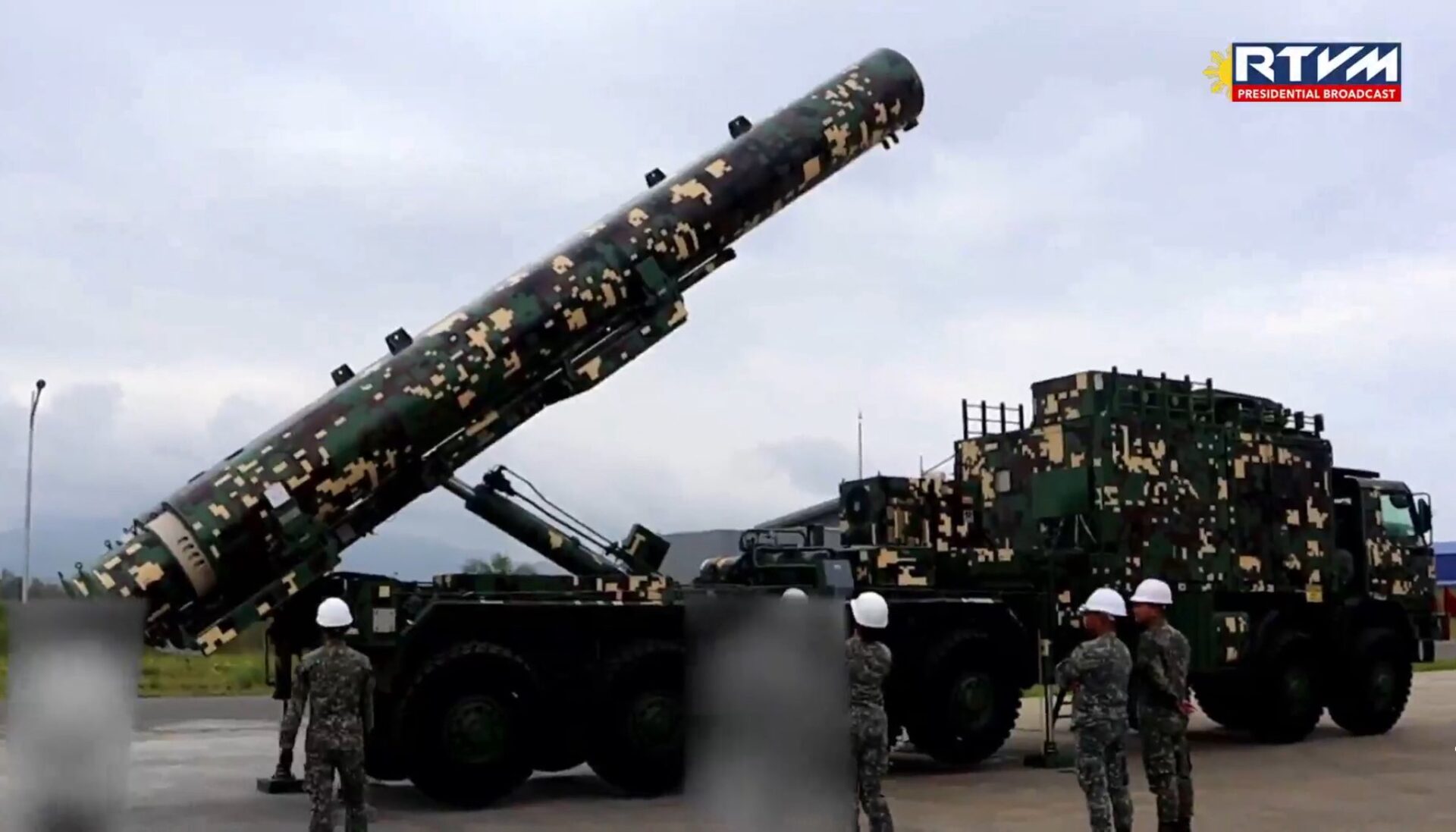 (DEFENCE SECURITY ASIA) — The Philippine Marine Corps officially unveiled its first BrahMos supersonic cruise missile battery during the force’s 75th anniversary celebration, marking a decisive leap in the nation’s external defense modernization.
The ceremony, held at the Marine Barracks Rudiardo Brown in Taguig City, showcased the operational deployment of the BrahMos system to a coastal defense base in Zambales—a move loaded with strategic messaging given its proximity to contested waters in the South China Sea.
The event signals a transformative era for the Philippine Marine Corps (PMC), positioning it not just as an amphibious and expeditionary force, but as a pivotal element in the Philippines’ anti-access/area denial (A2/AD) architecture designed to blunt potential incursions by hostile naval forces.
The unveiling marks a historic milestone for Manila, as this is the nation’s first-ever deployment of land-based anti-ship missiles, a capability long absent from the Armed Forces of the Philippines (AFP) despite decades of maritime pressure from China.
The BrahMos system’s placement in Zambales dramatically shifts regional threat calculations because the missile’s range extends to key flashpoints—foremost Scarborough Shoal—positioning it as a credible deterrent against coercive activities by foreign vessels inside the Philippine Exclusive Economic Zone.
The decision to operationalize the first battery at this location underscores the gravity of Manila’s commitment to defending its maritime sovereignty while escalating the sophistication of its coastal defense systems.
The deployment also reinforces the Philippines’ shift from a historically reactive maritime posture to a proactive, intelligence-driven coastal defense strategy that relies on long-range strike capability rather than mere presence patrols, strengthening Manila’s credibility in the South China Sea.
This paradigm shift elevates the BrahMos system as a central pillar of the Philippines’ emerging South China Sea A2/AD shield, optimized to deny adversary warships freedom of maneuver and impose substantial operational risks on any power projecting force near the country’s western seaboard.
The placement of the BrahMos in Zambales further enhances the Philippines’ geospatial advantage within the first island chain, enabling coordinated targeting with allied surveillance assets—including U.S. P-8A Poseidons and Japanese MQ-9B SeaGuardians—thus boosting maritime domain awareness and improving missile cueing efficiency.
Analysts warn that the mere presence of the BrahMos battery compels foreign naval commanders to allocate more defensive resources, alter patrol routes, and adopt conservative engagement envelopes—outcomes that significantly increase the strategic cost for any nation attempting to challenge Philippine maritime jurisdiction.
This decisive modernization step also strengthens the Philippines’ alignment with the growing network of Indo-Pacific security partnerships, positioning the BrahMos as a crucial component of broader regional deterrence efforts and amplifying Manila’s role in shaping the evolving South China Sea security architecture, a key SEO focal point for regional defense analysis.
From Humble Beginnings to a Modern Maritime Force
The Philippine Marine Corps, originally formed on November 7, 1950, under AFP General Order No. 319, began as Alpha Company of the 1st Marine Battalion within the Philippine Fleet.
Its initial complement—six officers and 206 enlisted personnel, many of whom were hardened World War II veterans—formed the backbone of a unit that would evolve into one of Southeast Asia’s most versatile amphibious and expeditionary forces.
The Corps has since grown into a 10,000-strong formation structured around rapid response, littoral warfare, and amphibious operations, reflecting the strategic demands imposed by the Philippines’ archipelagic geography.
At its 75th anniversary celebration themed “Marines: Forging Ahead for a Secure and Prosperous Philippines,” the PMC demonstrated how far it has progressed from a light infantry battalion into a force capable of fielding one of the world’s most advanced coastal defense missile batteries.
The ceremony featured a grand parade, static equipment displays, and speeches from national leaders, but the centerpiece was unmistakably the BrahMos missile system—an asset emblematic of the AFP’s shift from internal security operations to external deterrence in the Indo-Pacific’s most strategically volatile maritime arena.
Foreign dignitaries from India and the United States attended the event, signaling international recognition of the Philippines’ evolving defense landscape and the growing importance of integrated deterrence in the South China Sea.
The Philippines’ acquisition of the BrahMos system stems from a landmark USD 375 million (approximately RM1.76 billion) contract signed in January 2022 with BrahMos Aerospace Private Limited, a joint venture between India’s DRDO and Russia’s NPO Mashinostroyeniya.
The deal constitutes India’s first major export of the BrahMos system—a milestone achievement that elevates New Delhi’s status as a rising defense exporter while deepening its strategic ties with Manila.
The contract covers three complete missile batteries, each consisting of:
Mobile Autonomous Launchers (MALs)
Surveillance and targeting radar units
Mobile command posts
Missile reload and replenishment vehicles
Technical support
Training and maintenance packages
Deliveries began in April 2024, when the Indian Air Force transported the first battery to the Philippines.
A second battery arrived in April 2025, while the third battery is scheduled for delivery by early 2026, providing Manila with a fully formed coastal missile regiment by the end of AFP’s Horizon 3 modernization phase.
The Philippine Navy’s Shore-Based Anti-Ship Missile System (SBASMS) initiative—under which the BrahMos is procured—advances the broader goal of equipping the PMC’s Coastal Defense Regiment with capabilities capable of deterring or defeating high-value enemy naval assets.
The BrahMos procurement reinforces Manila’s intent to develop a credible A2/AD umbrella in the South China Sea using layered coastal defenses, long-range sensors, and strike capabilities.
BrahMos Procurement: A USD 375 Million Deal Reshaping the Indo-Pacific
The Philippines’ acquisition of the BrahMos system stems from a landmark USD 375 million (approximately RM1.76 billion) contract signed in January 2022 with BrahMos Aerospace Private Limited, a joint venture between India’s DRDO and Russia’s NPO Mashinostroyeniya.
The deal constitutes India’s first major export of the BrahMos system—a milestone achievement that elevates New Delhi’s status as a rising defense exporter while deepening its strategic ties with Manila.
The contract covers three complete missile batteries, each consisting of:
Mobile Autonomous Launchers (MALs)
Surveillance and targeting radar units
Mobile command posts
Missile reload and replenishment vehicles
Technical support
Training and maintenance packages
Deliveries began in April 2024, when the Indian Air Force transported the first battery to the Philippines.
A second battery arrived in April 2025, while the third battery is scheduled for delivery by early 2026, providing Manila with a fully formed coastal missile regiment by the end of AFP’s Horizon 3 modernization phase.
The Philippine Navy’s Shore-Based Anti-Ship Missile System (SBASMS) initiative—under which the BrahMos is procured—advances the broader goal of equipping the PMC’s Coastal Defense Regiment with capabilities capable of deterring or defeating high-value enemy naval assets.
The BrahMos procurement reinforces Manila’s intent to develop a credible A2/AD umbrella in the South China Sea using layered coastal defenses, long-range sensors, and strike capabilities.
30 Jun 2026 20 minute ago
30 Jun 2026 37 minute ago
30 Jun 2026 1 hours ago
30 Jun 2026 1 hours ago