12 Mar 2025 - {{hitsCtrl.values.hits}}
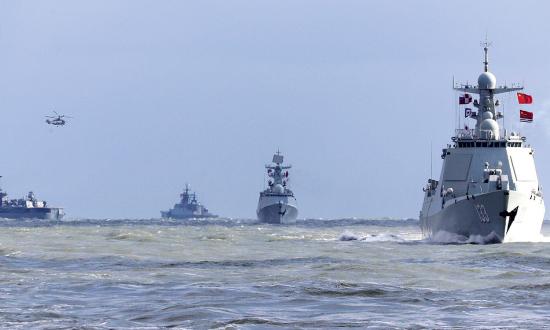 China's global ambitions are expanding well beyond its borders, aiming to control crucial trade routes and assert military dominance on a global scale. The so-called "Panama Strategy" is a manifestation of China's larger goal: to reshape the world order in its favor by leveraging strategic waterways and infrastructure investments. While Panama legally owns the Panama Canal, Beijing's operational control over ports at both ends raises significant concerns about the militarization of this vital waterway—an alarming move that threatens the principles of global trade and neutrality.
The Panama Canal serves as a focal point for China's influence. Though the United States remains its largest customer, China ranks second, using its presence to gain disproportionate influence over one of the world's most critical trade arteries. Critics argue that this influence has already led to higher transit costs for U.S. shipping interests, undermining Panama's neutrality—a cornerstone of the 1978 treaty with the United States. The Trump administration, for instance, contended that China's actions have violated these agreements, justifying U.S. intervention. This highlights a disturbing trend in which China's economic power translates into geopolitical leverage, potentially enabling Beijing to dictate terms in international waters.
However, the "Panama Strategy" is not an isolated policy; it is part of a broader geopolitical framework driven by the Chinese Communist Party (CCP). Through its Belt and Road Initiative (BRI), China has strategically invested in infrastructure projects worldwide—spanning roads, railways, ports, and energy pipelines. These deals often burden partner countries with massive debt and erode their sovereignty, turning critical assets into tools for Beijing’s strategic goals. In Latin America alone, China has deepened its presence, weakening governments and undermining the independence of nations. By integrating Chinese money and influence in these key regions, Beijing seeks to shift the global balance of power away from U.S.-led institutions.
China's maritime ambitions extend far beyond Panama. The South China Sea, one of the world's busiest shipping lanes, has been heavily militarized through the construction of artificial islands and military outposts. With approximately $3 trillion in global trade passing through these waters annually, China's military presence poses a direct challenge to U.S. security commitments to regional allies like Taiwan, Japan, and South Korea. This expansion is part of a broader effort to undermine the open seas doctrine, which has underpinned global trade and security since World War II. The CCP's aggressive actions in these contested waters signal that China is prepared to use military force to secure its interests, regardless of international norms.
China's influence also extends to other strategic waterways, such as the Strait of Malacca, a vital passage for global oil shipments and trade between the Middle East and Asia. With enormous volumes of imports and oil passing through this chokepoint, Beijing's naval presence, bolstered by investments and infrastructure deals, creates a vulnerability for countries reliant on these trade routes. Similarly, the Suez Canal Economic Zone in Egypt, linked to BRI projects, offers Beijing an opportunity to monitor and potentially control trade between Europe, Asia, and Africa. Each of these strategically positioned locations is part of a global chessboard where China aims to limit U.S. influence while securing its long-term geopolitical objectives.
China's reach even extends to the Persian Gulf, where it has forged a strategic partnership with Iran—a country that controls the Strait of Hormuz, another key oil chokepoint. China's military presence near Djibouti, where it maintains its first overseas military base, further exemplifies its intention to project power beyond its immediate region. This network of military bases and infrastructure investments is not only about securing China’s economic interests but also paving the way for a future where Beijing can dictate the flow of global trade and energy resources.
At the heart of Beijing’s strategy are four pillars: economic dominance, military supremacy, unchecked geopolitical influence, and energy security. The CCP's vision of the "China Dream" is predicated on the idea that, should the United States and its allies falter, China will effortlessly take their place as the world's dominant power. Every strategic investment, from the Panama Canal to the South China Sea, is part of this overarching ambition. For the CCP, success isn't simply about economic growth—it's about dismantling the rules-based international order that has governed global trade and security for decades.
Critics of China's strategy warn that these ambitions come at a significant cost. The undermining of international treaties, erosion of national sovereignty, and potential for military conflict all threaten the stability of the global order. The U.S. and its allies face a critical challenge in countering China's expansive efforts—not just through military or economic means but by reaffirming the principles of free trade, open seas, and the rule of law.
From the covert control of the Panama Canal to the overt militarization of the South China Sea, China's actions reveal a regime willing to disregard international norms and manipulate global institutions to serve its interests. The "Panama Strategy" is a stark reminder that Beijing’s influence is not confined to domestic policy; it is a deliberate and far-reaching effort to reshape the world according to its authoritarian vision.
For democracies worldwide, the challenge is clear: vigilance, strategic alliances, and a firm commitment to openness and fairness are essential to countering China’s ambitions. Clearly, Beijing is determined to reshape the global order in a way that favors coercion and control over freedom and cooperation. (Vaishali Basu Sharma )
The author is an analyst on geopolitical and macroeconomic issues
29 Jun 2026 55 minute ago
29 Jun 2026 56 minute ago
29 Jun 2026 58 minute ago
29 Jun 2026 1 hours ago
29 Jun 2026 1 hours ago