11 Oct 2025 - {{hitsCtrl.values.hits}}
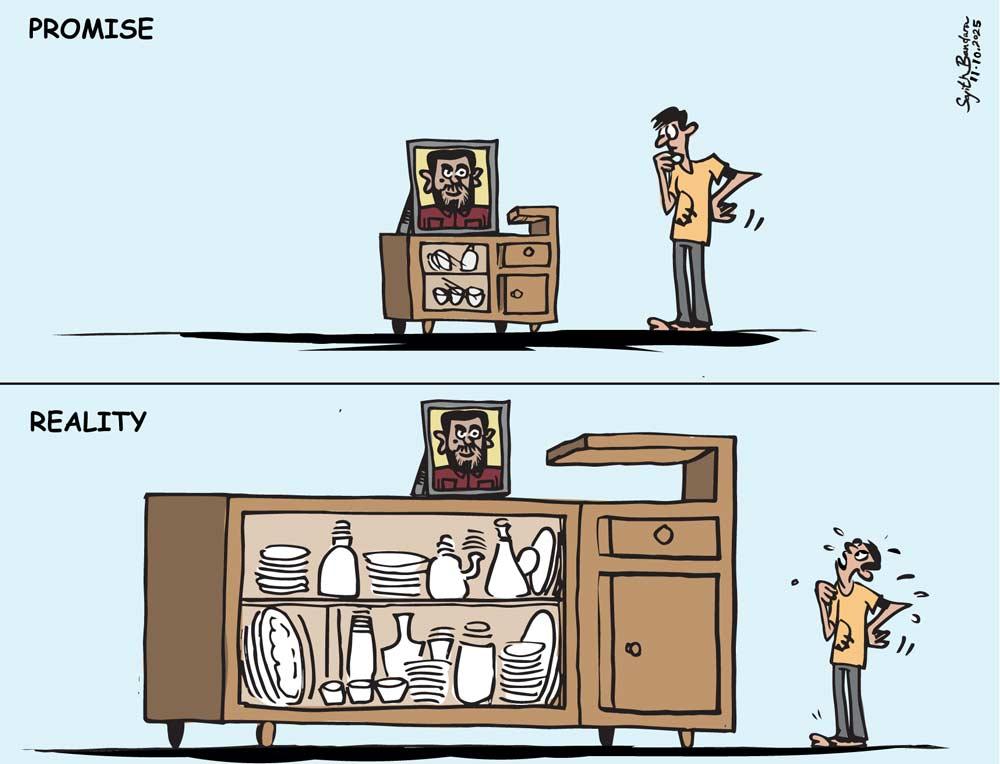
This cartoon, with its simple two-panel structure titled “Promise” and “Reality,” brilliantly captures the timeless deceit of political rhetoric. In the top panel, a man stands before a modest cabinet adorned with the portrait of a smiling leader. The shelves are neatly arranged, though clearly understocked — a promise of minimal but manageable prosperity. In the lower panel, labeled “Reality,” the same cabinet has grotesquely expanded — overflowing with plates, cups, and vessels — yet the man stands shocked, even dismayed. What appears abundant is, in fact, absurd.
At first glance, the cartoon might seem to mock incompetence — the failed delivery of a campaign promise. But a deeper reading reveals something far more biting: it critiques the illusion of plenty, the political habit of substituting optics for outcomes. The overstuffed cupboard becomes a metaphor for inflated narratives, where statistics, slogans, and spin replace genuine substance.
In politics, “more” is often mistaken for “better.” Leaders tout massive projects, sweeping reforms, and booming numbers, while ordinary citizens — symbolized by the frail, worn-out man — confront a reality that is distorted, impractical, and unsustainable. The comically oversized cabinet mirrors this distortion: it may look impressive, but it doesn’t fit into the room of lived experience.
The portrait of the leader perched on the cupboard adds another layer of meaning. It implies that political figures frame themselves as architects of prosperity, even as the structures they build defy logic or functionality. The citizen’s disbelief — even fear — underscores the alienation between governance and everyday life. Promises, once meant to uplift, have become burdens that crush the very people they were made for.
This is not merely a Sri Lankan story; it’s a universal one. The cartoon speaks to every society where propaganda outpaces progress — where leaders mistake exaggeration for inspiration and citizens are left to navigate the wreckage of “fulfilled” promises.
Ultimately, the cartoon distills a hard truth: false abundance can be more dangerous than visible scarcity. When the cupboard of politics is stuffed with empty achievements, it leaves no room for honesty — and no space for hope.
14 Jun 2026 7 hours ago
14 Jun 2026 9 hours ago
14 Jun 2026 14 Jun 2026
14 Jun 2026 14 Jun 2026
14 Jun 2026 14 Jun 2026